Potato Plants Per Square Foot Calculator
Estimate potato planting density, total plants, seed-piece weight, row-equivalent layout, and harvest potential for raised beds, allotments, market blocks, and containers.
Use this density calculator when you know the bed footprint and want to compare potato spacing plans. It converts row and in-row spacing into plants per square foot, then checks whether the estimated count fits the selected plot shape.
Potato Density Results
Use these estimates to decide whether the bed is planted for early yield, maincrop storage, seed increase, or large-tuber spacing.
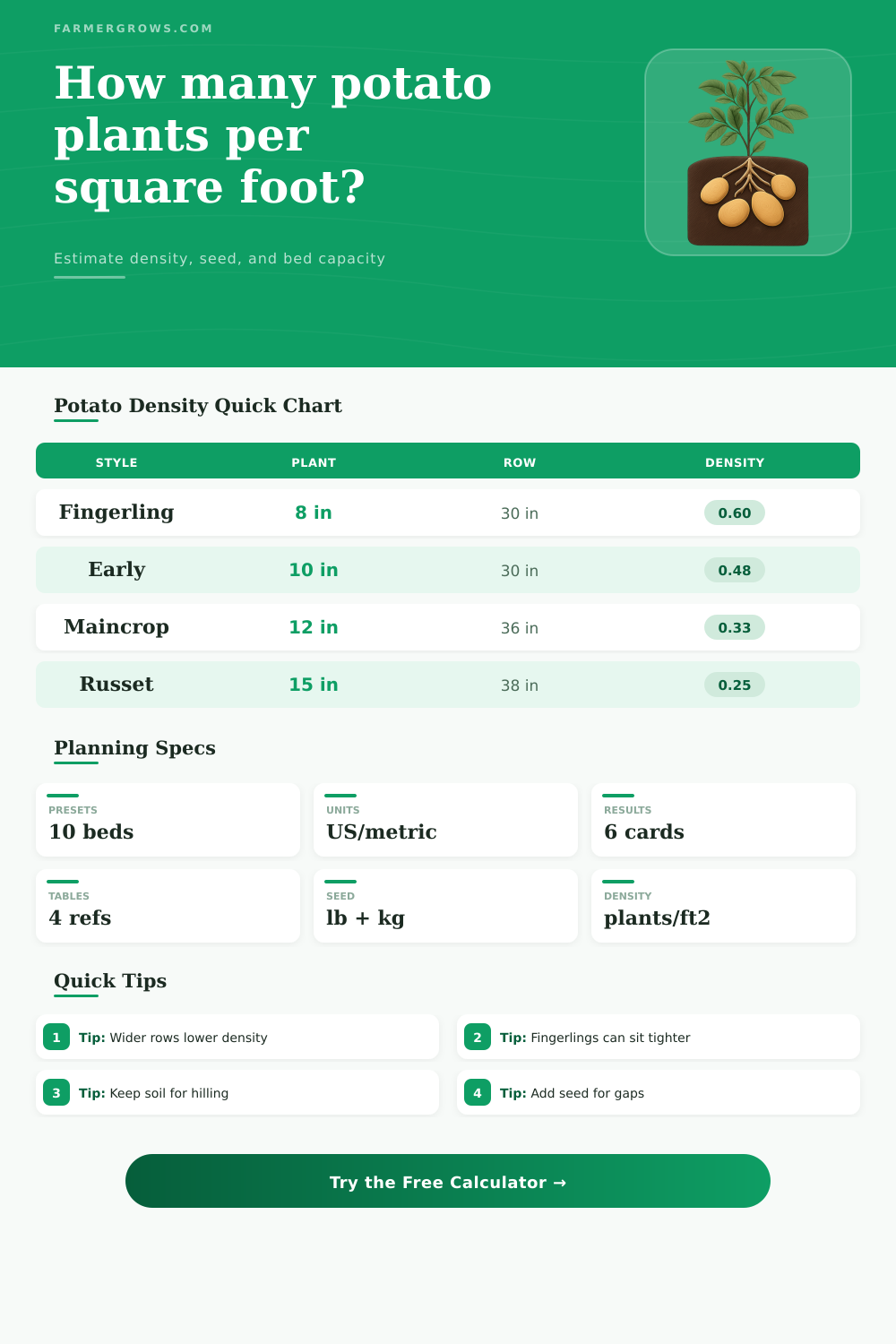
| Potato plan | In-row spacing | Row spacing | Plants per sq ft | Best use |
|---|---|---|---|---|
| Fingerling tight rows | 8 in | 30 in | 0.60 | Many small tubers and seed-size potatoes |
| Early potato bed | 10 in | 30 in | 0.48 | New potatoes lifted before full maturity |
| No-dig close bed | 11 in | 28 in | 0.47 | Rich compost beds with careful hilling |
| Maincrop garden rows | 12 in | 36 in | 0.33 | Balanced home-garden yield and access |
| Russet storage rows | 15 in | 38 in | 0.25 | Larger baker-size tubers |
| Bed area | 0.25 plants/sq ft | 0.33 plants/sq ft | 0.48 plants/sq ft | 0.60 plants/sq ft |
|---|---|---|---|---|
| 32 sq ft | 8 plants | 11 plants | 15 plants | 19 plants |
| 100 sq ft | 25 plants | 33 plants | 48 plants | 60 plants |
| 200 sq ft | 50 plants | 66 plants | 96 plants | 120 plants |
| 500 sq ft | 125 plants | 165 plants | 240 plants | 300 plants |
| 1,000 sq ft | 250 plants | 330 plants | 480 plants | 600 plants |
| Seed piece size | Pieces per pound | Seed for 25 plants | Seed for 100 plants | Metric piece |
|---|---|---|---|---|
| 1.25 oz | 12.8 | 2.0 lb | 7.8 lb | 35 g |
| 1.5 oz | 10.7 | 2.3 lb | 9.4 lb | 43 g |
| 1.75 oz | 9.1 | 2.7 lb | 10.9 lb | 50 g |
| 2 oz | 8.0 | 3.1 lb | 12.5 lb | 57 g |
| 2.5 oz | 6.4 | 3.9 lb | 15.6 lb | 71 g |
| Project | Area | Spacing assumption | Plant count | Planting note |
|---|---|---|---|---|
| 4 x 8 ft raised bed | 32 sq ft | 10 in by 24 in | 23 plants | Dense early crop with short rows |
| 10 x 20 ft garden bed | 200 sq ft | 12 in by 36 in | 60 plants | Maincrop family planting |
| 20 x 50 ft market block | 1,000 sq ft | 12 in by 36 in | 300 plants | Small market or shared plot |
| 30 in grow bag | 4.9 sq ft | Cluster planting | 4 plants | Needs deep soil and steady moisture |
| 3 x 9 m allotment | 291 sq ft | 30 cm by 75 cm | 116 plants | Metric row plan with paths excluded |
Check hilling room: A high plants-per-square-foot number is only useful if the row still has enough loose soil for hilling. If the finished hill width nearly equals row spacing, leave more room.
Match density to harvest goal: Tighter spacing favors more small potatoes, while wider spacing helps maincrop and russet varieties size up for storage or baking.
If you stand before an empty garden bed with A BAG of seed potatoes, there’s a certain type of panic: the space ahead of you seems so vast, yet sum of money allocated to planting stock seem so small. The equation before you is not agricultural; it’s geometric. If they are too close together, they will strangle each other and produce nothing but dust and weeds. Too far apart, and you’ve wasted valuable volume of soil that might otherwise be growing something to eat.
Once you enter your bed dimension into the calculator (above), it does the rest of the math for you. It handles the conversions and coefficients. It also turns spacing into a real number of seed pieces that you can either purchase or cut.
How to Plan Your Potato Garden Space
What’s the key variable? What is your goal: maximum tuber growth aggressiveness? Early potatoes don’t mind a little elbow room at all, and why would they, since you’ll be lifting yours before they’re fully mature? Sit back and relax, let those early guys get going and let them just about take up a whole plant per square foot if they want.
It’s a different beast with maincrops. Those boys are out to create large root systems. They will eat things up and require space. Typicaly, a third or so of a plant per square foot is what they’re after. If you’re growing long-keepers such as russet types best for storing or baking, where thick skins are important, allow even more area under each hill so each tuber doesn’t rub against another in the soil and get bruised. That’s why it’s so obvious from the table on the page, which spells this all out: As desired tuber size goes up, density drops.
But here’s another thing: What’s going on below ground? On paper, a high plant count per square foot might sound impressive, until you realize what happens when you hill them up. Potatoes need a mound of loose earth around each stem to protect the growing tubers from the sun, which would make them turn green and bitter. When you have too few inches of dirt to mound up, you lose yield, no matter how many seedlings you started with.
That’s why the tool provides an adjustable setting called “usable bed factor,” which takes into account the space you can’t plant in (the edges) and don’t need to plant in (the gaps for access and irrigation). This little detail fills the gap between theory (the most plants you can fit) and practice (how gardens actualy work).
Another place where careful planning means no waste is seed prep. I don’t know about you, but a potato isn’t a brick, it’s an irregular lump of a thing with eyes on it that must be cut apart. Usually each piece should weigh roughly two ounces (and have two or more eyes). The calculator adjusts that guess-timate number of plants to calculate how much seed you’ll actually need. That’s helpful, since seed potatoes are frequently available only by weight, not by the piece. It’s better to know you will need ten pounds of seed potatoes rather than thirty-two pieces, since those can vary greatly in shape and size depending on the variety.
Spacing: Whether your plot is laid out in straight lines or uses a staggered pattern isn’t as important as maintaining uniform spacing. If you want to make every inch of space count, plant staggered rows; that way the spaces between rows can be filled with an additional plant or two. But this makes things trickier for weeding and hilling. A straight row is simpler with just a hoe, or perhaps an old credit card. Use the calculator to toggle between a staggered and a straight-row design to see how much tighter they get. There is only so much you will gain by staggering. Most home gardeners will find that the inconvenence of doing so doesn’t outweigh a bit more crop per square foot.
But all in all, potato culture is an exercise in waiting, as well as hoping. On one hand, who doesn’t want to cram the most possible space out of their patch? But on the other, it’s a living thing you don’t want to mess up after you’ve set it down. If there’s one piece of advice I have, it’s get the spacing right the first time: No more hassle untangling vines later on when those hills flatten out.
The tool takes the guesswork out of this starting point. With no touch of trowel, you can play “what if” with various setups: How does a tighter sowing of early types compare to a scatter of storage russets? What can you fit into the actual space where your soil will go? That knowledge means when breaking-ground day arrives, you’re doing more than shoveling around dirt; you’re creating a framework for a crop to grow, right from the beginning.
Right density = handfuls of green versus a binful of golden.