
When you dig up your potato bed in high summer and discover that some tubers is rotting or otherwise shrunken, you might feel as though something’s wrong with the soil. In fact, the problem’s most likely on top of it… Plants growing nearby.
The vast majority of gardeners operate more like diners at a cafeteria line: Plant what’s in season. They forget about biology that’s happening beneath. That’s where companion planting comes into play, it takes those connections into account.
How to Grow Healthy Potatoes
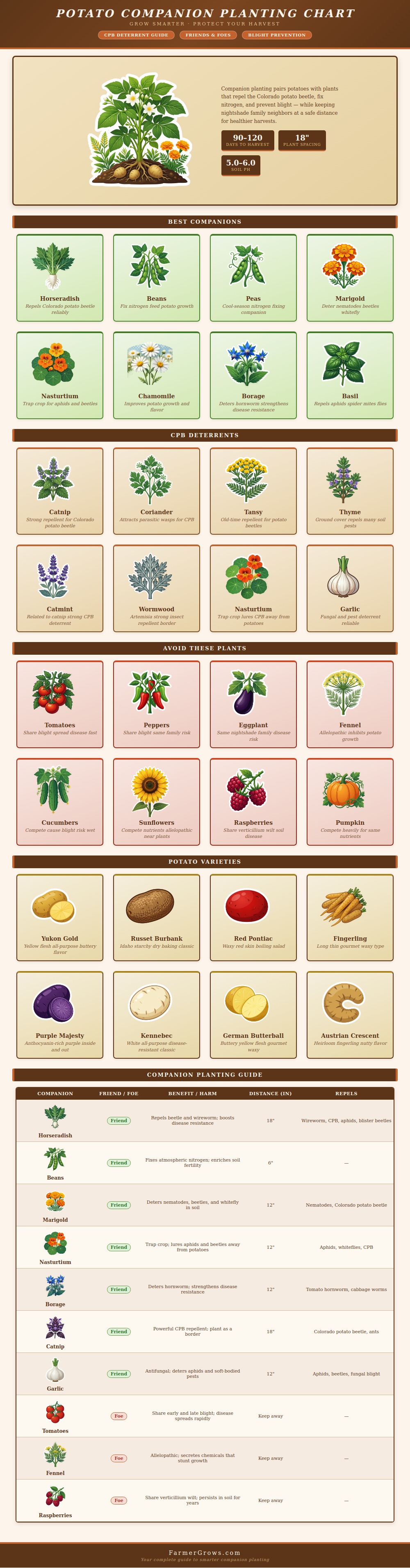
According to this chart (above) on what helps potato growing and what hinders it, here’s how they like their soil: slightly acid, with a pH range from 5.0-6.0. The reason? Anything more alkaline than that makes it harder for potatoes to take up nutrients, not good for your crop.
Also, give the tuber plenty of room to breathe! To encourage airflow, plant the potatoes every 18 inches apart. Why? Because airflow discourages certain fungal diseases. Blight loves humidity; so does crowding. Good airflow is the first physical defense.
Then it’s time to select proper companions. Horseradish and catnip act as deterrents against the Colorado potato beetle by releasing strong aromas that confuse pests and mask the scent of the potatoes. Pests are confused by these strong-smelling plants because they do not smell like a potato leaf. This throws them off and disguises the crop’s odor as well. These plants acts as a distraction to protect your potatoes from pests.
Other good companions include beans and peas, which help fertilize the soil with their ability to fix nitrogen. Because potatoes use up soil nutrients quickly, having some nitrogen-fixing companion nearby helps continuously fertilize without chemical fertilizers. That helps things grow steadily and strong.
Don’t put eggplant, pepper, or tomato plants in the same space as your potatoes. These nightshades (or nightshade family members) is prone to the same diseases, so early blight and late blight won’t respect your property boundaries. Once one plant becomes infected, a few hours later the spores may of drifted onto those potatoes. Avoidance of close kin isn’t optional; it’s required.
Another thing to avoid planting near your potatoes: fennel, which is a plant that harms others, meaning it releases chemicals that will inhibit neighboring plants’ growth. Raspberry also is risky, since it can harbor verticillium wilt, a tough-to-eradicate soil-borne disease that will hang around for years after infection.
Growing potatoes is also not one-size-fits-all; there are varieties for specific uses. For instance: Baking? Try Russet Burbank. All-purpose cooking? Pick Yukon Gold. Learn which potato variety you have so you can enjoy it. Disappointment awaits if you plant a waxy type in hopes of getting a fluffy baked potato. Vary the variety according to the meal at hand.
Potatoes are tricky; they need good care. Everything in the garden relates to everything else. The way we read what the soil tells us, and select our neighbors wisely, shapes the garden as an ever-resilient system. We want fewer problems (and better taste) when it’s time to dig. Tubers should be clean and firm. That happens if you plan ahead.