Pond Volume Calculator
Estimate pond water volume from shape, length, width, average depth, side slopes, plant shelves, liner freeboard, and evaporation reserve, then convert gallons to acre-feet and cubic meters.
Load a pond scenario, then adjust the dimensions, average depth, shelves, side slopes, liner allowance, and evaporation buffer to match your site.
Pond Volume Estimate
Enter pond dimensions to estimate water volume.
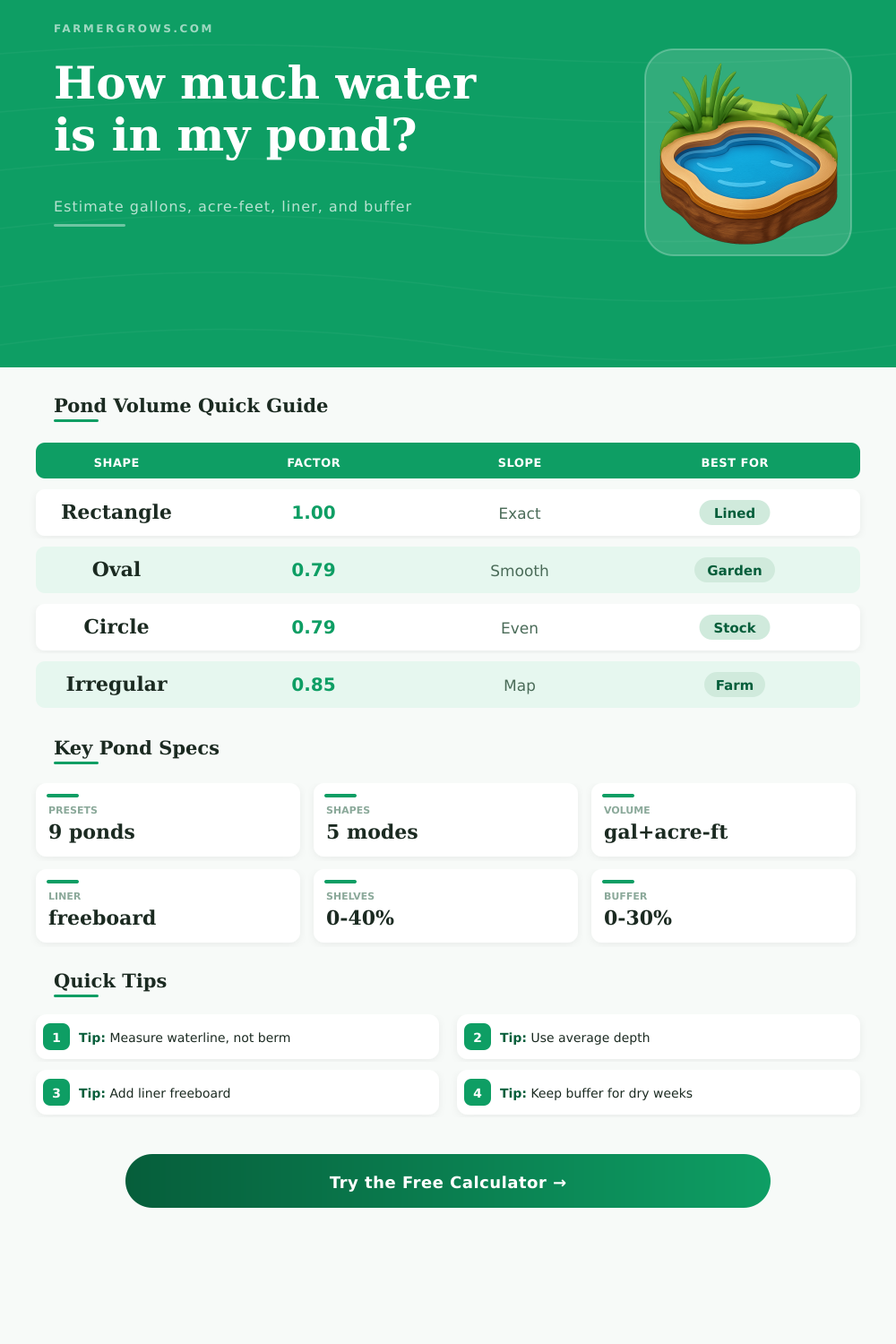
Shape factor changes surface area before depth is applied. Pick the closest outline or use mapped area for field ponds with uneven shorelines.
| Pond shape | Area formula | Typical accuracy | Use when |
|---|---|---|---|
| Rectangle or square | Length x width | High for straight edges | Lined farm ponds, tanks, holding basins, formal ponds. |
| Oval or ellipse | Length x width x 0.785 | Good for smooth rounded shorelines | Garden ponds, wildlife ponds, and rounded clay basins. |
| Round pond | Pi x radius squared | High when diameter is even | Round stock ponds, circular basins, or small lined ponds. |
| Kidney or natural | Length x width x custom factor | Moderate unless factor is surveyed | Curved ponds where the full rectangle would overstate area. |
| Mapped area | Direct square area input | Best when measured carefully | Irregular farm ponds measured from GIS, drone, or field grid. |
| Feature | Typical range | Volume effect | Planning note |
|---|---|---|---|
| Straight sides | 1.00 factor | No reduction | Works for tanks, retaining walls, or already averaged depth readings. |
| 3:1 gentle bank | 0.96 factor | Small reduction | Common for easy mowing and wildlife access around shallow ponds. |
| 2:1 moderate bank | 0.92 factor | Moderate reduction | Useful default for many small excavated ponds. |
| 1.5:1 steep bank | 0.88 factor | Higher edge reduction | Can fit tight sites but needs erosion and safety review. |
| Plant shelves | 5% to 25% area | Depends on shelf depth | Use lower shelf depth for ledges, baskets, and safety benches. |
| Pond type | Freeboard per side | Liner formula | Field check |
|---|---|---|---|
| Small garden pond | 1 to 1.5 ft | Length + 2 x depth + 2 x freeboard | Add more if edging stones or folds are heavy. |
| Koi or display pond | 1.5 to 2 ft | Use deepest point for liner length | Protect corners, skimmers, shelves, and vertical folds. |
| Farm reservoir liner | 2 to 3 ft | Add anchor trench and high-water allowance | Confirm panel size before excavation is finished. |
| Clay-lined pond | No liner blank | Use freeboard for water level planning | Still leave bank height above design waterline. |
| Irregular shoreline | 2 ft or more | Use longest length and widest width | Order from measured diagonals if the shape twists. |
| Reference | Value | Formula use | Why it matters |
|---|---|---|---|
| One cubic foot | 7.48052 gallons | Cubic feet x 7.48052 | Main conversion from pond dimensions to gallons. |
| One acre-foot | 325,851 gallons | Gallons / 325,851 | Useful for farm storage and irrigation planning. |
| One cubic meter | 264.172 gallons | Gallons / 264.172 | Metric volume for pumps, tanks, and records. |
| One inch drawdown | Area x 1/12 ft | Surface area x depth loss | Converts evaporation depth into lost gallons. |
| Dry weather buffer | 10% to 30% | Volume x buffer percent | Helps plan refill water during hot or windy periods. |
Take several depth readings across the basin and average them. Using only the deepest point can overstate gallons, pump size, treatment dose, and refill need.
Water volume uses the filled surface area and average depth. Liner planning uses the deepest span plus freeboard, edge folds, shelves, and anchor trench allowance.
This calculator is for planning and estimating. Confirm safety slopes, dam rules, liner specifications, overflow routing, and local water regulations before construction.
Calculating the water volume of you pond is a nesessary step in planning for your pond. The water volume of your pond will determine how much water is actualy in your pond. Many individuals will attempt to calculate the water volume of there pond by guessing how much water will be present.
However, such a guess are unlikely to be accurate in relation to the size of the pond itself. In order to accurately calculate the amount of water in your pond, you must understand how each of the measurement of your pond relate to the total water volume of your pond. The shape of the pond is a critical element in calculating the total water volume of the pond.
How to Calculate How Much Water Is in Your Pond
Ponds that are in the shape of a rectangle is easy to calculate the total water volume of the pond. However, ponds with an oval or kidney shape have curves that makes it more difficultly calculate the water volume. You should use the waterline measurements of the pond to calculate the water volume of the pond.
Using the outer berm of the pond to calculate the water volume will produce a measurement that is too high for the pond; the outer berm of the pond dont hold water. The depth of the pond is the primary measurement that determine the total water volume of the pond. Using a single depth measurement taken from the center of the pond will produce a reading of the water volume that is too high.
You should take a series of depth measurements across the entire basin of the pond, and the average depth calculate from those depth measurements is the depth that should be used to calculate the total water volume of the pond. The slope of the banks of the pond also impact the water volume of the pond. Banks that are gentle will reduce the total water volume of the pond less than banks that are steep.
The slopes of the banks of the pond should be accounted for in the calculation of the water volume. Changes to the water volume will impact the type of pump that is required for the pond, as well as the number of chemical that are required to be added to the pond. Plant shelves can impact the water volume of the pond.
Plant shelves will cover part of the area of the ponds surface, but the shelves exist at a shallower depth from the surface than the remainder of the pond. Thus, the plant shelves will contain less water than the main basin of the pond. The percentage of the pond that is covered by plant shelves and the depth of those shelves should be entered into a calculator that calculate the total water volume of the pond.
Otherwise, the water volume calculation will be incorrect. While the calculation of the water volume of the pond is a separate process to the planning of the pond liner, the two processes are still related to the dimensions of the pond. The pond liner must be large enough to cover the pond and extend to the deepest point of the pond.
It must extend up the banks of the pond to cover the edges of the pond, and provide extra material for anchoring the liner to the ground. Extra material, or “freeboard,” must be provided for the folds of the liner, as well as for the trenches in which the liner will be placed into the ground. Thus, the liner must be more larger than the area of the ponds surface.
If this measurement is not accounted for in planning the pond liner, the liner may be too small. One factor that will reduce the total water volume of the pond is evaporation. A buffer of water should be added to the calculations for the water volume of the pond to account for this potential water loss.
A 10% buffer in relation to the total water volume is often sufficient for ponds in normal summers when evaporation is relatively common. However, a 20% or 30% buffer in water volume is better for irrigation ponds, as irrigation ponds will need more water during dry stretches of summer. The depth of the pond that should of been lost to evaporation can be converted into gallon of water to determine how many gallon of water will be lost to evaporation during the summer months.
Finally, the total water volume that is calculated for the pond should be matched to the needs of the pond. For instance, a small garden pond may not require the same buffer of water then an irrigation pond. The garden pond may be small enough that it is easy to refill the pond with water that is added to the pond, but the irrigation basin must remain filled with water.
Thus, the measurements of the pond will help ensure that the pond has the correct amount of water to perform its intended function.