
When you see a fuzzy black and yellow thing skittering across your parsley plant, what’s the first thing you think? Panic? Will it devour entire garden? Is it poisonous? If it’s one particular species or another, the answer to all those questions is yes, or no.
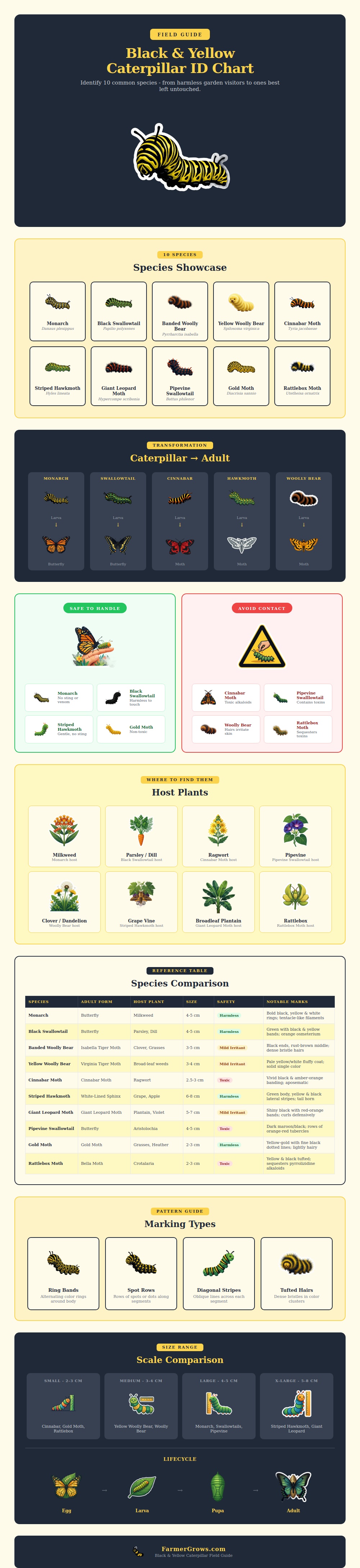
Caterpillars are nature’s palette of meaning. Many use the black-and-yellow color combo as a warning, but they also uses it for camouflage. It is also an echo of their ancestors colors and serves other purposes. Knowing which visitors are friends (or at least not enemies) and which are bad guys (the toxic ones), protects local biodiversity and gives you peace of mind. To get you started distinguishing between 10 familiar species (from the Rattlebox Moth larva to the Monarch), here’s how they break down in chart above.
How to Tell Good Caterpillars from Bad Ones
Begin by checking out their host plants and general body structure. For instance: the Monarch caterpillar is not hard to identify (its bold pattern of alternating white), yellow and black rings, and diet of just milkweed make it unmistakable. It is harmless if touched, though most people still shy away from handling it because we’ve been trained to fear anything striped as if it were poisonus. But that’s going to backfire if you’re trying to create an environment that invites pollinators into yard.
In contrast, the Black Swallowtail larva doesn’t even look much like a Monarch, as its segments is green and banded in yellow and black. It also favors a different set of plant: fennel, dill and parsley. So if you grow these (and notice something chewing on them), chances are you’ve got some Swallowtails around. Again, there is nothing to fear. They are gentle creatures that will turn into beautiful butterflies and will never sting or irritate human skin.
Things get more complicated when you encounter woolly bears. Because of their cute fuzziness, we tend to reach out and grab woolly bear caterpillars (both Yellow Woolly Bear and Banded Woolly Bear) but it’s best not to. Their dense coat of hair can cause irritation for those with sensitive skin, so think of them as a mild irritant. As larvae, they eats things like grasses and clovers, so they’ll be frequent inhabitants of your lawn or an untamed area of the garden edge.
It’s a subtle but key detail: Note that the Banded variety has a rusty middlegear band between black tips and the rest of its body, while the Yellow is predominantly white or pale yellow. Knowing that difference will show you why certain caterpillars don’t use chemical warfare but instead rely on physical barriers.
And then there are the no-no’s… Caterpillars you certainly do not wish to touch, such as poisonous ones like the Pipevine Swallowtail or the Cinnabar Moth larvae. Anything dumb enough to munch one of these will get a dose of whatever poisonous substances the caterpillar has been taking from its host plant in the first place. The Pipevine Swallowtail gets its poison from aristolochia plants, while the Cinnabar gets it’s from ragwort. Bright colors are a warning signal to predators, and the caterpillars is saying “stay away, I’m poison.” ouch. Don’t pick them up. They contain toxins that cause pain, and even washing up right after can be problematic.
Ditto for another larval type who stores pyrrolizidine alkaloids, making the Rattlebox Moth larva unappetizing and possibly dangerous. It’s not just shape, either; there’s size. For instance, some of them don’t get very big (a couple of centimeters long), while some, such as the Striped Hawkmoth, can reach eight centimeters in length.
This one, the Hawkmoth larva, is actualy quite calm and perfectly safe to hold, even though it looks large and scary with its tail horn: The Striped Hawkmoth larva eats apples and grapevines, so it’s frequently seen in orchards. Knowing which insects eat which plants will really help with identifying them. Rather than trying to remember all the characteristics of every species, focus on where they’re hanging out.
Are they eating parsley? Okay, come over this way for a closer look, but do so from a safe distance. They’re eating ragwort? Keep your distance. Observation is part of gardening, so is cultivation. Though you’re no entomologist, you don’t have to be one to admire all those little guys. Learn to read the signs, such as the plant association and the visual clues they use to alert you. Then, enjoy your garden in peace.
That’s why the next black and yellow streak across your path won’t make you jump. You’ll know if it’s someone you should fear or if you should just get out of the way and let them do their thing.