Cauliflower Growth Time Calculator
Estimate cauliflower sowing, transplanting, curd initiation, blanching dates, harvest window, frost clearance, heat-stress pressure, and spacing fit from your variety and season.
Cauliflower is less forgiving than many brassicas. This calculator separates seedling time, packet maturity, curd protection, spacing, soil temperature, frost dates, and heat stress so you can see where the crop schedule is tight.
Snow Crown, Snowball, and Denali make familiar white heads but need leaf cover once curds are visible.
Wrapper leaves help shade the curd, though loose plants may still need tying during bright weather.
Orange, purple, and green types usually skip blanching so color can build in full light.
Late summer transplants often hit curd sizing as nights cool, reducing buttoning and ricey heads.
Close plants can make smaller curds and raise leaf humidity, while wider spacing supports larger heads.
Cauliflower Growth Plan
Enter your crop details to estimate transplanting, curd protection, harvest, and climate risk.
| Cauliflower variety | Typical maturity | Season fit | Blanching need | Growth note |
|---|---|---|---|---|
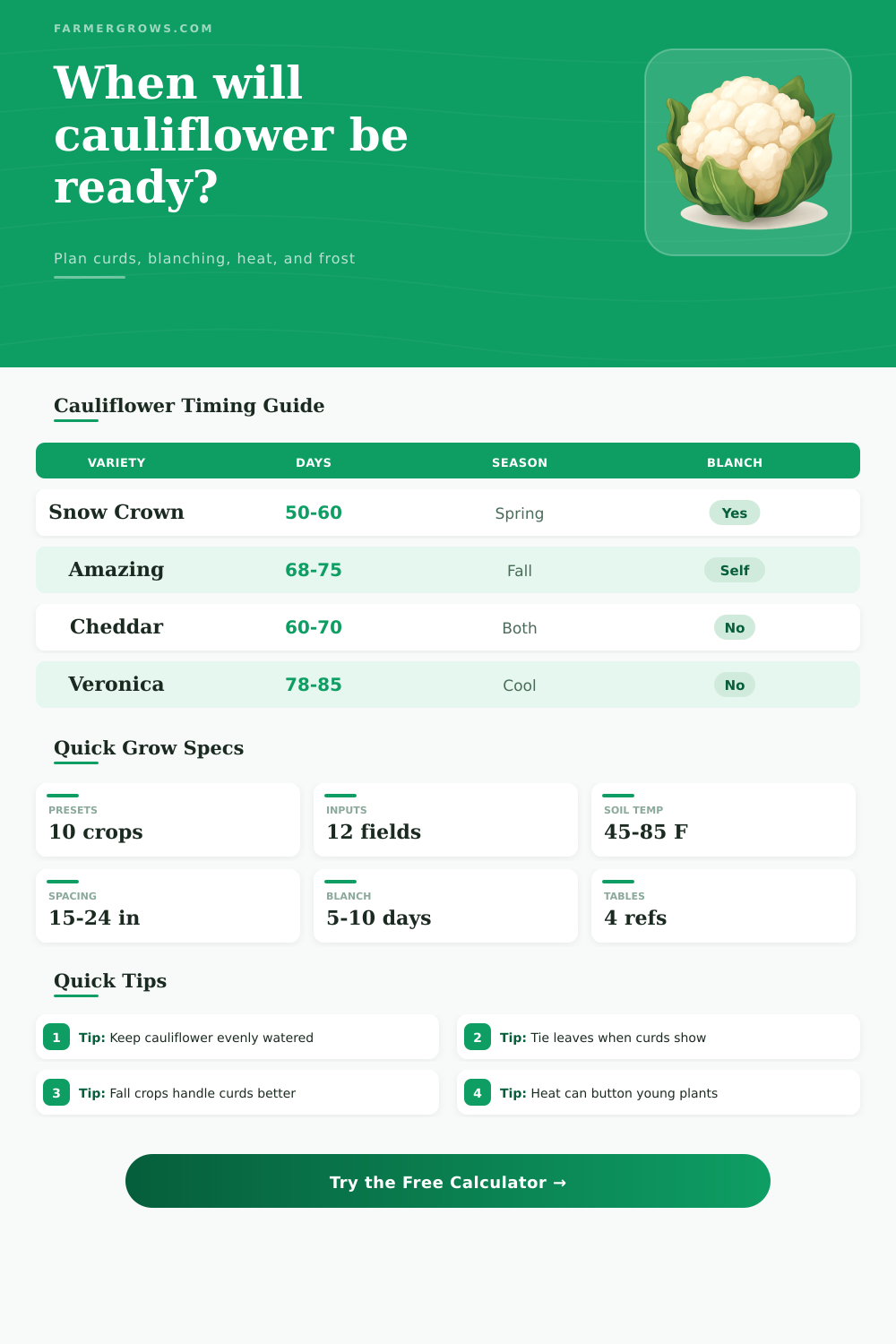
| Snow Crown | 50-60 days from transplant | Spring or fall | Tie leaves over white curd | Fast hybrid, good for short spring windows. |
| Amazing | 68-75 days from transplant | Fall and cool spring | Self-blanching, inspect curds | Wrapper leaves help shade heads during cool finishing weather. |
| Early Snowball | 55-65 days from transplant | Cool spring | Tie leaves | Classic white type that dislikes heat swings. |
| Cheddar or Flame Star | 60-75 days from transplant | Spring or fall | No blanching | Orange curds color best with light exposure. |
| Graffiti | 70-80 days from transplant | Cool fall | No blanching | Purple curds prefer steady temperatures and room to size. |
| Veronica romanesco | 78-90 days from transplant | Fall or mild winter | No blanching | Longer season; harvest before beads separate. |
| Soil temperature | Expected germination | Seedling result | Timing adjustment | Management note |
|---|---|---|---|---|
| 40-44°F | Very slow or uneven | Weak stand risk | Add 7-10 days | Use indoor trays or wait for warmer soil. |
| 45-55°F | 7-12 days | Workable cool start | Add 2-5 days | Good for hardened transplants and protected beds. |
| 60-75°F | 3-6 days | Fast, uniform seedlings | No delay | Best seed-starting range for cauliflower. |
| 76-85°F | 4-8 days | Warm but usable | Add 1-3 days | Keep trays moist and move seedlings cooler after emergence. |
| Above 85°F | Erratic | Buttoning risk later | Add 4+ days | Shade the seed area or start in a cooler place. |
| Spacing goal | Plant spacing | Row spacing | Expected curd | Best use |
|---|---|---|---|---|
| Compact garden bed | 15-18 inches | 18-24 inches | Smaller heads, faster turnover | Raised beds with steady water and close harvest checks. |
| Standard home garden | 18 inches | 24-30 inches | Medium heads with good leaf cover | Most spring or fall white cauliflower crops. |
| Large curd spacing | 20-24 inches | 30-36 inches | Larger curds and better airflow | Fall crops, romanesco, and storage-type heads. |
| Colored varieties | 18-24 inches | 24-36 inches | Colorful exposed curds | Cheddar, Flame Star, Graffiti, and Veronica. |
| Growth stage | Typical timing | Blanching action | Harvest cue | Risk to watch |
|---|---|---|---|---|
| Seed germination | 3-12 days | None | Cotyledons open under bright light | Cold soil, hot trays, drying media. |
| Transplant-ready | 28-42 days from sowing | None | 4-6 true leaves and sturdy stem | Rootbound starts can button early. |
| Curd just visible | 10-16 days before harvest | Tie white types when curd is 2-3 inches wide | Wrapper leaves shade the head | Sun yellowing, loose leaves, trapped moisture. |
| Harvest-ready curd | 50-90 days from transplant | Remove ties at cutting | Firm, tight, full-size head before ricey texture | Heat, frost, uneven moisture, pest-damaged leaves. |
Begin checking plants before the expected harvest date. Tie wrapper leaves once the curd is visible but still small, then check every couple of days.
Use fall timing where possible. Cauliflower often makes better curds during cooling weather than during spring heat waves or dry summer swings.
To grow cauliflowers right, you have to think based off the calendar; don’t guess. You need a period of consistent cool weather beginning at seedling time. It must not be so long as to allow bolting (or flowering) before curd develops. It also must not be such a short period as to result in small heads. Many gardeners get the latter, or both.
Understanding how your location’s frost dates combine with variety selection and planting techniques starts a reliable schedule. There are also varietal differences. For example, while some white ones will need to be blanched when curd appears, romanesco types and others with color skip this step altogether. Those are field differences that result in extra work (or risk). Self-blanching varieties require less labor, but we must be careful because sometimes wrapper leaves may loosen and expose the head to sunlight, which yellows it.
How to Plan Your Cauliflower Growing Schedule
If you select a variety that fits the season, then there’s less likelihood of getting hit by heat stress just when the crop wants to form its curds, where many plant go down. The numbers that goes into the calculator shown above are the actual decisions you make by setting a date, such as soil temperature at planting time (which impacts how fast seed will germinate and roots grows), spacing (how big of a head vs. How quickly can you turn it?).
Cauliflower is not among those brassicas that can handle stop-and-go; heat stress level shifts the maturity curve, as does consistent moisture conditions. If a transplant finishes growing after the first fall frost, or stays in its hole to long after the last spring frost, it affects quality of the curd. The whole plan is anchored by the frost dates.
Those inputs are transformed into dates that work for you: the transplant (or sowing) window, when to start blanching, how long the crop will last. All these dates come up on screen at once to help visualize what’s tight in schedule. You get a crop fit score indicating quickly if it looks like this combination of crop, season, location and variety has a good chance of working, or if a tweak here or there (like starting a little later, or with more space between plants) might make it better.
Since it is easy to forget them before planting, take special care with spacing and moisture. Spacing: The closer you plant, the smaller curds (and also the higher the head’s humidity level, too high, and it might invite disease). Space them wider to get bigger heads, but you will need more garden space.
Moisture fluctuates. As with heat, too much or not enough moisture lead to buttoning issues, making consistent feeding a part of the timing process instead of an afterthought. So does it also bring to light the contrast of transplanting vs. Direct sowing vs. Does it also include indoor sowing?
Transplanting adds days (between sowing indoors and then planting in the field); direct sowing eliminates that process but requires a bit warmer soil (and means more thinning). It includes all this to keep your target date for harvest realistic. Cooler nights during head-sizing time means fall-planted heads tend to produce best; spring crops may work, too, but need extra care and will start with an earlier date in mind.
It’s a matter of comparing those dates; no need to run through the math yourself. With your harvest dates in hand, all that’s left is to watch: Real life never measures up to the averages, so check your plants a couple of days ahead of projected harvest (or blanching) time, and adjust ties or row cover to match, if it looks like things are progressing more rapidly… Or less, then anticipated. You’ve got yourself a map, but your plants will still provide the directions on when to go.