Carrot Seed Germination Time Calculator
Estimate how many days carrot seeds should take to emerge, how much stand you can expect, when to thin, and whether a slow row should be re-sown.
Carrot germination is mostly a seed-line moisture and soil-temperature problem. This calculator focuses on emergence and early stand, not full carrot growth time, harvest date, or root sizing.
Below about 50°F, carrots can still sprout, but emergence often stretches long enough that weeds and drying become the bigger problem.
Carrot seed is small and shallow. A crusted surface or missed watering can stop sprouts before they break through.
Pellets, tape, and older lots need a tighter moisture window. The calculator separates those effects from variety type.
Carrot germination result
The emergence window is based on seed-line temperature, moisture, depth, seed age, and soil surface risk.
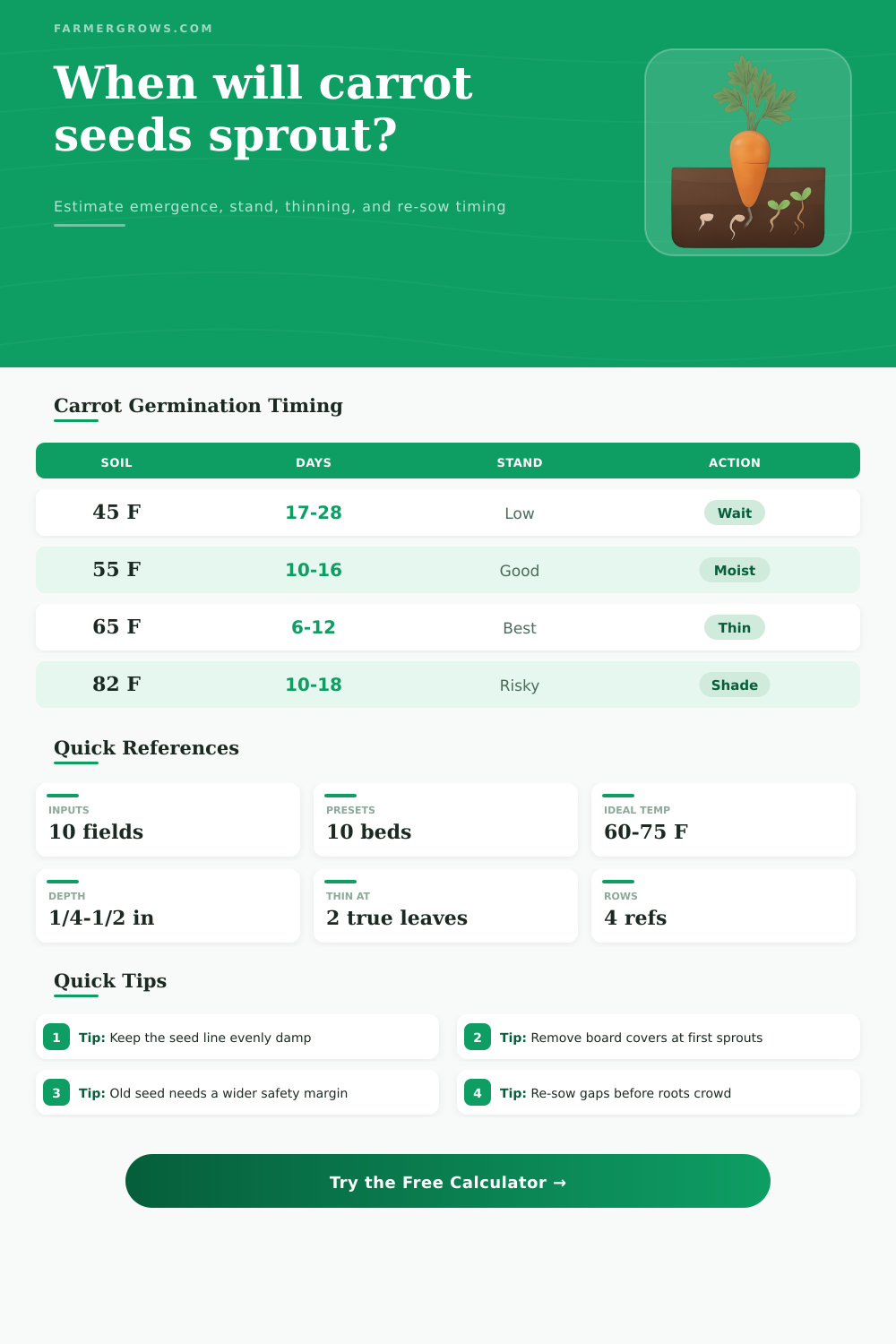
| Soil temperature | Expected emergence | Stand outlook | Best use | Watch point |
|---|---|---|---|---|
| Below 40°F | Very slow or stalled | Poor | Wait for warmer soil | Seed can rot or lose vigor before sprouting. |
| 40 to 49°F | 17 to 35 days | Low to fair | Early cool beds | Weeds may emerge well before carrots. |
| 50 to 59°F | 12 to 22 days | Fair to good | Spring sowing | Keep the seed line from drying between waterings. |
| 60 to 69°F | 7 to 15 days | Good | Main-season sowing | Keep shallow seed covered and evenly damp. |
| 70 to 77°F | 6 to 12 days | Good to excellent | Fastest reliable range | Remove solid covers as soon as sprouts show. |
| 78 to 85°F | 8 to 18 days | Fair | Late summer with shade | Hot soil raises drying and dormancy risk. |
| Above 85°F | Erratic | Poor | Delay or shade heavily | Re-sow may be better after a cooler weather break. |
| Seed format | Timing effect | Stand effect | Moisture need | Calculator note |
|---|---|---|---|---|
| Raw loose seed | Baseline | Best vigor if fresh | Even shallow moisture | Can be over-sown and thinned after emergence. |
| Pelleted seed | Often 1 to 2 days slower | Slightly lower if surface dries | High at first wetting | Pellets must stay damp after the coating softens. |
| Seed tape | Often 1 to 3 days slower | Lower if tape dries | Steady until paper breaks down | Tape improves spacing but can wick moisture away in dry soil. |
| Primed seed | Usually faster | Often stronger | Moderate | Useful in cool spring or tight market-garden windows. |
| Light coated seed | Slightly slower | Near baseline | Moderate to high | Check packet guidance for storage and sowing depth. |
| Seedbed texture | Emergence effect | Stand risk | Best adjustment | Thinning effect |
|---|---|---|---|---|
| Fine garden loam | Baseline | Low | Firm the row lightly after sowing. | Thin normally once first true leaves form. |
| Sandy bed | May warm fast | Drying risk | Use light mulch, board, or more frequent misting. | Patchy rows may need selective re-sowing. |
| Silty soil | Good if not sealed | Crusting after rain | Use compost dusting or fine vermiculite on the row. | Thin gently because roots can lift in sheets. |
| Clay or heavy soil | Slower | High crust risk | Make a shallow drill of fine compost or sand blend. | Thin slightly earlier before roots tangle. |
| Compost-rich raised bed | Often steady | Low to moderate | Keep the top half inch from drying out. | Good for closer baby-carrot spacing. |
| Crusting surface | Delayed | Very high | Break crust carefully or re-sow into a finer cap. | Stand gaps matter more than calendar date. |
| Carrot type | First thin | Final spacing | Row goal | Use in calculator |
|---|---|---|---|---|
| Baby or mini | 1 true leaf if crowded | 1 to 1.5 in | Small tender roots | Enter 1 to 1.5 inches. |
| Nantes | 2 true leaves | 1.5 to 2.5 in | Uniform fresh bunching | Enter around 2 inches. |
| Danvers | 2 true leaves | 2 to 3 in | Broader shoulders | Use wider spacing for storage roots. |
| Imperator | 2 true leaves | 2 to 3 in | Long straight roots | Avoid crowding in deep loose soil. |
| Parisian | 1 to 2 true leaves | 1.5 to 2 in | Round container roots | Use closer spacing in pots and troughs. |
| Fall storage crop | 2 true leaves | 2.5 to 4 in | Large mature roots | Thin before seedlings shade each other. |
The critical zone is the top half inch above the seed. A bed can look damp below while the seed line dries enough to stop germination.
Boards, burlap, or fabric strips help hold moisture, but they should come off when the first sprouts appear so seedlings get light.
A few radish seeds can mark the line and show crusting, but do not use them to judge carrot germination timing.
If the calendar says the row is late and the stand is thin, re-sowing short gaps early is better than waiting until root spacing is fixed.
Sometimes things like carrot seeds don’t come up as fast as back of the pack said they would. You check in ten days and it’s all still just dirt, even though package said to expect them by day 10. It’s typically physics more than failure. Carrot seeds is really small, with limited energy to power their way up through cold or dry soil.”
The calculator bases its advice not on the latest weather prediction but on real-time temperature and moisture levels in your own soil (the former being the key), allowing you to decide when to try again a week later, or not. It converts the vague sense that you’ve done something wrong to a concrete “day-by-day” timeline rooted in conditions belowground.
Why Carrot Seeds Take Time to Grow
Seed needs warmth. Or rather, the soil beneath the seed must be warm, which can vary from species to species: With carrots (which like temperatures between sixty and seventy-five degrees Fahrenheit), you don’t have much chance of growing them fast if soil is under fifty, which is why spring sowing often feel interminable. But because the seeds haven’t died, they’re merely biding their time till conditions improve. They’re essentially just holding their breath in that cold mud. But they won’t really start up again till things warm up a bit.
That is why “when to expect germination” date shown by the calculator will often be a couple of weeks or even longer with springtime sowings. That is fine. It’s just biology doing what biology does, taking its sweet old time. Be patient! Don’t force those seeds into chilly soil and hope for the best.
To manage moisture properly, keep the top quarter-inch of soil moist but not sodden, most people mismanaging moisture cause loss of carrot crop in their gardens; once that narrow layer dries up, the seed dessicates, resulting in a binary world: Either it lives (and sprouts) or dies. Since the question involve how much water you’re adding to what kind of soil, and if you have row cover on, the tool asks those questions. Because row covers helps keep dry soil moist, the tool asks those questions to see if you are doing okay or taking a risk.
Use burlap or board cover, if necessary, to slow drying off the soil, then remove it once things start to pop up, or else end up with a row of weak, yellow seedlings. But when I look down the row where germination has just barely begun, what’s the deal? Some seed types moves at different speeds. Certain seed ages also cause changes in speed, such as older packets, pelleted seeds with coatings, or damaged seed membranes slowing things down. The calculator takes all those factors into play.
It also tells difference between seed-variety characteristics versus physical limitations (like soil texture). Sandy soil dries too rapidly, and clay soils crust and form barriers to little emerging shoots, so knowing your soil type will help translate the results. Is it in heavy clay and no good at holding moisture? You’re probably looking at a lower estimate of stand percentage, and you should treat that as needing extra-tender care rather than a reason to give up.
What does it mean if you get no germination at all? Another valuable result of the tool: The proper time to thin carrot seeds (which is not when they’re merely large, but when they’ve developed two true leaves to avoid getting tangled up as their roots grow) isn’t always intuitive, which is why it provides a target date so you know exactly when to do it.
With this calculator, I get a target date to work toward, so I’m not standing around with my clippers in hand wondering am-I-too-soon-or-not? It makes me more likely to wait until the right time, because carrots grown too late will be stunted and/or forked. Again, knowing the target can help you know when to stop guessing, and start paying attention.
And yes, the tool doesn’t grow the carrots for you, but it takes away the angst of the interval between now and then. There’s no magic bullet with growing carrots, there is nothing I do but sow and be patient and consistent. Keep the seedline moist and check the soil temperature down there. Believe the timeline on the calculator. Let the seeds tell you when to proceed by not proceeding.
Believe me, sometimes that will mean holding off while the ground appears blank, but the seeds know what’s happening. Once you realize germination is a game of negotiating time, warmth, and moisture, the fear goes away. Instead of staring at bare earth, you’ll see a future waiting to be released when the moment arrives.