Pond Stocking Calculator
Estimate fingerling counts, species mix, standing biomass, pond volume, predator-to-prey balance, survival losses, and harvest goals for farm ponds and small production ponds.
This calculator estimates a planning stock from target carrying biomass. It scales the target by pond condition factors, then divides by expected harvest weight and survival to estimate fingerlings to stock.
Stocking Results
Use these estimates as a planning starting point, then confirm locally with water temperature, dissolved oxygen, pond history, and extension guidance.
| Formula | Expression | What it estimates | Example use |
|---|---|---|---|
| Pond volume | surface acres x average depth | Acre-feet, gallons, and cubic meters | 1 acre x 6 ft = 6 acre-feet |
| Adjusted biomass | area x target lb/acre x condition factor | Standing fish biomass supported by pond conditions | 1 acre x 250 x 1.08 = 270 lb |
| Survivors needed | biomass / harvest weight | Fish expected alive at harvest size | 270 lb / 0.75 lb = 360 fish |
| Stocking count | survivors / survival x buffer | Fingerlings to stock today | 360 / 0.75 x 1.10 = 528 fish |
| Species ratio | total stock x predator percent | Predator and prey fingerling split | 528 x 20% = 106 predators |
| Species mix | Predator ratio | Prey ratio | Planning note |
|---|---|---|---|
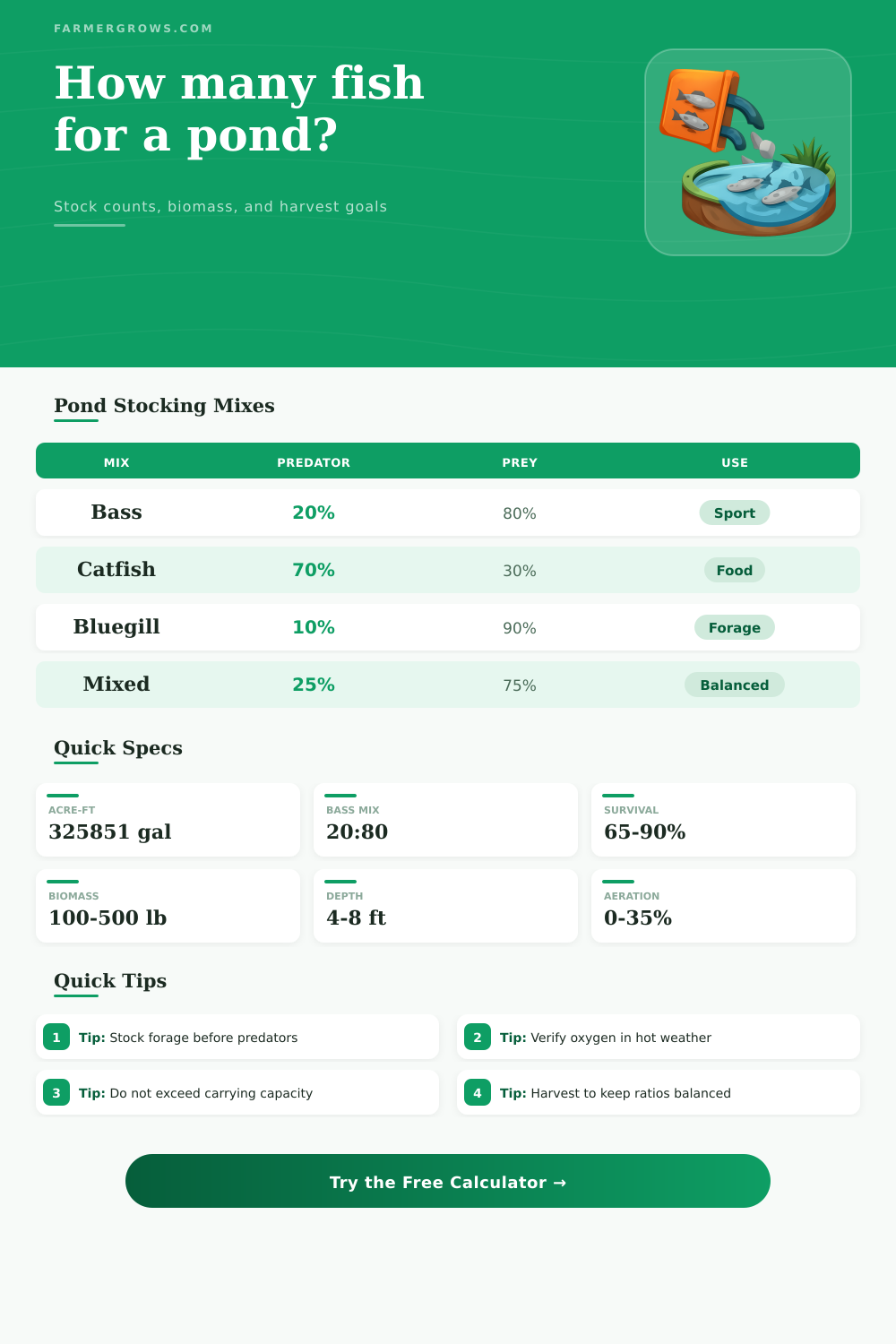
| Bass and bluegill sport mix | 15% to 25% | 75% to 85% | Stock forage first or at the same time with small predators |
| Channel catfish focused | 60% to 90% | 10% to 40% | Feed improves growth but raises oxygen demand |
| Bluegill and forage pond | 0% to 10% | 90% to 100% | Good for bait, forage base, or later predator stocking |
| Tilapia warm-season growout | 40% to 80% | 20% to 60% | Warm water species; survival depends strongly on climate |
| Trout cool-water stocking | 70% to 100% | 0% to 30% | Requires cold, oxygen-rich water and conservative biomass |
| Pond condition | Biomass factor | Best fit | Caution |
|---|---|---|---|
| Clear, low fertility, no aeration | 0.70 to 0.85 | Light recreational stocking | Do not expect high harvest without feed or bloom |
| Moderate fertility, light aeration | 0.95 to 1.10 | Balanced farm pond planning | Watch summer oxygen after cloudy weather |
| Fertile green pond, nightly aeration | 1.15 to 1.35 | Higher forage production and faster growth | Blooms can crash; monitor dissolved oxygen |
| Fed pond with intensive aeration | 1.40 to 1.80 | Managed food fish production | Feed waste and oxygen demand can rise quickly |
| Pond size | Average depth | Moderate stock target | Comparison note |
|---|---|---|---|
| 0.10 acre small pond | 4 ft | 20 to 35 lb biomass | Small ponds swing faster in heat and oxygen |
| 0.25 acre homestead pond | 5 ft | 50 to 90 lb biomass | Good fit for light harvest or ornamental stocking |
| 1 acre farm pond | 6 ft | 200 to 350 lb biomass | Common size for sport fish balance planning |
| 3 acre production pond | 6 ft | 600 to 1,500 lb biomass | Aeration, feeding, and harvest records matter more |
Before adding predators: Build the forage base first. Bluegill, minnows, or other prey fish need time to reproduce before heavy predator pressure begins.
Before raising biomass: Check dissolved oxygen at dawn during warm weather. Aeration can help, but water quality sets the real carrying limit.
A well-stocked pond is not just a place where fish live but also where a system perform its tasks. A well-stocked pond maintains a balance between the growth of fish, the forage that the fish eats, and the fish that are harvested from the pond. Often, it is difficult for individuals to determine the number of fish that a pond can support.
Additionally, it is also difficult for individuals to determine the number of fish that will reach the required size for harvest. However, by using a planning tool for ponds, an individual can determine the number of fish that should be stocked into the pond. This tool will prevent an individual from having to guess at the number of fish that will work best within the pond.
How to Plan and Stock a Fish Pond
The surface area of the pond is one of the critical measurements that should be made for each pond. The surface area of the pond will determine how much sunlight that is allowed to fall onto the pond. The sunlight that falls onto the pond will allow plankton and aquatic plants to perform the functions necessary for the growth of the fish that live in the pond.
Additionally, the depth of the pond is another critical measurement. The depth of the pond will determine the rate at which the pond water heats up during the summer months and the rate at which the pond lose its oxygen levels during the warm summer nights. Furthermore, deep ponds will resist changes to the temperature of the pond but will require more money to both fill and aerate the pond.
When an individual enters the measurements for the surface area and the depth of the pond, the planning tool will calculate the volume of the pond. That calculated pond volume will determine the total weight of the fish that should be stocked into the pond. The type of fish that will live in the pond is another factor that must be considered when stocking the pond.
A sport pond will usually include a percentage of predators but a higher percentage of prey fish. Predators are required to keep the population of prey fish from becoming too high, which causes the prey fish to stunt in their growth. Additionally, prey fish are required to provide food for the predator fish.
If there are too many predator fish, there will not be enough prey fish to sustain the predator fish population and the predator fish will all stut in their growth. Additionally, there will be too many small prey fish if there are too many prey fish in the pond. A fish pond stocking calculator allows an individual to enter the percentage of each type of fish that will live in the pond to determine how many fingerlings of each type of fish need to be purchased for the pond.
Other factors that will influence the number of fish that live in the pond include the aeration of the pond and the fertility of the pond. Aeration will provide the pond water with the amount of oxygen necessary to support the amount of fish that will live in the pond. Fertility will allow the pond to produce the amount of natural food that the fish require to support their growth.
These two factors will mulitplied by the calculated number of fish that can live in the pond based on the volume of the pond. This calculation will produce a number that takes into account the actual conditions of the pond rather than the average conditions of ponds in general. The survival of the fish in the pond will also play a critical role in determining the number of fingerlings that should be placed into the pond.
Due to the fact that not all fish will survive to the size that they are to be harvested, the stocking calculator will ask the individual how many percent of the fish are expected to survive. Additionally, some species of fish will reach the size that is required to be harvested at different times. Due to these factors, the stocking calculator will produce a number for the individual of how many fingerlings of each species to purchase.
However, that number is a generalization, and an additional small number of fish can be added to the total because factors such as the source of the fingerlings may vary, and the weather may impact the survival of the fish that are stocked into the pond. Reference tables exist within stocking calculators that show examples of the type of calculations that can be made based on different sizes of ponds and with different conditions within the ponds. These tables are not meant to replace the calculations made with the reference tables but do allow an individual to get an idea of whether or not the number of fish that are to be stocked into the pond is within the normal range for that type of pond.
Additionally, if the target biomass of fish that will live in the pond is higher than the values that are represented in the reference tables for that pond’s aeration levels, the stocking calculator will alert the individual that the oxygen load on the pond is high. This high load of oxygen will require an individual to monitor the oxygen levels in the pond during the summer months. Ponds have a history that is often left out of stocking calculations but is essential to know prior to adding fish into the water.
For example, if a pond has often had fish harvested from it, the pond may need to be lightly stocked with fish during its first year. However, if a pond has never had any fish harvested from it, the pond may already contain many fish of the same species. An individual can test the fish pond to determine the level of alkalinity, the level of hardness of the water, and the amount of plankton that is already living in the pond.
By testing these factors of the pond, an individual can ensure that the water will not become a problem for the fish that are to be added to the pond. Testing the water is worth the cost for each pond because it can prevent an individual from purchasing fish that will not be able to thrive in their new home. Other than stocking calculations, another factor that an individual who is planning to stock a fish pond with fish should consider is the order in which the fish are to be added to the pond.
Fish that are prey for other fish species should be added to the pond prior to the addition of any predator fish species. By doing so, the predator species that are to be added to the pond will not eat the prey fish. Additionally, prey fish should be added to the pond first so that they can start to establish a population within the pond prior to adding the other fish species.
A final factor that should be considered in the stocking of a pond is the harvesting of the fish from that pond. If an individual removes too many fish from the pond each year that the fish are growing, the remaining fish will not be able to keep up with the amount of forage that each fish requires to grow. However, if too few fish are removed each year, the pond will become crowded with fish, and the growth of each individual fish will slow down.
By entering the number of fish that an individual would like to harvest each year into the stocking calculator, the calculator can show an individual whether or not that goal for the harvest of the pond fish is realistic. The numbers that stocking calculators calculate for fish are only as good as the information that is entered into the calculator. An individual should measure the size of the pond at normal water levels.
The size of the pond should not be measured after a period of heavy rain or during drought periods in the area. An individual should use the most recent tests of the pond water. The tests of the pond should not be based on an individual’s old memories of the conditions of the pond.
An individual should use the number that the stocking calculator calculates as the starting number of fish to purchase for the pond. However, after the fish are added to the pond and after they have grown to their different sizes, the plan can be adjusted based on the observations of the pond fish. The pond is a living system, and an individual should be willing to make changes to the stocking plan that the stocking calculator calculated if the fish in the pond exhibit different results than the predictions of the stocking calculator.