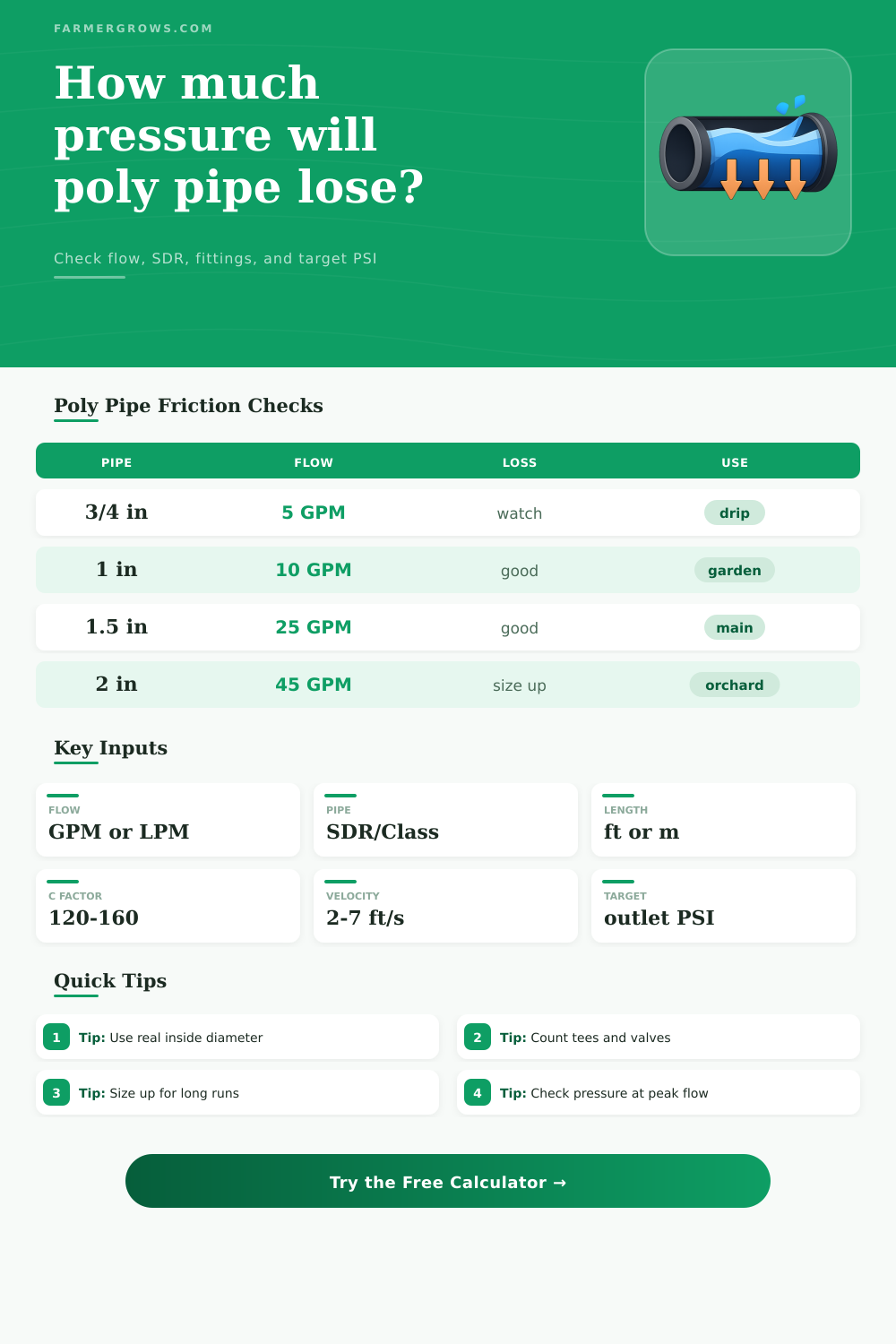
Friction Loss in Poly Pipe Calculator
Estimate Hazen-Williams friction loss for polyethylene irrigation pipe from flow, inside diameter, SDR/class, length, fittings, water temperature, elevation change, and target outlet pressure.
Use measured inside diameter when possible. Nominal poly pipe, IPS HDPE, CTS, and rural poly can vary by manufacturer, pressure class, and standard dimension ratio.
Poly Pipe Friction Loss Results
Results update after calculation.
This grid recalculates friction loss for common poly sizes using your flow, length, fittings, C factor, water temperature, elevation, source pressure, and target pressure.
| Pipe Option | ID | Velocity | Friction | PSI / 100 ft | Outlet PSI | Status |
|---|
| Calculation Step | Formula Used | Input Units | Meaning |
|---|---|---|---|
| Velocity | v = 0.4085 x GPM / ID squared | GPM, inches | Water speed through the selected inside diameter |
| Hazen-Williams | hf = 4.52 x L x Q^1.852 / (C^1.852 x ID^4.871) | ft, GPM, inches | Friction head loss in feet of water |
| Pressure loss | PSI = head ft / 2.31 | feet of water | Converts friction head to pressure drop |
| Elevation pressure | PSI = elevation ft / 2.31 | feet of rise | Positive uphill rise uses pressure; downhill fall adds pressure |
| Metric flow | GPM = LPM / 3.78541 | liters/min | Internal conversion for metric entries |
| Metric pressure | PSI = kPa / 6.89476 | kilopascals | Internal conversion for source and target pressure |
| Pipe Condition | Typical C | When to Use It | Calculator Note |
|---|---|---|---|
| New smooth polyethylene | 150 | Clean irrigation water and fresh pipe | Good starting point for HDPE and poly tubing |
| Lightly aged poly | 140 | Several seasons of use with normal mineral film | Conservative for most farm laterals |
| Dirty water or biofilm | 125 to 135 | Pond water, algae, iron, or neglected filters | Use lower C to keep pressure margin realistic |
| Old rough line | 110 to 120 | Older pipe with scale, sediment, or deposits | Consider flushing, filtration, or upsizing |
| Temperature adjustment | Approx. | Cold water is slightly more resistant to flow | This tool adjusts C modestly from 40 to 100 F |
| Nominal Size | Thin Wall ID | SDR 21 ID | SDR 17 ID | SDR 11 ID |
|---|---|---|---|---|
| 1/2 in | 0.622 in | 0.560 in | 0.535 in | 0.475 in |
| 3/4 in | 0.824 in | 0.780 in | 0.745 in | 0.681 in |
| 1 in | 1.049 in | 0.995 in | 0.955 in | 0.862 in |
| 1-1/4 in | 1.380 in | 1.265 in | 1.215 in | 1.097 in |
| 1-1/2 in | 1.610 in | 1.530 in | 1.469 in | 1.330 in |
| 2 in | 2.067 in | 1.939 in | 1.860 in | 1.687 in |
| 2-1/2 in | 2.469 in | 2.323 in | 2.225 in | 2.013 in |
| 3 in | 3.068 in | 2.900 in | 2.780 in | 2.515 in |
These are planning estimates, not a substitute for the marked manufacturer inside diameter. Small ID changes can produce large friction-loss changes.
Hazen-Williams is intended for turbulent water flow in pressurized pipe. For very low flow, slurry, chemicals, air, or mixed-phase flow, use a method matched to the fluid and pipe condition.
Friction loss in poly pipe is one of the factors that will determine how well the irrigation system perform. Friction loss in poly pipe can lead to a decrease in the water pressure at the emitters of the irrigation system. Pressure loss in poly pipe occur due to the fact that the water that is moving through the poly pipe rubs against the inside walls of the poly pipe.
Furthermore, the water can also rub against the inside of elbows, tees, and other valve that are located along the poly pipe. If the pressure loss along the poly pipe is too high, then the water pressure at the emitters will be too low for them to function correctly. The friction calculator can calculate the friction loss within the poly pipe by taking into account the flow rate, the length of the poly pipe, the inside diameter of the poly pipe, and other conditions of the site.
Why Water Loses Pressure in Poly Pipe
The inside diameter of the poly pipe is one of the most critical factor in determining how much friction loss will occur within that poly pipe. A change in the inside diameter of the poly pipe will significantly change the friction loss that occurs within that pipe. For instance, increasing the inside diameter of the poly pipe by only a half inch will reduce the friction loss within that pipe by half.
The manufacturers of the poly pipe utilize different thicknesses of the pipe wall, so the actual inside diameter of the poly pipe needs to be measured. Furthermore, the inside diameter of the poly pipe will not matter much if the length of that pipe is short; however, if the length of the poly pipe is any considerable length, then the inside diameter of that pipe will be an important factor in the calculation of the friction loss that will occur through that pipe. Flow rate is another of the major factors that will contribute to the friction loss within the poly pipe.
Friction loss will increase if the flow rate of the water within the poly pipe increase. The reason for this is that if the flow rate increases, the velocity of the water within the poly pipe will also increase, which will cause an increase in the friction loss of that water. The relationship between the flow rate of the water and the friction loss is not linear, however; instead, the friction loss increases by a greater factor if the flow rate is double.
This is because the Hazen-Williams equation raises the flow rate to the 1.852 power. Furthermore, the calculations of the friction loss calculator can determine the velocity of the water within the poly pipe; this velocity should be between two and seven foot per second for the irrigation system. If the velocity is too slow, the capacity of the poly pipe is being wasted.
If, however, the velocity is too fast, the water may cause wear on the irrigation system at the elbows and valves. Each of the fittings along the poly pipe can also contribute to the friction loss within the poly pipe. It is important to account for these fittings in the calculation of the friction loss within the poly pipe.
Each of these fittings will contribute to the resistance to the flow of water that is moving along the poly pipe. The friction loss calculator will calculate the length of the poly pipe that each of these fittings will act upon so that they can be accounted for in the calculations of the friction loss within the system. For instance, a few elbows along the system may contribute to as many feet of loss as a hundred feet of straight poly pipe.
These preset buttons on the calculator should be used to ensure that the number of elbows, tees, and valves along the irrigation system is accounted for in the calculations of the friction loss within that system. The temperature of the water within the poly pipe can also contribute to the pressure that will be emitted from the irrigation system. If the water that is flowing through the poly pipe is colder than the water that is in the irrigation system, the water will be more viscous, leading to a slight increase in the friction loss of that water.
The friction loss calculator will adjust the C factor of the poly pipe for these differences in water temperature. The elevation of the outlet of the poly pipe is another factor that will affect the pressure of the irrigation system. Elevation does not affect friction loss.
However, gravity will reduce the pressure of the water if the outlet of the poly pipe is uphill of the source of the water; however, if the outlet of the poly pipe is downhill of the source of the water, gravity will increase the pressure of the water that exits the irrigation system. The friction loss calculator accounts for elevation as a direct factor in the final pressure of the irrigation system. The comparison grid within the calculator will show the performance of poly pipe of different sizes using the same flow rate and length of poly pipe.
This grid can help determine whether increasing the size of the poly pipe will allow for the velocity of the water to reach an acceptable range; it can also reveal whether the current size of the poly pipe will provide enough pressure margin to the emitters of the irrigation system. The comparison grid can help to determine if purchasing a larger size of poly pipe will be worth the cost relative to the poly pipe that is currently being purchased. The friction loss that occurs within poly pipe can change over time.
The filter through which the water passes can become loaded with debris. Furthermore, the water within the poly pipe can leave behind a mineral film within the poly pipe. Both of these conditions will contribute to increased friction loss within the poly pipe over time.
The friction loss calculator can adjust the C factor that is utilized to reflect the possible dirty condition of the poly pipe. For instance, the C factor of new poly pipe can be 150, but dirty poly pipe can have a C factor of 130 or lower. By adjusting the C factor to a lower number, a buffer can be provided for the increased friction loss that may occur due to the dirty nature of the poly pipe.
Because of the factors described above, it is also important to ensure that the velocity of the water within the poly pipe remains within certain ranges. If the velocity of the water is too slow, sediment may settle within the poly pipe. However, if the velocity of water is too fast, the high velocity of the water may contribute to wear at the fittings of the irrigation system.
These ranges for the velocity of the water can be seen within the friction loss calculator to help determine a proper size for the poly pipe. The pressure margin that is calculated at the end of the irrigation system is the most important measurement for determining any decisions that are to be made regarding the irrigation system. The pressure margin will reveal how much pressure remains in the system after the system has accounted for the pressure that is required to operate the emitters of the irrigation system.
A high number for the pressure margin indicates that there is enough pressure in the system to account for any small increases in resistance. A pressure margin that is near zero indicates a very low amount of extra pressure to the system. Furthermore, if the pressure margin is a negative number, then the system does not have enough pressure to meet the requirements of the irrigation system.
The pressure margin will allow for the irrigation system designer or installer to decide whether poly pipe of a larger diameter should be ordered, whether the length of the poly pipe should be shortened, or whether a lower target pressure should be established for the emitters of the irrigation system. These calculations should of been performed prior to installing the poly pipe into the ground. The decisions that are made based off these calculations will prevent future problems with the irrigation system; once the poly pipe is installed in the ground, any friction loss problems can only be resolved by the installation of a pump to increase the water pressure at the end of the irrigation system.
Furthermore, the friction loss calculator allows for the testing of various sizes of poly pipe and flow rates to determine the correct size of the poly pipe without having to perform the calculations manually. By performing these calculations prior to installing the poly pipe, it is certain that the pressure will remain within the level that is desired from the irrigation system.