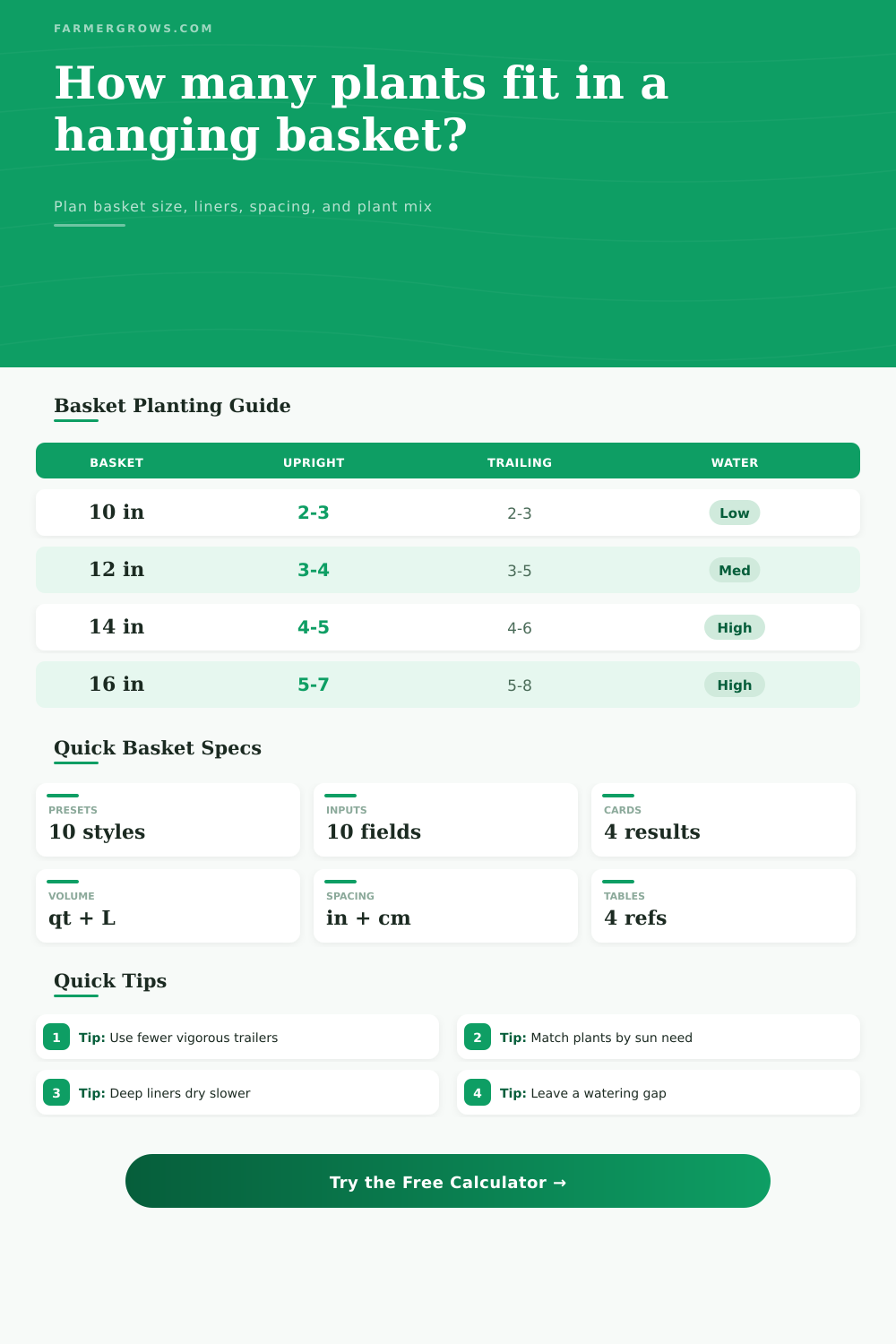
Plants in a Hanging Basket Calculator
Plan how many upright fillers and trailing spillers fit by basket diameter, liner depth, usable soil volume, plant vigor, spacing, sun exposure, water demand, and finished design style.
Use this as a planting-density planner for annual baskets, herb baskets, strawberry baskets, and mixed patio displays. It estimates a practical count, then checks whether the liner has enough root volume to carry that design.
Use similar upright and trailing counts for a full ball of bloom without a heavy skirt.
Give trailing plants more positions and keep upright plants fewer so stems can drop cleanly.
Reserve center space for one strong focal plant with fillers and small trailers around the rim.
Herbs, strawberries, and tumbling tomatoes need fewer plants and deeper root volume.
Begonia, fuchsia, coleus, ivy, and impatiens usually prefer steady moisture and airflow.
Succulents and drought-tolerant mixes work best with wider spacing and fast drainage.
Hanging Basket Planting Results
Estimated plant count, liner volume, spacing, and water demand.
| Basket diameter | Typical depth | Approx volume | Planting note |
|---|---|---|---|
| 10 in | 6 in | 4 to 5 qt | Best for 3 to 5 compact plants or one small edible focus |
| 12 in | 7 in | 6 to 8 qt | Common porch basket size for 5 to 7 annuals |
| 14 in | 8 in | 10 to 13 qt | Good for vigorous trailers and fuller flowering displays |
| 16 in | 9 in | 15 to 19 qt | Use for thirsty edibles, big shade baskets, and hot exposures |
| Plant group | Vigor | Upright spacing | Trailing rim spacing |
|---|---|---|---|
| Calibrachoa, lobelia, alyssum | Compact to standard | 4 to 5 in | 3.5 to 5 in |
| Petunia, verbena, bacopa | Vigorous | 5 to 6 in | 5 to 7 in |
| Begonia, fuchsia, impatiens | Standard | 4.5 to 6 in | 5 to 6.5 in |
| Herbs, strawberries, tomato | Root-heavy | 6 to 9 in | 6 to 10 in |
| Succulents and sedum | Slow | 3.5 to 5 in | 4 to 6 in |
| Exposure | Water multiplier | Volume advice | Best fit |
|---|---|---|---|
| Bright shade | 0.85x | Standard liner usually works | Fuchsia, begonia, ivy, coleus |
| Part sun | 1.00x | Use normal plant counts | Most mixed annual baskets |
| Full sun | 1.20x | Add volume or reduce plant count | Petunia, verbena, calibrachoa |
| Hot exposed sun | 1.40x | Deep liner or self-watering insert helps | Drought-tolerant or large baskets |
| Basket style | Size | Typical split | Notes |
|---|---|---|---|
| Calibrachoa dome | 12 in | 3 upright / 3 trailing | Even bloom cover with compact plants |
| Wave petunia cascade | 14 in | 2 upright / 5 trailing | Lower count because petunias spread hard |
| Shade begonia mix | 12 in | 4 upright / 2 trailing | Keep airflow around foliage in humid shade |
| Strawberry spillover | 14 in | 3 crown / 4 rim | Use deeper volume for fruiting and runners |
| Tumbling tomato basket | 16 in | 1 tomato / 3 herbs | Root volume and watering matter more than count |
A hanging basket grows in three directions. Leave enough rim and soil room for plants to expand, for water to soak in, and for air to move through the crown.
A full-sun petunia and a shade fuchsia can both look great in baskets, but they do not want the same heat, watering rhythm, or liner dryness.
It’s in your hands. There you stand, at the garden center, clutching a suspiciously lightweight plastic liner for the volume of soil you’ll soon purchase. Why? Because the basket, already selected for its pleasing look beside your door frame. Called out for filling up. So what do you put inside, besides something that just takes up space? Something colorful! Something blooming!
Most people stuff a basket by picking petunias or ivy by the handful to cover the surface. Within days, they end up with what was a nice-looking mass of green, but is now a sopping, brown mess. That’s because there isn’t any air between the roots; also, because it doesn’t dry out before next watering.
How to Plant Your Hanging Basket Correctly
That leaves the design part for you, and the math part for the tool (above). It figures out the usable soil volume based off the container’s shape and liner depth. It also doesn’t ask you to guess how many plants will fit in circumference. This is more important then you realize. Even containers of equal diameters has very different amounts of soil in them: the wide-mouthed ones with shallow liners hold less than bowls that are deeper but narrower.) The missing soil volume mean lost water-holding potential.
Pack too many vigorous trailers into a shallow liner, and their roots will bind and encircle each other in days; the plant then starves itself of moisture when it most needs it, in high summer. Choosing a vigor setting help the calculator estimate how many plants will fit, giving fast-spreaders like calibrachoa more space than compact herbs.
Most beginner’s mistakes occur with spacing. The mentality of planting involves putting dots on a map, but a plant is a sphere and expands outward. Choosing a high growth setting will increase the distance recommended between your trailing spillers and upright fillers. This gives each plant plenty of side space to establish its root ball without fighting for resources.
Following these tips may make you feel like you left too many empty spaces. Fight that temptation. Plants live in 3 dimensions, and what appears sparse at planting time will soon be a lush, full display in just a few weeks. Overcrowding is the silent killer in hanging baskets because it creates a local environment of stagnant humidity around the crown.
Sun exposure acts as a multiplier for your watering efforts. For instance, a three-day gap between soaking sessions in bright shade works for a basket. The same basket in hot exposed sun (and I mean hot) would probably be one or two times per day during an August heat wave. In fact, those multiplying factors are spelled out clearly in the reference tables on the page. You can see how they support the “four-gallon liner” recommendation for use in full sun: not just to hold more plants, but to create a buffer against quick water loss through evaporation. Even though the outside of the deeper soil profile dries, there’s still moisture left in the middle, which cools down sooner and stays that way longer.
That’s also where design style comes into play. How many plants do you have? Is it a thriller-filler-spiller combo (one big dramatic thing plus fillers and spillers)? This combo create less space in the ground for each plant than a mass of similar-looking annuals, like a mound of them. Or what about an edible like tumbling tomatoes or strawberries, where the issue isn’t so much how dense they make things visually but how deep their roots can be: They require plenty of reserve in the ground to produce runners and later fruit.
When you choose edible modes, the calculator assumes that and advises you to plant fewer plants with bigger buffers between them. This avoids a mistake I see people making all too often with tomato plants, which we think should of just get tossed in there like another kind of decorative petunia.
There is an additional layer: water demand. A successful grower knows the importance of matching plants with similar thirst levels. Succulent drought-tolerant plants and high-demand bloomers won’t work well together, a maintenance nightmare. By selecting your water demand profile, the calculator will adjust the volume recommendations accordingly (implicitly flagging these mismatches). If you’re mixing it up, make sure they’re on the same page. A mix that needs the same amount of moisture is much easier to maintain than one where some parts are drowning while others are bone dry.
That’s half the story; now add the liner type. Heavy-duty plastic bowls hold moisture longer than coconut coir liners, which are popular and more breathable. For most annual baskets, standard coco liners is a happy medium. If your display is thirsty, go for deeper inserts for an added reserve of soil. Quick comparison cards on the page lay those volume factors out side-by-side, so you can see just how much soil is being lost to air space versus storage capacity.
A hanging basket isn’t an exercise in filling something in; it’s about using limited materials as wisely as possible: a certain volume of available soil, some unpredictable exposure to light, and plants who will insist on having more than what you’re prepared to provide them. A calculator reminds us all of our limits. Before we get digging, we treat the exercise not as a guessing game but as a sustainable design challenge. The result? A better-looking basket; one that lives longer.
Yes, you will still purchase fewer plants than your heart initialy hoped to stuff full of color. That self-restraint is the key to a lush display of bloom that lasts through high summer till frost.