Pistachio Trees Per Acre Calculator
Estimate pistachio trees per acre, total plantable spots, row count, male pollinizer trees, nursery reserve, canopy clearance, drip emitters, and lateral length from orchard spacing.
Choose a pistachio spacing plan, then adjust block shape, layout, cultivar vigor, headlands, male tree ratio, replacements, canopy diameter, drip hardware, and expected mature yield.
Pistachio Orchard Estimate
Your pistachio spacing estimate will appear here.
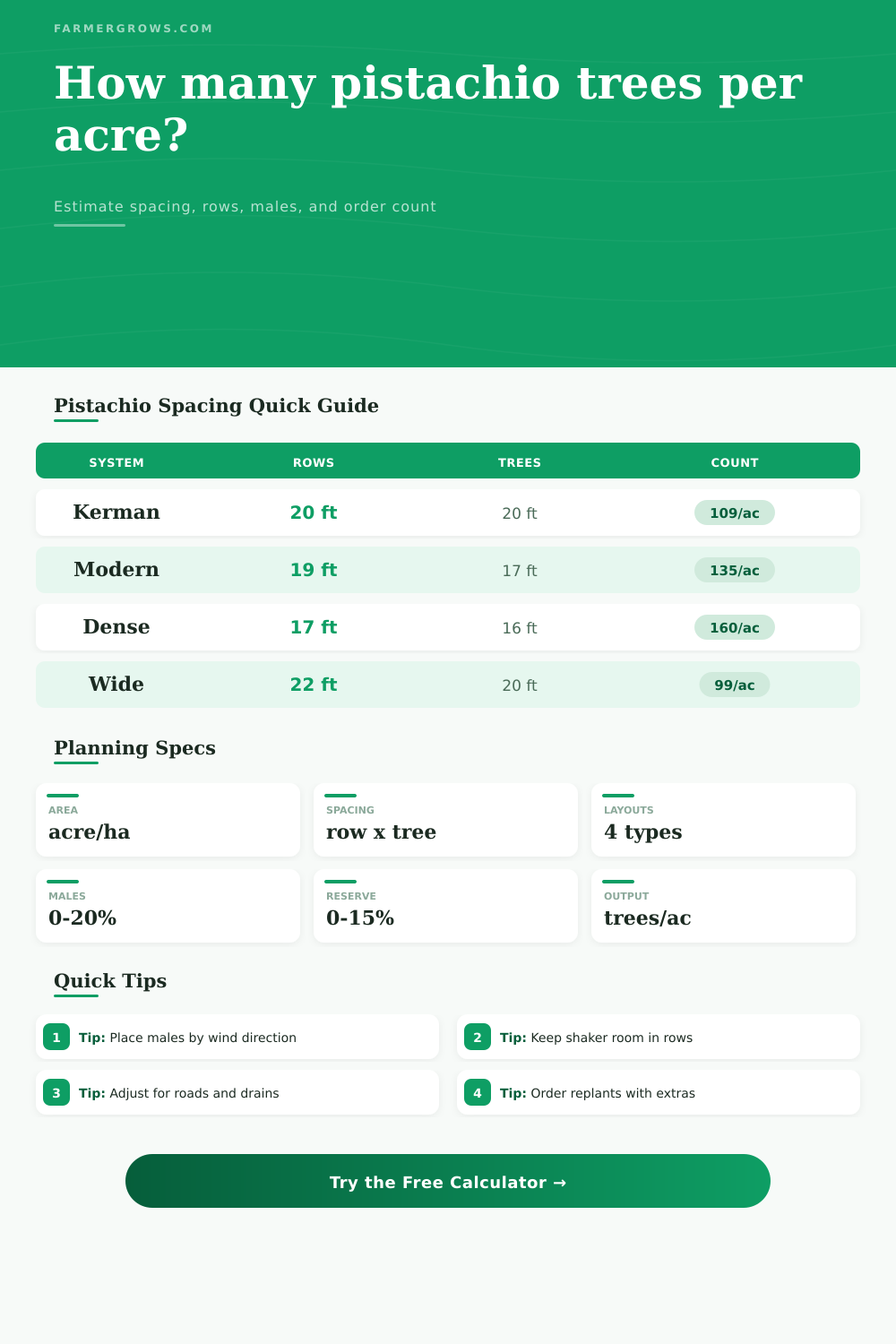
Use these quick reference values to compare spacing choices before applying headland, road, service lane, survival, and nursery reserve adjustments.
| Spacing | Square Grid | Triangular Grid | Best Fit |
|---|---|---|---|
| 22 x 20 ft | 99 trees/ac | 114 trees/ac | Vigorous sites and equipment access |
| 20 x 20 ft | 109 trees/ac | 126 trees/ac | Traditional mature pistachio canopy |
| 19 x 17 ft | 135 trees/ac | 156 trees/ac | Modern medium-density planting |
| 17 x 16 ft | 160 trees/ac | 185 trees/ac | Dense system with planned hedging |
| Male Share | Total Trees | Male Trees | Female Trees |
|---|---|---|---|
| 8% | 1,000 | 80 | 920 |
| 10% | 1,000 | 100 | 900 |
| 12% | 1,000 | 120 | 880 |
| 15% | 1,000 | 150 | 850 |
| Block Example | Area | Spacing | Approximate Count |
|---|---|---|---|
| Small trial | 2 acres | 20 x 20 ft | 218 gross trees |
| Quarter section corner | 35 acres | 19 x 17 ft | 4,719 gross trees |
| Dense young block | 40 acres | 17 x 16 ft | 6,406 gross trees |
| Wide shaker block | 80 acres | 22 x 20 ft | 7,920 gross trees |
Keep the male count separate. The calculator splits total plantable trees into male pollinizers and female producing trees so the nursery order reflects the actual orchard mix.
Check canopy before ordering. Dense pistachio spacing can look efficient on paper, but mature canopy diameter, shaker room, and row access decide whether the design stays workable.
Because of the type of crop, years pass between the purchase of a sapling and first yield. That’s why upfront financial investment in an orchard is more longer-term commitment than most other agricultural crops. That is also why making the right spacing decisions is so important because they become permanent as soon as the roots settles in.
For example, how many pistachios is there per acre? If you’re planting moddern-style dense hedgerow orchards, it’s around 135 trees per acre. If you’re going old-school with wider-spaced canopy trees, it’s about 109 trees per acre. And it varies further based off factors like equipment access and soil type.
How to Plan Your Pistachio Orchard Spacing
After selecting the spacing preference (above), the calculator does the rest of math. Using the geometry of your block, it estimates total number of plantable spots. That’s something you’ll want to know before calling up nursery; at those volume levels, their bulk prices fluctuates quickly. After deducting drainage ditches, service lanes, and headlands, the tool calculates the total number of places where plants can be planted.
Why do these deductions matter? When you factor in the machinery required to shake the trees, a theoretical acre diminishes quite a bit. If you can’t get to tree, you can’t harvest it.
Because pistachios has separate male and female trees, there’s an interesting twist in planning your orchard: Pistachio trees bear either male or female flowers; both types must be present. (The males don’t yield nut income; only the females.) To set up your orchard correctly, you’ll want to order the right mix of tree… Male to female, and the calculator will sort it out. A typical split is 10 percent males; wind direction may change this requirement. For instance, if prevailing winds comes from the north, planting males along the north border will better distribute pollen. You can use this tool to adjust the percentage and placement pattern to suit your own situation.
The orchard’s structure is in its spacing. With traditional systems, rows are spaced at a width of 20 feet; trees within rows is 20 feet apart. That gives roughly one hundred and nine trees per acre, with plenty of room for canopy (and space to get shaker machinery in).
In modern systems, the spacing is tightened, down to a nineteen- by seventeen-foot grid, which ramps up the density to approximately one hundred and thirty-five trees per acre. More tree bear earlier fruit, so there is revenue sooner. But trees must be pruned strictly enough to maintain sufficient light penetration. And denser planting mean more drip lines and emitters, driving up irrigation expense per acre. The calculator scales the irrigation portion of the list according to your desired layout.
Then there’s the loss during establishment. Not every plant survives after being planted. Heat stress and transplant shock are common causes of first-year mortality, along with other pest damage. To accommodate these losses, the tool lets you set a reserve percentage when ordering, so that you’ll be sure to have some extra trees on hand to plug holes. A five percent reserve means you can fill holes without having to wait another year until next nursery season rolls around. Uneven canopy development makes mechanical harvesting harder later.
On the page are reference tables that contrast a triangular vs. A square planting pattern. With a triangular grid pattern, you shift the position of trees in alternate rows, using the space more effectively. You can plant more trees then with a square grid but still keep equal station area for each tree. The disadvantage is it complicates straight line machinery operations. Unless the potential yield increase would of been great enough to justify equipment issues, most commercial growers stay with rectangular grids for ease of operation.
A sanity check for your density goals is the mature yield estimate. Packing in too many trees will cause reduced yield of each tree as they compete with each other for light and water. The calculator project total acre yield based on assumed per-tree production. This will help you imagine if tighter spacing will result in greater profits (more money per pound, but also smaller pounds), or simply smaller nuts. Market price for pistachios is very high, but so are processing fees which is scaled to volume. Knowing how much to expect per acre helps you negotiate harvest contracts ahead of time.
Spacing also depends on the strength of the tree’s canopy, which is affected by soil type. Vigorous trees growing in deep sandy loam require more space than those planted in shallow soils that don’t allow roots to grow out as much. However, this doesn’t mean they should be crowded, as they would compete with each other. There’s an adjuster for rootstock vigor on the tool so you can fine-tune the estimate accordingly. A little extra attention here will help avoid big errors in calculating canopy clearance.
How far apart you plant means how far apart you leave the rows so that the shaker can get through there without breaking branches or denting trunks. The science of orchard planning is also the art of risk management. Your thirty year plan locks down your operating costs in the form off your spacing decision. Denser planting means higher maintenance complexity but faster cash flow; wider spacing mean lower input cost per tree, but longer wait to reach full production.
No one solution fits all. The best answer depends on the market timeline, irrigation capacity, and available labor. The calculator doesn’t make that call for you. It just shows the tradeoffs so they are clear rather than vague, giving you numbers you can use to take action.
Start with your equipment constraints, move to tree counts, then adjust for pollinizer needs and set aside trees. What comes out is a planting plan that is both economic and biological. Think of it as creating a long-term asset: Get the foundation right before you break ground.
Sometimes math will tell you something your intuition may not.