Pine Straw per Acre Calculator
Estimate pine straw bales per acre from covered acres, needle depth, bale type and weight, expansion coverage, loose straw density, excluded beds or rows, slope loss, wind loss, and refresh mode.
Choose a common field, orchard, or garden use, then adjust the bale tag, coverage claim, and field exclusions for your actual delivery.
Pine Straw Coverage Estimate
Results round bale counts up because pine straw coverage varies with needle length, moisture, shaking, tucking, slope, and how tightly each bale was tied.
Often longer needles and cleaner color. Use 45 to 55 sq ft per bale at three inches when spread evenly.
Common field bale for farms and orchards. Use about 40 to 50 sq ft per bale at three inches.
Variable needles, leaves, and moisture. Keep an extra buffer when bale quality is inconsistent.
Useful for small gardens and tree rings, but needs more bales per acre than field bales.
Heavy square bales may cover well after shaking, but damp bales can spread short.
Good for longer rows and open work areas. Confirm actual expanded width before scaling acres.
Efficient for orchard, nursery, and erosion work when handling equipment can reach the rows.
Enter your own bale weight, loose density, and coverage claim from the supplier or a test spread.
Use these tables as planning guides. A small test spread is still the best way to calibrate local bale expansion, moisture, and labor style.
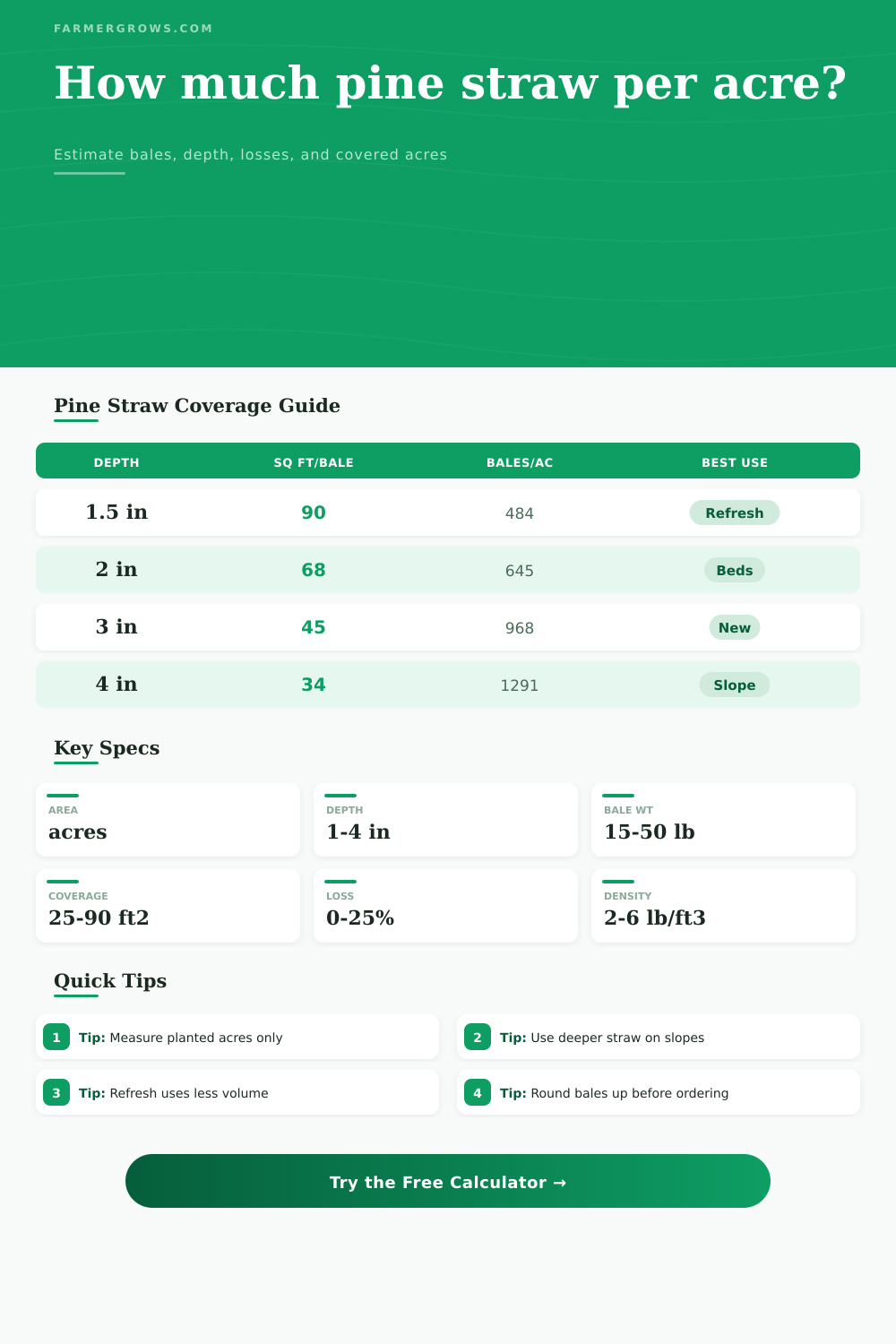
| Needle depth | Sq ft per cu yd | Approx bales per acre | Typical use |
|---|---|---|---|
| 1 inch | 324 sq ft | 323 to 430 bales | Very light topdress where old straw remains visible |
| 1.5 inches | 216 sq ft | 484 to 645 bales | Spring refresh, tree rings, bed color renewal |
| 2 inches | 162 sq ft | 645 to 860 bales | Moderate garden paths and established beds |
| 3 inches | 108 sq ft | 860 to 1,089 bales | Fresh landscape bed or new orchard row mulch |
| 4 inches | 81 sq ft | 1,291 to 1,720 bales | Slope, erosion cover, or extra weed suppression |
| Bale type | Typical weight | 3 in coverage | Notes for acreage estimates |
|---|---|---|---|
| Small retail bale | 12 to 18 lb | 25 to 35 sq ft | Works for small garden areas; acre jobs need many handling trips |
| Mixed square bale | 18 to 22 lb | 35 to 45 sq ft | Increase loss buffer if needles are short, damp, or leafy |
| Longleaf square bale | 22 to 28 lb | 45 to 55 sq ft | Often spreads farther because long needles interlock and fluff well |
| Dense field square bale | 28 to 35 lb | 50 to 65 sq ft | Use supplier coverage if bales are tightly compressed but dry |
| Roll bale | 40 to 50 lb | 70 to 95 sq ft | Useful for long orchard rows, strips, and nursery alleys |
| Use case | Common exclusion | Suggested depth | Planning note |
|---|---|---|---|
| Landscape beds | 5% to 20% | 2.5 to 3.5 in | Exclude buildings, turf, patios, and hardscape before calculating bales |
| Orchard rows | 25% to 55% | 2 to 3 in | Count only the mulched strip width under trees or between rows |
| Vegetable paths | 35% to 70% | 1.5 to 3 in | Exclude planted beds when straw is used only in walkways |
| Berry rows | 20% to 50% | 2 to 4 in | Use deeper cover where fruit stays near the soil surface |
| Nursery yards | 10% to 40% | 1.5 to 2.5 in | Remove container footprints, drains, staging lanes, and equipment paths |
| Field condition | Extra loss | Why it matters | Calculator setting |
|---|---|---|---|
| Flat sheltered bed | 0% to 5% | Easy spreading and low blow-away risk | Use low slope and wind values |
| Open orchard block | 5% to 12% | Wind moves loose needles before the first rain | Add wind loss and keep coverage conservative |
| Moderate slope | 8% to 18% | More straw is tucked uphill and around edges | Add slope loss for handling and settling |
| Steep exposed bank | 15% to 30% | Needles slide, blow, or require thicker anchoring | Use erosion preset or manual high loss |
| Damp compacted bales | 5% to 20% | Wet bales weigh more but may spread fewer square feet | Lower expansion percentage |
Calibrate one bale: Spread one representative bale to your target depth, measure the covered rectangle, and enter that result as the bale expansion at three inches after adjusting for depth.
Separate gross and covered acres: Pine straw per acre can swing widely when rows, beds, roads, trunks, irrigation pads, and harvest lanes are excluded from the actual mulched area.
This is because a pro’s results depends on much more than expertise; they depend on understanding exactly what area they’re working with. Knowing exactly how many acres (or square feet) of land you’ll be covering also means that you don’t end up buying too much or to little of the stuff. Calculating exactly how much you need means you won’t end up running short on that final bed. It’s gone!
When you plug in your actual planted area, the rest of math is handled by calculator. No more guessing how many square feet a square bale covers. It almost never are an acre, which is what most folks think they have. Subtract the dead space.
How to Calculate the Right Amount of Pine Straw
The exclusion percentage in the tool take into account tree trunks, irrigation pads, house foundations, and walkway area. For example if you’re working in an orchard, you may want to exclude say thirty percent of gross area, meaning just the area under canopy gets mulched. With a veggie garden, you may leave raised beds exposed (but mulch the paths), so that would be higher. Getting it right means you don’t order too much material or run out at last bed.
There’s another depth variable that trips people up, too: 2 inches looks pretty good in a photograph, but 3 inches really suppresses weeds and holds water during a hot summer. To correct for this, you can tinker with depth settings on the calculator, but you should also consider install mode.
When installing fresh over bare ground, you want full volume of material to create the layer. But if you’re doing a refresh in springtime over an existing straw surface, it’s different. The underlying layer of old needles has broken down some already. There’s a base layer. You’re merely topping it off to keep visual thickness. That makes a big difference to order size. The tool will recognize that a refresh-type job (topping off) need a lot less new material compared to starting from scratch. Small distinction, but it changes the order size by a quarter or more.
And then there’s the bale. All pine straw are not alike. Longleaf needles are fluffier and longer than those of short, dense slash pines and cover more ground with each pound of needle. The calculator comes preset for several types of bales, but ultimately, as always, real test is local.
A damp bale weighs the same as a dry one but expands far less. Compressed bales is harder to move and take up less space during transport, which saves money for suppliers. Because of this, they may need more vigorous shaking if you buy from such a supplier. The calculator has an option called “bale quality” that allows you to dial it in. If your bales are compact and dense, drop the number. If they are light and airy, raise it.
Now go play in the dirt!
Another complicating factor is wind and slope, which most charting programs fails to account for. On a windy day, needles will blow off and be lost long before they get settled on an exposed open field or hillside where mulch will also run down-slope. That’s where the tool comes into play with a loss buffer factor for such cases. No, it isn’t just pessimistic padding… it’s practical insurance. Better to have five more bales in the truck than have to make a second run back to supplier when the wind has ripped all your work bare.
This shows up in their reference tables on that page where they show what coverage decreases at each depth increase. Doubling the depth does not double the work linearly; it demands exponentially more volume because you are filling space, not just painting a surface. Twice the depth means exponentially more volume because you are filling in space instead of just painting a surface. The tables will help with sanity checks. If the number coming off of your calculator is way outside the table’s range for something like a standard 3 inches deep then do a sanity check on what you entered. Chances are you didn’t account for exclusion area or mistakenly used wrong bale density.
All in all, it’s a volume game: pine straw. It’s cubic feet of aesthetic and insulative value per dollar spent. The calculator turns your aesthetic desires into something real, a shopping list, if you will, of how much material you need to cover your desired area. No more guessing; just a final number that matches your area…and your wallet. Just be sure to measure what you’re covering, not what you possess. That’s the difference between a perfect result and a partially filled-out pallet come quitting time.