Pine Straw Mulch Lifespan Calculator
Estimate how long pine straw mulch will keep usable cover, when to refresh it, and how many bales are needed to top up beds, tree rings, paths, slopes, and foundation plantings.
Load a realistic pine straw bed, island, tree ring, slope, or path, then adjust the needle type, exposure, age, depth, and bale size for your site.
Pine Straw Lifespan Estimate
Results update as you change the pine straw depth, area, bale, and exposure fields.
| Installed depth | Best use | Coverage per 7.5 cu ft bale | Typical refresh trigger |
|---|---|---|---|
| 1 to 1.5 in | Cosmetic topdress | 60 to 90 sq ft | Color dulls or soil shows |
| 2 in | Light weed cover | 45 sq ft | Layer drops near 1 in |
| 3 in | Standard bed cover | 30 sq ft | Layer drops near 1.5 in |
| 4 in | Fresh seasonal install | 22 sq ft | Layer drops near 2 in |
| 5 to 6 in | Slope or path cushion | 15 to 18 sq ft | Edges thin or straw washes |
| Bale format | Fluffed volume | Coverage at 3 in | Use in calculator |
|---|---|---|---|
| Mini bale | About 5 cu ft | 20 sq ft | Small beds and containers |
| Standard bale | About 7.5 cu ft | 30 sq ft | Home landscape beds |
| Large bale | About 10 cu ft | 40 sq ft | Broad foundation beds |
| Commercial roll | About 22 cu ft | 88 sq ft | Long borders and crews |
| Scenario | Area | Starting depth | Likely service life |
|---|---|---|---|
| Shaded acid-loving shrub bed | 120 sq ft | 3 in | 7 to 10 months |
| Sunny foundation planting | 140 sq ft | 3.5 in | 5 to 8 months |
| Tree ring with clean edge | 80 sq ft | 3 in | 6 to 9 months |
| Windy border with blower cleanup | 180 sq ft | 3 in | 4 to 6 months |
| Sloped bed with tucked straw | 160 sq ft | 4 in | 5 to 8 months |
Pine straw often loses visible height quickly after rain because the needles nest together, not because all material decomposed.
Color can fade before the layer stops suppressing weeds, especially in full sun or near reflective walls.
A tucked rolled edge helps pine straw hold on slopes and keeps loose needles from drifting into turf.
Keep straw pulled back from trunks, crowns, and stems so the mulch layer does not hold moisture against bark.
Measure after fluffing: Pine straw mats after rain and cleanup. Lift or rake a small area before measuring current depth so the calculator models usable cover instead of a packed crust.
Use top-up depth: For established beds, topping up to the original depth usually gives a better estimate than replacing the whole layer unless soil is exposed or weeds have rooted through.
In spring, pine straw looks different: suddenly it’s no longer crisply golden; instead, it’s matted and moist and, well, brown. This shift occurs fast, if you put it down following rainfall, all the faster. It’s not because the material has biologically broken down in the ground; most gardeners assume that’s what happened, but it hasn’t. What’s happening is physical, not biological: the needles simply settle themselves between one another, forming a tight layer that appears thin but actualy remains effective. Knowing why will make it easier to keep your garden beds in shape through remainder of the year.
You input how much space you have to work with (bed dimensions) and how deep the mulch currently is and let the calculator do the math. No more guesswork about volume or how fast it will break down. Depending on what type of straw you purchase, the calculator also breaks down its life expectancy.
How to Keep Your Pine Straw Mulch Fresh
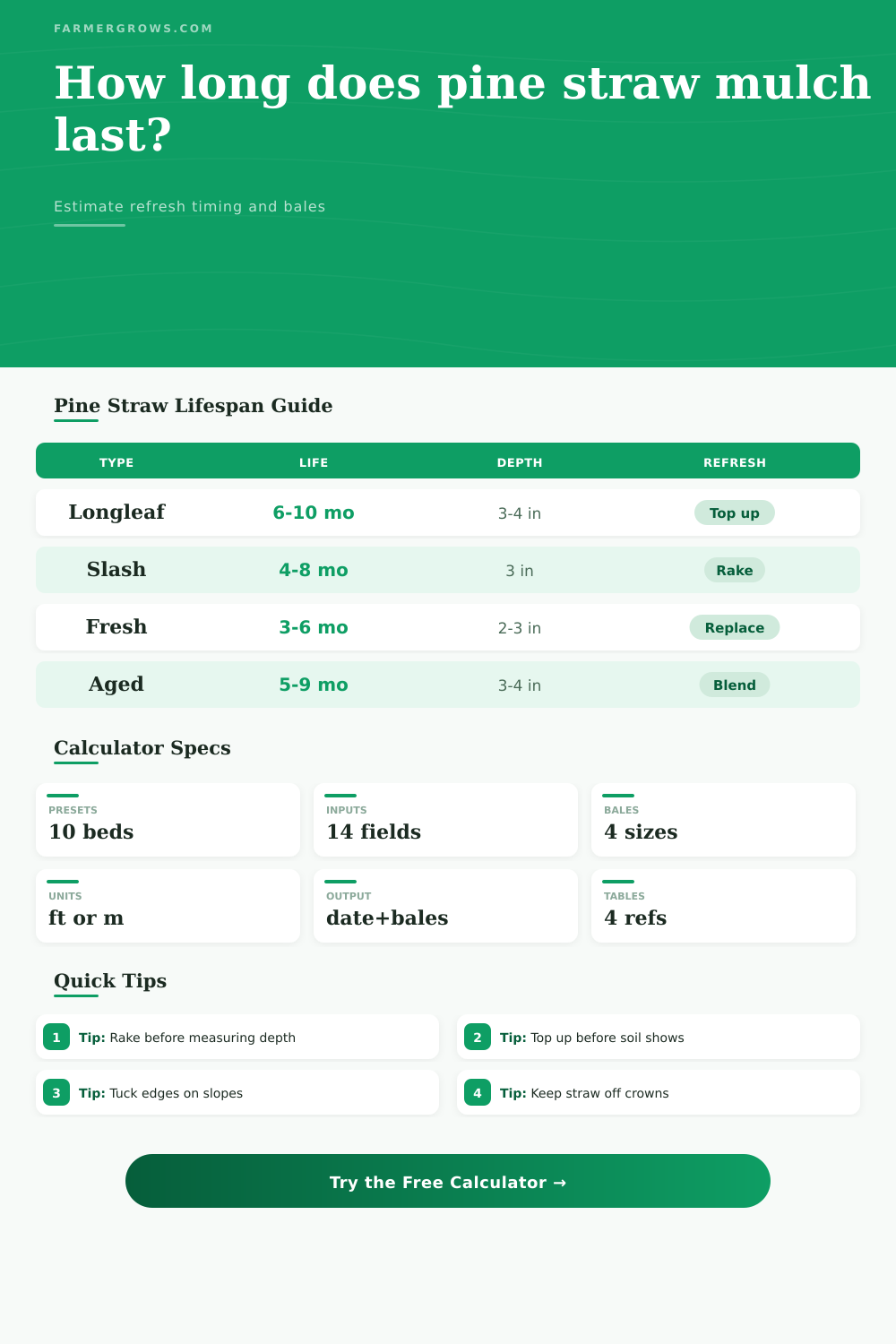
The longest-lasting type is longleaf pine, as its needles is long and tough and interlock well, creating a structure that can absorbs up to 10 months before needing replacement. Soft, shorter slash pine will mat down and break down fasterer, too, typically around the eight-month mark when it need to be refreshed. Fresh, green-tipped straw will settle down within the first month or so; this is expected and doesn’t indicate the straw was faulty, it’s simply lost its air pockets.
Most of us do not know how much light and water affect it. A bed in full sun, perhaps backed by a reflective wall, will fade in color faster then it will stop weeds. Its physical layer may last even longer. The needles will turn brown and brittle from baking heat, but the layer itself stay physically intact until next big storm or cleanup day.
Frequent watering, or heavy rains, and sloped beds without well-secured edges can wash away straw. That’s where the tool asks about whether the bed is on a steep slope and/or exposed to the wind. A flat, sheltered bed holds its straw in place; a steep one with loose edges will let that straw gets washed away in runoff. Even though you have a full layer of paper, if it blows off each time you hit it with leaf blower, how long it lasts drops dramatically.
How to know: Are you doing regular maintenance, or do you really need to top up or replace? A little fluffing by raking across the surface will revive matted layer. This keeps it looking like it was just applied. It also prevents the material from getting too packed down and forming airless pockets where weeds can root. Leave the whole layer matted solid and eventually the top layer rot, but the bottom layer remains dry and ineffective.
One other little step that pays big dividends if you have any slope: tuck the edges of mulch. That’s how most homeowners see the straw go wandering. Into their lawns. This table of coverages rates will help you buy only as much as you need to touch up the bed, rather then replace the entire bed unneccesarily.
Don’t heap the straw right up against the crowns of shrubs or the trunk of trees. Invite rot and invite pests; keep several inch of bare soil surrounding the trunks of all plants. Besides, it’s neater that way.
Using the calculator, you can calculate when to top up based off your starting depth and current condition. If you’re at two-months-to-go, according to the calculator, look around your edges and maybe you could of stretched it out to three or four months by raking the center first.
RELATED: How do I know when my mulch layer is thin enough?
Pine straw is forgiving, but this mulch also demands respect because of its physical shape. No, it’s no magic mulch that dissapears into the ground without a trace. Nope; it’s a physical barrier, settling here and shifting there, finally breaking down. Keeping an eye on it; and adapting your maintenance regimen accordingly. Saves money, and makes your garden look polished.
Yes, that first golden glow might fade. But if you help it along the way, protection lasts longer than it looks like it will.