Pine Straw Calculator
Estimate pine straw bales for beds, tree rings, slopes, and refresh jobs with bale type, coverage, depth, slope surface area, compression, overage, weight, and loose volume.
Load a common landscape job, then adjust the area shape, bale style, coverage rating, finished depth, old straw layer, slope, compression, and overage.
Pine Straw Estimate
Your bale order and coverage summary will appear here.
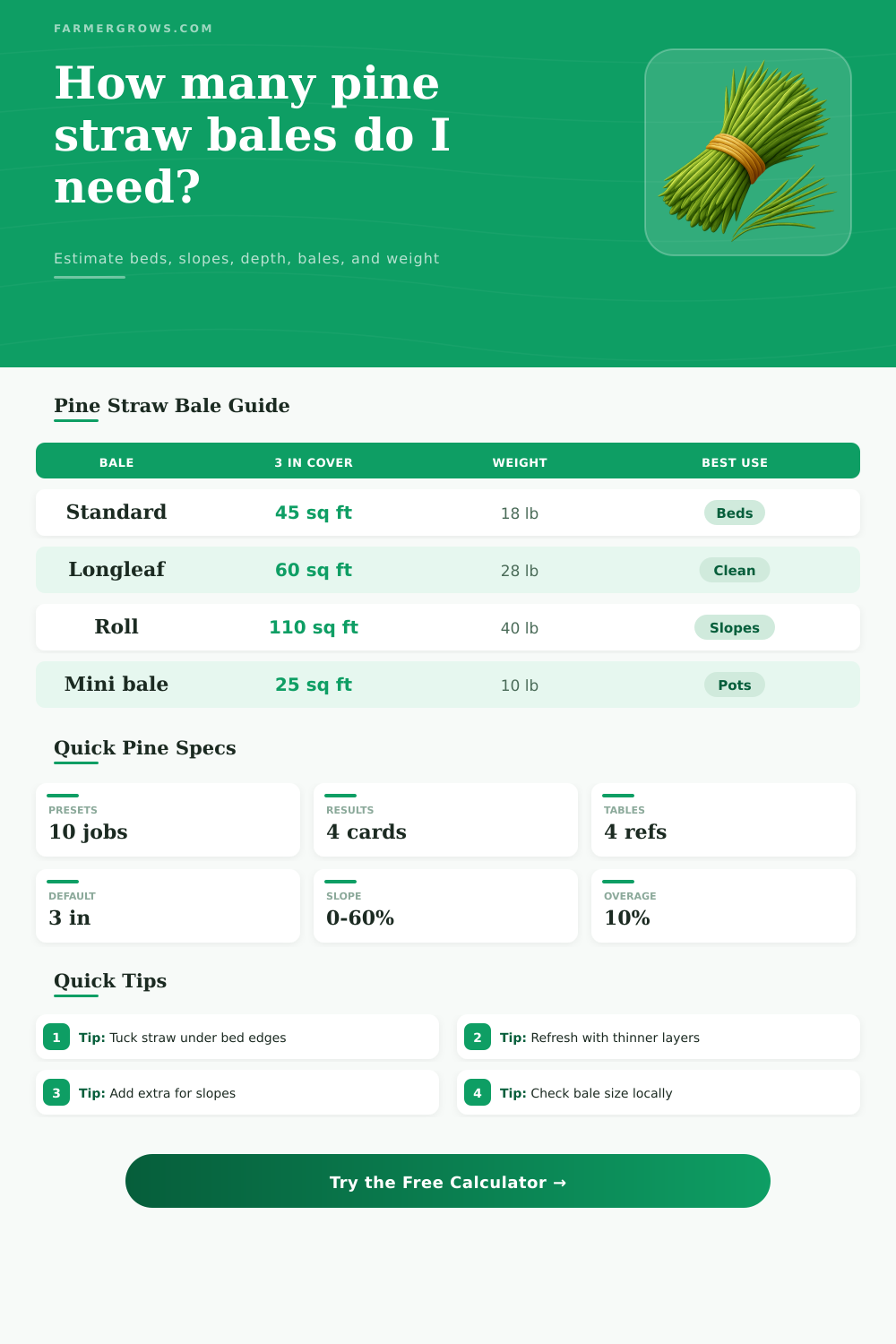
Common for routine bed installs and refresh work. Coverage is useful when bales are similar size from the same supplier.
Longer needles tend to knit together, resist washing, and make a neater finish around shrubs and foundation beds.
Rolls are handy for larger banks and open beds because each unit covers more square footage with fewer pieces to handle.
Best for patio beds, planters, and spot repairs where a full bale would leave too much leftover straw.
| Finished depth | Standard bale | Longleaf bale | Pine straw roll |
|---|---|---|---|
| 1.5 in light refresh | 90 sq ft per bale | 120 sq ft per bale | 220 sq ft per roll |
| 2 in refresh layer | 68 sq ft per bale | 90 sq ft per bale | 165 sq ft per roll |
| 3 in standard install | 45 sq ft per bale | 60 sq ft per bale | 110 sq ft per roll |
| 4 in heavy slope cover | 34 sq ft per bale | 45 sq ft per bale | 83 sq ft per roll |
| Project type | Common depth | Use when | Planning note |
|---|---|---|---|
| Light refresh | 1 to 1.5 in | Old straw still covers the bed | Fluff old straw before measuring gaps |
| Normal refresh | 2 in | Color is faded but bed is stable | Use lower overage on clean edges |
| New install | 3 in | Bare soil or thin old cover | Good default around shrubs and beds |
| Slope or erosion edge | 3.5 to 4 in | Needles must knit on a bank | Add slope and overage buffers |
| Average slope | Surface factor | Extra area | Field cue |
|---|---|---|---|
| 0% | 1.000 | 0% | Flat bed or level island |
| 15% | 1.011 | 1.1% | Gentle bank beside walk |
| 30% | 1.044 | 4.4% | Noticeable landscape slope |
| 60% | 1.166 | 16.6% | Steep bank needing extra tuck |
| Project | Area | 3 in standard bales | 3 in longleaf bales |
|---|---|---|---|
| Foundation strip 24 x 6 ft | 144 sq ft | 4 bales with buffer | 3 bales with buffer |
| Round island 14 ft diameter | 154 sq ft | 4 bales with buffer | 3 bales with buffer |
| Back border 60 x 5 ft | 300 sq ft | 8 bales with buffer | 6 bales with buffer |
| Large install 50 x 40 ft | 2000 sq ft | 54 bales with buffer | 38 bales with buffer |
Subtract patios, stepping stones, thick shrub masses, and places where straw will be tucked thin under plant canopies.
Fluff the existing layer first, estimate the depth that remains, then order only the added layer plus a practical edge buffer.
Calculating the correct amount of pine straw to order is an important process for a person who wish to properly cover they garden bed with pine straw. If a person select an incorrect amount of pine straw to order, the person may experience either a shortage of pine straw to adequately cover there garden beds, or they may experience a surplus of pine straw that will sit in their driveway and take up valuable spaces. In order to avoid these problems, a person should utilize a calculator that accounts for the shape of their garden bed, the slope of the ground in which the garden bed will be established, the depth of the pine straw, and how much the pine straw may settle once it is add to the garden bed.
The shape of the garden bed is one of the factor that must be considered in the calculation of how much pine straw will be needed for coverage of that bed. Garden beds can have a variety of shapes, including rectangular shapes, circular shapes (around trees), and triangular shapes (within garden bed corners). These dimensions can be account for in the calculator to determine the total surface area of the garden bed.
How to Figure Out How Much Pine Straw to Order
An edge deduction feature can also be used in the calculator to account for the area in which the pine straw will not be visible (under shrubs or stone). The slope of the ground is another factor to consider in the calculation. Ground slopes increase the area of the ground that must be covered in pine straw.
A person can use a flat area to establish their garden bed, but the slope will increase the area that must be covered. A person can utilize a factor in the calculator to account for this slope so that the amount of pine straw required will account for this slope. If the slope is not accounted for, the pine straw may appear thin on slopes due to the needles of the pine straw may slide down that slope during periods of rain.
The depth of the pine straw is another factor to consider in the calculation. A person can choose a depth of one or two inch to cover the ground if they are simply replacing the pine straw that may have decomposed over time. For those who are establishing a new bed, they may choose three inches of pine straw so that the needles of the pine straw will knit with the other.
For those who wish to suppress weeds, or those who are establishing a bed on a bank of the ground, four inches of pine straw may be select. This depth can be entered into the calculator so that the amount of pine straw to be ordered is adjusted according. The type of pine straw bale that is ordered is another factor to consider.
Standard bales of pine straw is available, but bales with longleaf pine straw contain pine straw needles that interlock with each other better than other types of pine straw needles. Additionally, longleaf pine straw needles are less likely to wash away from slopes. Rolls of pine straw cover more ground than bales of pine straw, and mini-bales are less wide so that they are useful in covering small jobs.
The calculator can account for these factors so that the person accurately calculates the total amount of bales of pine straw that is needed. Finally, it is important to consider the settling of the pine straw and any overage of pine straw that may be required. Pine straw bales contain compressed pine straw, and the pine straw will settle to become thinner pine straw after the pine straw is fluff.
A person can also add an overage percentage to account for any inaccuracies in the coverage of the pine straw (especially if the bag split), as well as to account for the irregular edges of the garden bed. The calculator can also account for these percentages to determine the total amount of pine straw that the person should order. The weight of the pine straw is another factor to consider.
The weight of pine straw is light when the pine straw is dry, but will be heavier if the pine straw contains water from rain or dew. The weight of the pine straw will not impact the area of the garden bed that the pine straw will cover, but will impact the total weight of the pine straw that will be deliver to the garden bed. A person can use a reference table to determine the total amount of pine straw that is required based off the depth, slope, and surface area of the garden bed.
Both the pine straw calculator and the reference tables will help a person to order the correct amount of pine straw for their garden bed.