Pickle Brine Calculator
Size jar brine for cucumber spears, chips, onions, peppers, beans, okra, carrots, mixed vegetables, and fermentation cover brines.
Formula Breakdown
Classic Vinegar Dill
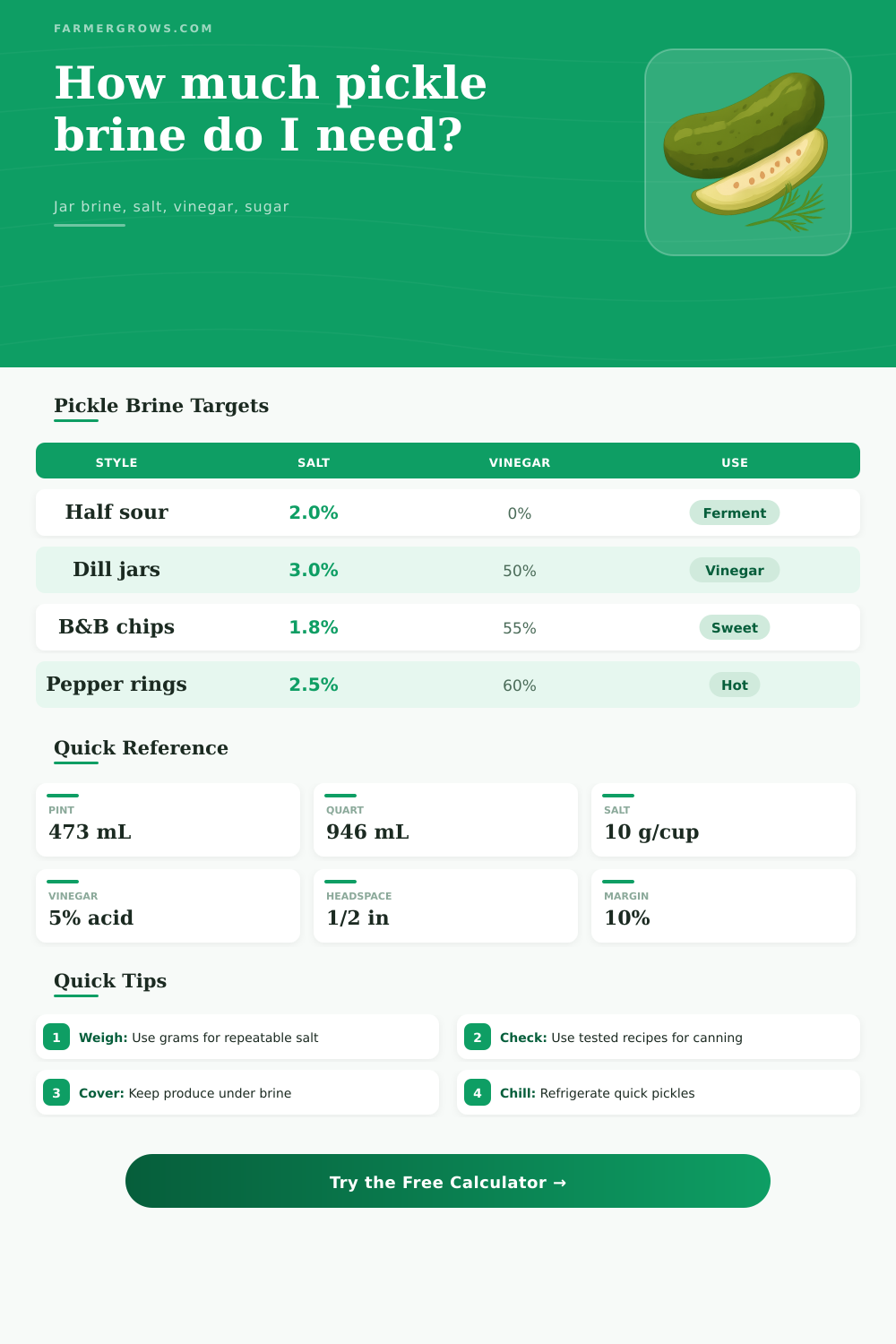
About 3% salt, 50% of liquid as 5% vinegar, little or no sugar, and a firm jar pack.
Half-Sour Ferment
About 2% to 2.5% salt with no vinegar at the start; cover produce fully under brine.
Bread & Butter
Lower salt, 50% to 60% vinegar share, and a higher sugar target for sweet cucumber chips.
Hot Pepper Rings
Higher vinegar share helps balance hollow pepper pieces that trap more liquid between rings.
| Pickle style | Typical salt strength | Vinegar share | Sugar target | Best use |
|---|---|---|---|---|
| Half-sour cucumbers | 2.0% to 2.5% | 0% at start | 0 g/L | Fermented crock or jar |
| Full-sour fermented dill | 3.0% to 3.5% | 0% at start | 0 g/L | Longer cucumber ferment |
| Vinegar dill jars | 2.5% to 3.5% | 50% with 5% vinegar | 0 to 20 g/L | Cucumber spears, beans, okra |
| Bread and butter chips | 1.5% to 2.2% | 50% to 60% | 120 to 220 g/L | Sweet cucumber chips |
| Pepper rings | 2.0% to 3.0% | 55% to 70% | 0 to 40 g/L | Jalapeño, banana, cherry peppers |
| Quick onions | 1.5% to 2.5% | 45% to 60% | 20 to 60 g/L | Refrigerated sliced onions |
| Jar or vessel | Full volume | Tight pack brine | Standard pack brine | Loose pack brine |
|---|---|---|---|---|
| Half-pint jar | 236 mL / 1 cup | 83 mL | 98 mL | 115 mL |
| Pint jar | 473 mL / 2 cups | 166 mL | 196 mL | 230 mL |
| 24 fl oz jar | 710 mL / 3 cups | 249 mL | 294 mL | 345 mL |
| Quart jar | 946 mL / 4 cups | 332 mL | 392 mL | 460 mL |
| Half-gallon jar | 1.89 L / 8 cups | 664 mL | 784 mL | 920 mL |
| Ingredient measure | Metric equivalent | US equivalent | Calculator use | Accuracy note |
|---|---|---|---|---|
| 1 US cup liquid | 236.6 mL | 8 fl oz | Brine volume | Use liquid cups |
| 1 US quart liquid | 946 mL | 4 cups | Large brine batches | Same as quart jar volume |
| Pickling salt | 18 g/Tbsp | 54 g per 3 Tbsp | Salt spoon estimate | Weigh for best repeatability |
| Morton kosher salt | 15 g/Tbsp | 45 g per 3 Tbsp | Alternate salt estimate | Flakes are less dense |
| Diamond Crystal kosher | 9 g/Tbsp | 27 g per 3 Tbsp | Alternate salt estimate | Very light flakes |
| Granulated sugar | 12.5 g/Tbsp | 200 g per cup | Sweet pickle estimate | Dissolve fully before filling |
| Vinegar type | Common label acidity | Flavor profile | Typical pickle use | Calculator setting |
|---|---|---|---|---|
| Distilled white vinegar | 5% | Clean and sharp | Dills, peppers, beans | 5.0 acidity |
| Apple cider vinegar | 5% | Fruity and round | Onions, carrots, sweet chips | 5.0 acidity |
| White wine vinegar | 6% | Bright and wine-like | Delicate vegetables | 6.0 acidity |
| Rice vinegar | 4% to 4.5% | Mild and soft | Refrigerator pickles | Read label first |
| Homemade vinegar | Varies | Unpredictable | Flavoring only unless tested | Use measured acidity |
| Common project | Jar plan | Estimated brine | Salt at 3% | Vinegar at 50% |
|---|---|---|---|---|
| Dill cucumber spears | 4 quart jars, tight | 1.46 L | 44 g | 730 mL |
| Bread and butter chips | 6 pint jars, loose | 1.52 L | 46 g | 760 mL |
| Pickled pepper rings | 8 half-pints, loose | 1.01 L | 30 g | 505 mL |
| Dilly green beans | 7 pint jars, tight | 1.28 L | 38 g | 640 mL |
| Half-sour crock | 1 half-gallon, tight | 0.73 L | 22 g | 0 mL |
For shelf-stable canned pickles, use a tested recipe and approved processing time. This tool scales ingredient quantities, jar volume, and brine strength.
A brine calculator are a tool that will help you determine the amount of liquid needed to cover you’re vegetables in a jar. The amount of liquid required by the vegetables in the jar depend on various factors. For instance, the amount of space that the vegetables will leave in the jar will impact the amount of brine that the vegetables will require in order to pickle corectly.
Thus, the brine calculator will allow you to ensure that you have enough brine to cover all of the jar that you need to fill. To use a brine calculator, you must first select the size of the jar in which the vegetables will be sit. The size of the jar will impact the amount of brine that are required to cover the vegetables in each jar.
How to Use a Brine Calculator for Pickles
For instance, a small jar will hold less brine then a large jar. You will also need to select the way in which the vegetables will be cut. For instance, cucumber spear will take up more space in a jar than carrot sticks will.
Additionally, you will need to select an pack density for the vegetables. Vegetables that are packed more dense will leave less space for brine than vegetables that are packed loose. The brine calculator will also allow you to adjust the salt strength that will be use in the brine and the share of vinegar that will be use.
The salt strength will determine the flavor and safety of the pickles. For instance, pickles may require either a two percent salt solution or a three and a half percent salt solution. Additionally, the share of vinegar will determine the amount of liquid that is contributed by vinegar as opposed to water.
Thus, changing the share of vinegar will change the acidity of the brine, and changing the salt strength will change the saltiness of the brine. You can use the brine calculator according to the weight of the produce that will be pickled. For instance, if you know the weight of the vegetables that will be used for pickling, the brine calculator can determine the amount of brine that will be required according to the weight of the vegetables.
Thus, the weight of the vegetables allow for the estimation of the amount of brine that will be needed, and also allows for the setting of a target salt amount. Many people uses the volume of the jar to calculate the amount of brine that will be needed. However, many also use the weight of the produce to calculate the amount of brine.
Using both calculations will allow you to compare the amount of brine that are calculated in each way to determine which is the more accurate calculation for the vegetables that will be pickled. A brine calculator will account for the margin of the brine and the headspace of the brine. For instance, the jar will lose some of the brine when you pour it into the jar, or when the vegetables absorb some of the brine.
Thus, you must account for the loss of brine. Furthermore, headspace must be allowed for the vegetables. The headspace allow for the liquid to expand, and prevents the lid from touching the vegetables.
A small amount of brine must be accounted for in these variable to ensure that there is enough brine to last to the last jar. Not all vegetables will require the same amount of brine as other vegetables. Different vegetables will have different shape and densities.
For instance, pepper rings will trap some of the brine within the pepper rings, meaning that pepper rings will require more brine than the jar volume would suggest. Green beans will pack more dense than cucumber chips, meaning that green beans will leave less room for brine. Carrots will contain less water than cabbage, meaning that cabbage will require more brine to absorb than carrots.
It is also important to use the weight of the salt rather than the volume of the salt. For instance, some salts are more dense then others. A tablespoon of sodium chloride will weigh more then a tablespoon of potassium chloride.
Using weight measurement will ensure that you add the correct amount of salt to each jar. Thus, using weight guarantee that you add the correct amount of salt, rather than risking adding too much or too little salt if you use volume measurement. Brine calculators account for this by asking for the salt amount in grams, rather than in tablespoon.
Finally, one of the major use of a brine calculator is that it will help plan the entire batch of pickles that will be make. By planning the entire batch of pickles that will be make, you will know how much vinegar and how much salt are required for all of the pickle. Planning the batch allow you to ensure that the acidity level of the pickles is correct before you begin the pickling process.
Any change to the acidity level of the pickles can be made prior to packing the vegetables with brine. Thus, the brine calculator allow for the planning of the batch, and help to avoid any mistake when making pickles. You should of used a calculator to make sure you dont mess up teh batch.
It isnt hard to use and it make things way easier than guessing. One of the biggest mistakes is when people uses too much salt.