
The apple tree cannot produce fruit on its own. Its own pollen can’t fertilize its flowers. If you plant a Honeycrisp, you’ll get blooms year after year but no apples for many years. This is because a different variety must be nearby to pollinate yours with matching pollen. The difference is between beautiful decorative plant and one that produces a crop.
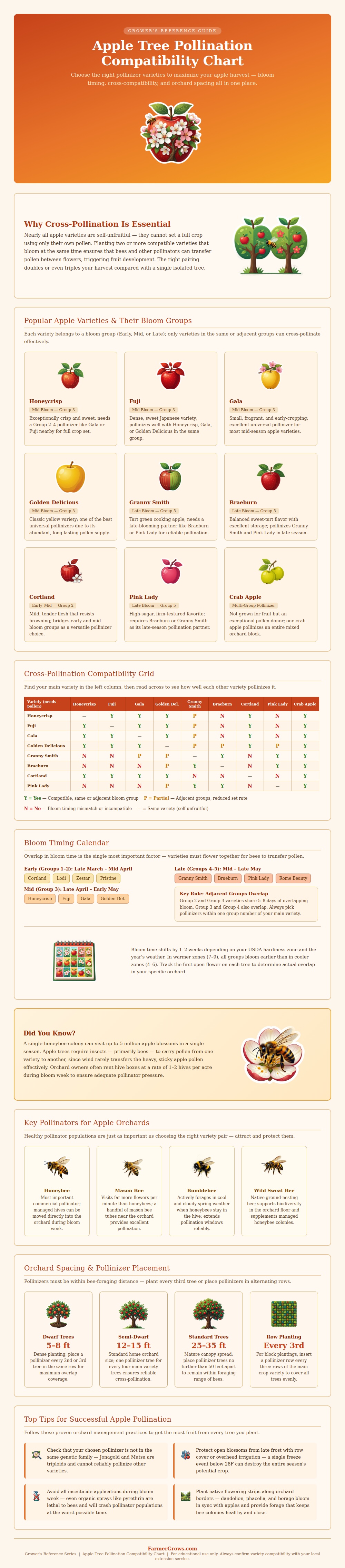
To see who pollinates whom, refer to chart of compatible varieties (genetics and timing are both involved). For example, a Honeycrisp blooms in mid-spring, and its partner bloom at the same time. This is not the case for a Granny Smith (late bloomer) and a Cortland (early bloomer) because their bloom periods don’t align. The bees visit one tree but then it’s already too soon/late for the other.
How to Make Apple Trees Grow Fruit
Pick two trees from the same adjacent bloom group before they go into the ground. Many of us has an apple in our home orchard that makes a good pollinizer: Golden Delicious. Why? Because it’s a heavy producer of pollen, which bees transport well and it flowers consistantly. As graphic illustrates, it will work well with both early and late bloomers (such as Fuji and Gala, respectively). If you plant a Golden Delicious, all bets are off: This tree will serve as your one-stop shop. No complicated cross-breeding information to remember; just make sure there’s a Goldie around.
But half the tale involve the other half of the equation: the plants themselves, plus the bees to pollinate them. Wind doesn’t do a good job with heavy-sticky apple pollen. What you want is insect life present at the time your flowers bloom. The obvious answer is honeybees, but native bumblebees and mason bees is often more efficient. They’re out on those cool overcast days when the honeybee wants to be in its hive. That persistence can mean fruit set despite an otherwise cool, wet spring.
Spacing also determine how successful you are at pollinating things. Because bees don’t like a lot of flying around, they love it when flowers is bunched up real close together (they won’t bother flying long distances between flower if they can help it). With the standard trees spaced 30 feet apart, they might just sit there and stare at them while closer and easier targets gets their business. With dwarf and semi-dwarf rootstocks, you can plant things tighter, close enough that pollinators stays near the trees. The closer you plant, the more likely each tree are to set fruit.
Some novices makes common blunders, such as spraying with insecticides in middle of bloom week. That’s a no-no because it kills bees required for pollination. Triploid varieties (such as Jonagold) is another trap; these trees bear only sterile pollen that can’t be used to fertilize other apples. Without some variety for cross-pollinating, you would of forgot harvest time. Know what you’re buying, and read the label.
The orchard is a community (not just a series of single plants). Make your plantings mutually beneficial: select varieties that will flower at the same time, and make sure they’re located near each other so bees can hop a branch or two and get from one to another. Keep the colonies healthy by planting wildflower strips along the edges of property. Shield them from chemical and frost during the most vulnerable periods. Get the branches loaded with fruit when things go right; it’s all worth it.