
What wakes up to go to work one day only to discover your seedlings is down to their stems? That’s frustrating. You’ve waited; you’ve watered; you’ve weeded, and by morning the leaves has dissapears.
Most times it’s not an obvious culprit or something you can see, but something small and hidden in foliage or even the soil. Pattern recognition… Not general pest control… Is how to identify caterpillars that will wreak havoc among your crops. From quick-disappearing hornworms to fuzzy woolly bears, a chart can teach you what to look for. And knowing means no unnecessary sprays in garden at large.
How to Identify Garden Caterpillars
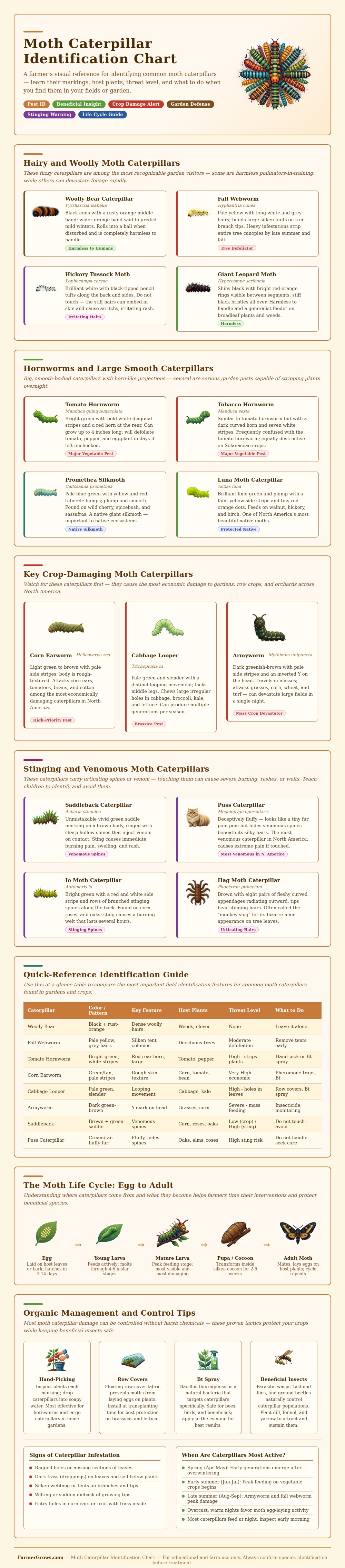
The hairy caterpillar: Many gardeners think all these hairy things is harmful. That’s a common mistake. The woolly bear caterpillar (black ends, rusty orange in the middle) is harmless to touch, will even form a tight little ball if you disturb it, and are good for the environment. So leave it be.
The same is true for the giant leopard moth caterpillar (shiny black body; red rings; feeds primarily on weeds). Again: harmless; leaves of most trees and shrubs is noxious to it. You don’t want to mess with its stiff hairs. They itch.
To learn where the markings differ (and not get upset), check out an identification guide. Knowing each one’s unique features will help you distinguish between the irritating ones and the harmless ones.
How big do they get? How fast can it harms the crops? They are big and speedy. The garden-harmful hornworms is large creatures, typically smooth and they have a horn-like protrusion at the end of their bodies. One is the tobacco hornworm (whose horn is black), and the other is the tomato hornworm (with a red horn).
They’re always bright green, and blend right into the foliage with those diagonal white stripes. Because they chew nonstop, they can quickly turn your pepper or tomato plants limp. If you spot even one, you’ll know you’ve lost some foliage already. The best defense is to pick them off by hand as soon as you see them. Yes, it’s tedious, but it also preserves the rest of the crop.
Note that their backs may have little white dots on them. Those are the egg cases of parasitic wasps. If you notice any eggs like these, don’t pick the worm off. Nature is trying to keep things under control here.
Others, such as fall webworms, are social, meaning they group up to wreak havoc fast. Then there are those like armyworms and fall webworms: Not only do they consume foliage leaf by leaf but also they forms tent-like silken shelters or march en masse across acres of turf. That’s how the armyworm got its name… Because it eats lawns (and other grasses) quickly.
The rest of the plant goes next if you don’t pay attention immediately, since they will keep going until they’ve eaten everything in sight. Moth control with row covers before egg-laying begins is a first strike against these pests. Physical barriers like row covers let light and moisture in, while keeping pests out. This proactive thinking eliminate the need for more action later.
Identification can also be about safety: Not all caterpillars should be touched. Some are quite toxic. Venomous spines on a saddleback caterpillar (above), for instance, deliver their pain when they come into contact with your skin. And beneath that furry exterior, the puss caterpillar is one of North America’s most venomous caterpillars. It conceals its own stinging spines (think little fur ball).
Respect and distance are required with these guys. That doesn’t mean killing; just don’t touch. Knowing what to look for will save some painful experiences, especially if you have kids.
Knowing the life cycle puts things in perspective. Here’s how: Eggs are laid by moths on their host plant; they then hatch into very small larvae (caterpillars), who sheds their skins multiple times before cocooning up and becoming pupae. That explains why inspecting at the right moment is important.
An early-morning check is prime time for finding caterpillars that tuck themselves away from the day’s heat. Specifically targeted to them, Bt spray (an organic option) works. Birds and bees are fine. When hands-on removal is not enough, this is a targeted weapon.
Using both timing, plus good visual ID, really helps protect the garden. Instead of just responding to injury, you can prevent it. The next creature whose presence you notice will be identified, and you’ll know if it’s welcome or not.