Pepper Seed Germination Time Calculator
Estimate pepper seed emergence timing, likely sprout percentage, transplant readiness, and seed-starting risk from root-zone warmth, seed age, moisture, depth, dome use, and light timing.
Use this for pepper seed trays, plug flats, and home nursery starts. The estimate assumes viable seed in a sterile seed-starting mix; very salty water, untreated garden soil, or uneven heat can shift the results.
Pepper Germination Estimate
Results combine variety group, effective root-zone temperature, seed age, sowing depth, moisture, dome use, light timing, and elapsed days since sowing.
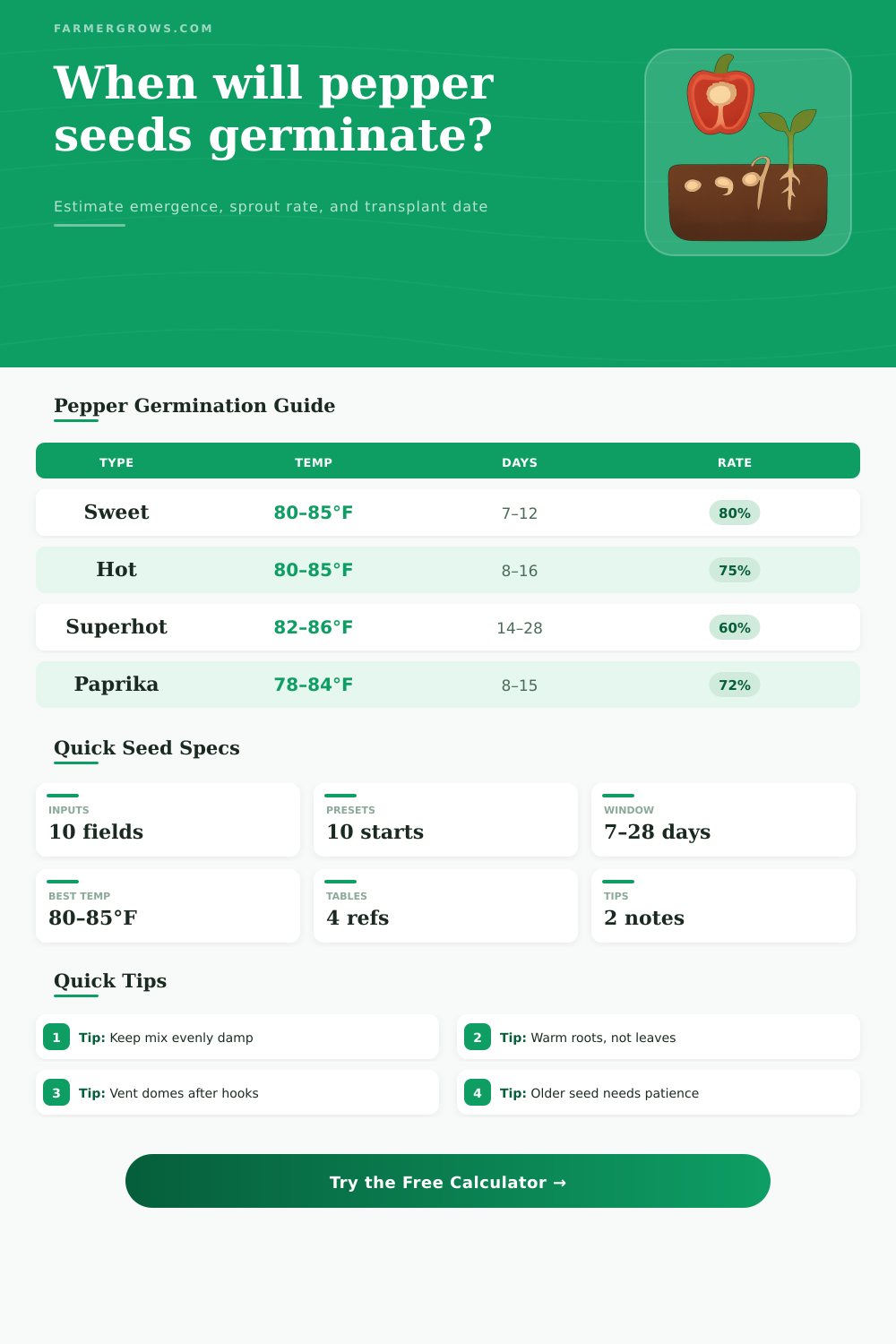
| Pepper type | Typical group | Warm germination window | Base emergence | Transplant note |
|---|---|---|---|---|
| Sweet annuum | Frying, banana, lunchbox, pimento | 7 to 14 days at 80 to 85°F | About 85% | Often ready 6 to 7 weeks after emergence |
| Hot annuum | Cayenne, serrano, Thai, ornamental | 8 to 16 days at 80 to 85°F | About 78% | Steady heat improves uniformity in flats |
| Paprika | Spice and drying peppers | 8 to 15 days at 78 to 84°F | About 76% | Good for block sowing if seed age is known |
| Baccatum | Aji, lemon drop, bishop crown | 10 to 20 days at 80 to 85°F | About 70% | Allow a longer indoor nursery period |
| Superhot chinense | Habanero, ghost, scorpion, reaper | 14 to 28 days at 82 to 86°F | About 62% | Start earlier and avoid cool windowsills |
| Root-zone temperature | Effect on timing | Emergence factor | Risk pattern |
|---|---|---|---|
| Below 60°F | Often stalled or very slow | Very low | Seed decay, sour mix, long wait |
| 60 to 69°F | Slow and uneven | Low to moderate | More failed cells and delayed hooks |
| 70 to 74°F | Acceptable but not ideal | Moderate | Longer window, especially for superhots |
| 75 to 79°F | Good nursery range | High | Usually reliable with fresh seed |
| 80 to 85°F | Best pepper range | Highest | Fastest uniform emergence |
| 86 to 90°F | Fast but watch moisture | Moderate to high | Dry edges and sealed-dome heat stress |
| Above 90°F | Too hot for many trays | Reduced | Embryo stress and rapid drying |
| Seed age | Stored dry and cool | Expected viability | Calculator adjustment |
|---|---|---|---|
| Fresh seed | Current season or recently purchased | 85% to 95% | No delay |
| 1 year old | Good label and dry packet | 80% to 90% | Small reduction |
| 2 years old | Still useful if stored well | 65% to 80% | Add about 1 day |
| 3 years old | Test before large trays | 45% to 65% | Add about 2 days |
| 4 years old | Patchy without a pre-test | 25% to 45% | Add about 4 days |
| 5+ years or unknown | Best treated as a rescue lot | 10% to 30% | Add about 6 days |
| Seed-starting condition | Preferred setting | Why it matters | Warning sign |
|---|---|---|---|
| Planting depth | About 1/4 inch cover | Keeps seed damp but lets hooks lift | Deep cells emerge late or not at all |
| Media moisture | Evenly moist, airy, never soupy | Seeds need water and oxygen together | Glossy wet mix or crusted dry top |
| Humidity dome | Vented until first hooks, then off | Reduces drying without trapping too much heat | Condensation dripping into cells |
| Light timing | Bright light ready by first emergence | Prevents stretch after germination | Long pale stems before lights are on |
| Plug tray size | 50 to 72 cells for early peppers | Balances root room and heat uniformity | Dry edges and wet center cells |
Temperature tip: If room air is cool, measure the mix itself. A heat mat without a thermostat can make edge cells too hot while the center stays wet.
Tray timing tip: Remove or vent the dome once the first hooks appear, then move the tray close to bright light so early seedlings do not stretch while slow cells finish.
It’s day three of sitting there watching a tray of what seems to be identical-looking soil. You’ve done everything right: followed the directions on the packet; made it slightly damp; planted at the recommended depth; set it in a warm room. Nothing is happening, it’s torture. A few more days and maybe you figure the seed is dead or rotten.
Relax: once you understand biology and thermodynamics instead of relying on blind faith, you can get those peppers to sprout. The thing is, there’s a number-cruncher up top that takes care of all the math for you if you’ll just plug in seed age and your soil temperature. There’s no guessing about what goes where and how to convert or which coefficient to apply. To get it right, you has to know why each of those numbers matters.
How to Grow Pepper Seeds
For example: Temperature is the dominant factor because seeds are originally from tropical regions. They don’t understand what a temperate zone is (or a room thermostat). Because they are confused, their metabolism slows down and they won’t respond to your thermostat. They only respond to what that soil-probe tell them. Is the soil seventy degrees? A slow metabolism is asked to jump into action. You need it near eighty-two for reliable speed. And many people gauge the air temp, assuming that heat will magically move itself to the root zone. But it doesn’t work like that.
But there’s another silent but deadly player: seed age. Vigorous fresh seed has reserves in its cells to overcome some challenges. Older seed from an envelope do not. My calculator factors in age by reducing both sprouting percentage and emergence window. It says older seed requires more heat and longer to equal the performance of fresh. Treating seed as if it doesn’t matter how old it is is like attempting to drive your old car on a chilly day without warming up first. You may luck out, but usually friction will win.
Biological work depends off physical environment: depth and moisture. If you plant too deeply, energy goes into fighting its way up to light instead of down. Too shallow, and it dries out before rooting in.” (A quarter-inch seems like a reasonable rule-of-thumb depth; most guides say so.) “How does water flow through your mix? The texture of your mix changes how water moves through it; heavy soils holds water against the seed but can suffocate it if not aerated well. Light mixes dry fast. This tool takes all that into account and gives a realistic risk score. You’ll be able to see whether you’re setting yourself up for drying out, or mold growth, before you ever get anything green.
Another trick for novice gardeners: They wait to turn on the grow lights until the seeds sprout, which is usually too soon. If a seedling emerges in darkness, it stretches immediately for its first bits of light. Delaying the start of lights not only slows down emergence (not good), but also reduces early vigor and affects transplant readiness, factors that matter to the calculator. It is better to have the lights up and running by the time germination ends rather than when it begins. This produces shorter, stronger stems. These stems make transition to hardening off easier later.
If you sow too soon, you transplant those peppers before the garden’s soil is warm enough, and they sit stalled until it catches up. When you sow too late: Their root systems gets crowded in narrow cells, getting twisted around so much they won’t separate easily when it comes time to transplant. The calculator fills that timing gap, calculating a date when it predicts they’ll be ready (assuming you have some idea about the conditions under which you’re doing the sowing). That will match the plant’s internal biological clock with what the calendar tells it must do given your locality’s frost dates.
Generally speaking, superhot types like the chinense peppers (notoriously slow) require more indoor time than sweet ones; sweet peppers can race along once they get moving, while superhots cannot. A ghost pepper isn’t going to germinate as fast as a jalapeno; no matter how hard you try to hurry it. They each has their genetic pace, set by their heat response and other factors.
The last ingredient is patience, and no tool can help there. Peppers are slow. Even if you have fresh seed and the right temperature. If it wasn’t clear before, use reference tables on the page. Compare varieties, and then get real about expectations rather than hard-and-fast deadlines. A garden’s a negotiation with nature, where we manage the inputs (such as moisture and heat), and the plant manages everything else. Trust the data; watch the soil. Watch for the first few little hooks poking up through surface; that is the moment when all that waiting feels worthwhile again.