Peony Bulb Planting Depth Calculator
Estimate peony eye depth, planting hole depth, initial backfill height, soil-settling allowance, spacing capacity, crown risk, and container clearance for bare-root herbaceous, Itoh, and tree peonies.
Peonies are usually planted as bare-root crowns or grafted tree peonies, not true bulbs. This calculator uses the top eyes or graft union as the reference point because burying herbaceous eyes too deeply is one of the most common causes of leafy plants with few flowers.
📋Peony Depth Presets
⚖Peony Depth Method
Herbaceous and Itoh peony eyes usually sit shallow below the settled soil surface.
Tree peonies are often planted with the graft union deeper so the scion can root.
Fresh backfill settles. The calculator estimates the initial mound needed before watering in.
Peonies are long-lived plants, so capacity uses mature spacing rather than temporary bedding density.
🌺Peony Planting Inputs
Peony planting depth plan
Enter your root and site details, then calculate to see the depth plan.
📊Peony Depth Reference Cards
📘Reference Tables
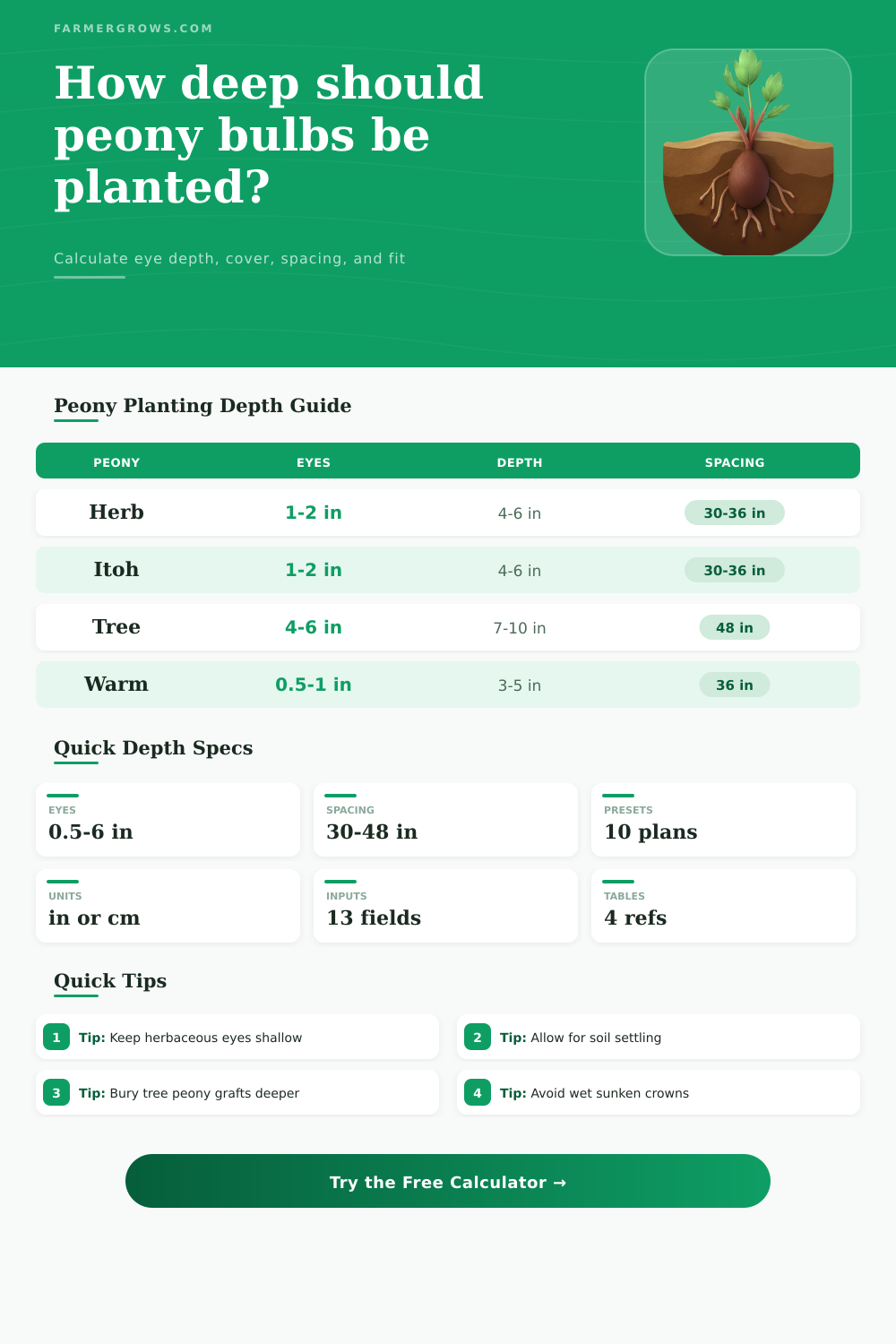
Peony Type Depth Guide
| Peony type | Reference point | Settled depth target | Typical hole depth | Spacing |
|---|---|---|---|---|
| Herbaceous peony | Visible crown eyes | 1 to 2 in below soil in cool zones | 4 to 7 in depending root height | 30 to 36 in on center |
| Itoh peony | Visible crown eyes | 1 to 2 in below finished soil | 4 to 7 in depending root height | 30 to 42 in on center |
| Warm-zone herbaceous | Visible crown eyes | 0.5 to 1 in below soil | 3 to 6 in depending root height | 34 to 40 in on center |
| Grafted tree peony | Graft union on stem | 4 to 6 in below soil | 7 to 11 in depending root size | 42 to 60 in on center |
| Moved mature crown | Highest viable eyes | 1 to 1.5 in below soil | Use crown height plus cover | 36 to 48 in on center |
Soil, Drainage, And Settling Adjustments
| Condition | Depth effect | Settling note | Risk to watch |
|---|---|---|---|
| Balanced loam | Use standard target | 10 to 15 percent settling is common | Low if watered in well |
| Loose raised-bed mix | Plant slightly proud before settling | Can settle more than native soil | Eyes may sink too deep later |
| Heavy clay | Keep eyes toward shallow side | Less settling but more water pressure | Wet crown and slow emergence |
| Sandy soil | Can use modestly deeper cover | Settles quickly after watering | Dry roots and winter heave |
| Wet low spot | Do not plant deeper to compensate | Raise the crown on a berm instead | Root rot and poor bloom |
Spacing And Bed Capacity Examples
| Planting layout | Spacing | Area per plant | Approximate capacity | Best use |
|---|---|---|---|---|
| 4 ft by 12 ft border | 36 in | 9 sq ft | 5 peonies | Home mixed border |
| 3 ft by 20 ft row | 30 in | 6.25 sq ft | 9 peonies | Young herbaceous row |
| 6 ft by 12 ft feature bed | 42 in | 12.25 sq ft | 5 peonies | Itoh or large cultivars |
| 8 ft by 16 ft tree peony bed | 48 in | 16 sq ft | 8 tree peonies | Woody peony planting |
| 100 ft field row | 36 in in row | 3 ft row spacing | 33 per row | Cut flower production |
Depth Troubleshooting Guide
| Symptom | Likely depth issue | Calculator input to check | Adjustment |
|---|---|---|---|
| Leaves but no flowers | Herbaceous eyes too deep | Eye depth and settling percent | Reset crown in fall to shallow target |
| Eyes exposed after winter | Too shallow or frost heave | Zone, mulch, sandy soil | Add light soil and mulch after freeze |
| Crown stays wet | Sunken planting pocket | Drainage and soil type | Raise the planting site, not the mulch depth |
| Tree peony suckers from rootstock | Graft may be too shallow | Peony type and depth target | Plant graft deeper on next reset |
| Weak first spring growth | Root stress or late planting | Root size and backfill volume | Keep even moisture and avoid replanting again |
🌱Planting Tips
Peony depth should be judged from the final soil line after watering, light firming, and winter settling, not from fluffy soil right after digging.
Before backfilling, identify the pink or white eyes so the target cover is measured above them rather than above the thick storage roots.
For grafted tree peonies, deeper planting can help the desired woody top form its own roots and reduce rootstock dominance.
If the calculator flags wet soil, raise or move the planting area. Extra depth or heavy mulch will not fix a soggy crown pocket.
Late spring brings gardeners heartbreak: After tugging aside those peony leaves, all you see are no blooms, just green foliage. The plant look good, yet won’t bloom. Why? You planted too shallow or too deep; here’s how to prevent such a mistake. Most of us think of the soil as a lifeless ingredient of gardening, but that is not true. Whether you have flowers or just leaves depends on how far apart pink eyes sits from the ground.)
The tool figures out mature spacing and settles soils so you don’t have to. It also determines exactly how deep to dig your holes, based off what kind of peony variety it is and its root height. You choose your type of peony, enter its root height, and the system figures out exactly how deep to plant the roots so the eyes end up an inch to two inches below ground surface after soil settles.
How Deep to Plant Peonies
That’s important, fresh backfill is all fluffy, so people miss the settlement factor; when you water it in, then winter freeze-thaw cycles come along, voila: A lot of the soil compress. If you plant based on the level of the loose dirt, the plant’s eyes will be buried too deep by June. The calculator takes this into account, so you get a realistic target different than an optimistic one.
Some peonies is deep-rooted; others are shallow (though they vary widely in depth, depending on type). Because they need their buds right near the soil surface, herbaceous and Itoh peony can’t spends the energy to push their flowers up through the dirt. Grafted tree peonies are different. Here’s where you want them buried deeper, often four to six inches below the surface, and why: They forms their own roots from the woody scion part of the plant. That’s another point where the calculator will help tell apart and meet requirements of each type. That way, you’ll be able to achieve both goals (crown dryness to prevent rot), but also shallower buds that emerge easily.
The soil type makes a big difference here. In heavy clay soil, water clings to the crown for too long, which invites rot and fungal issues. Planting deeper (to protect it from the cold of winter) sounds like a good idea, but can be a risky tradeoff. It is better to plant shallowly and create a small mound of soil around the crown to channel water away. Do not tuck eyes into a watery pit.
If the soil is sandy, things will compact fast and drain off quickly; in that case, you can get away with being a bit more generous with the covering action. The reference tables shows these tradeoffs: how fast the ground drains affects your best guess for the right depth.
Another place common sense goes out the window: How much room do I leave between things? Crowding peonies like an annual that you cram in for a quick fix now won’t work; remember, these are permanent garden citizens who may reach thirty to forty-eight inches across after a dozen years. By then, if crowded, they’ll be choking one another, with weakened stems and no doubt lots of mildewe. To prevent this, the calculator calculates number of plants you can squeeze into the bed, assuming proper final spacing… Typically thirty to forty-eight inches (depending on the variety) from center to center. That way you don’t end up purchasing a set of crowns that exceed what the bed can accommodate.
Peonies requires accurate measurement and some waiting to succeed. This isn’t simply a root in a hole, it’s a permanent home for a plant that could outlive you. Believe the numbers; take into account how well your yard drains, and measure to where they’ll settle in the ground. Get the depth correct, and expect decades of faithful annual bloom as reward. You should of checked the spacing first.