Peony Bulb Bloom Time Calculator
Estimate bloom week, first-year bloom probability, chill-hour fit, eye-depth risk, and establishment time for peony roots and bare-root divisions rather than generic spring bulbs.
Start with a realistic bare-root peony scenario, then adjust the planting date, chill hours, eye depth, root size, and site conditions. These presets are for dormant roots and divisions, not packaged generic bulbs.
Peony Bloom Time Results
Your bare-root peony bloom estimate will appear here.
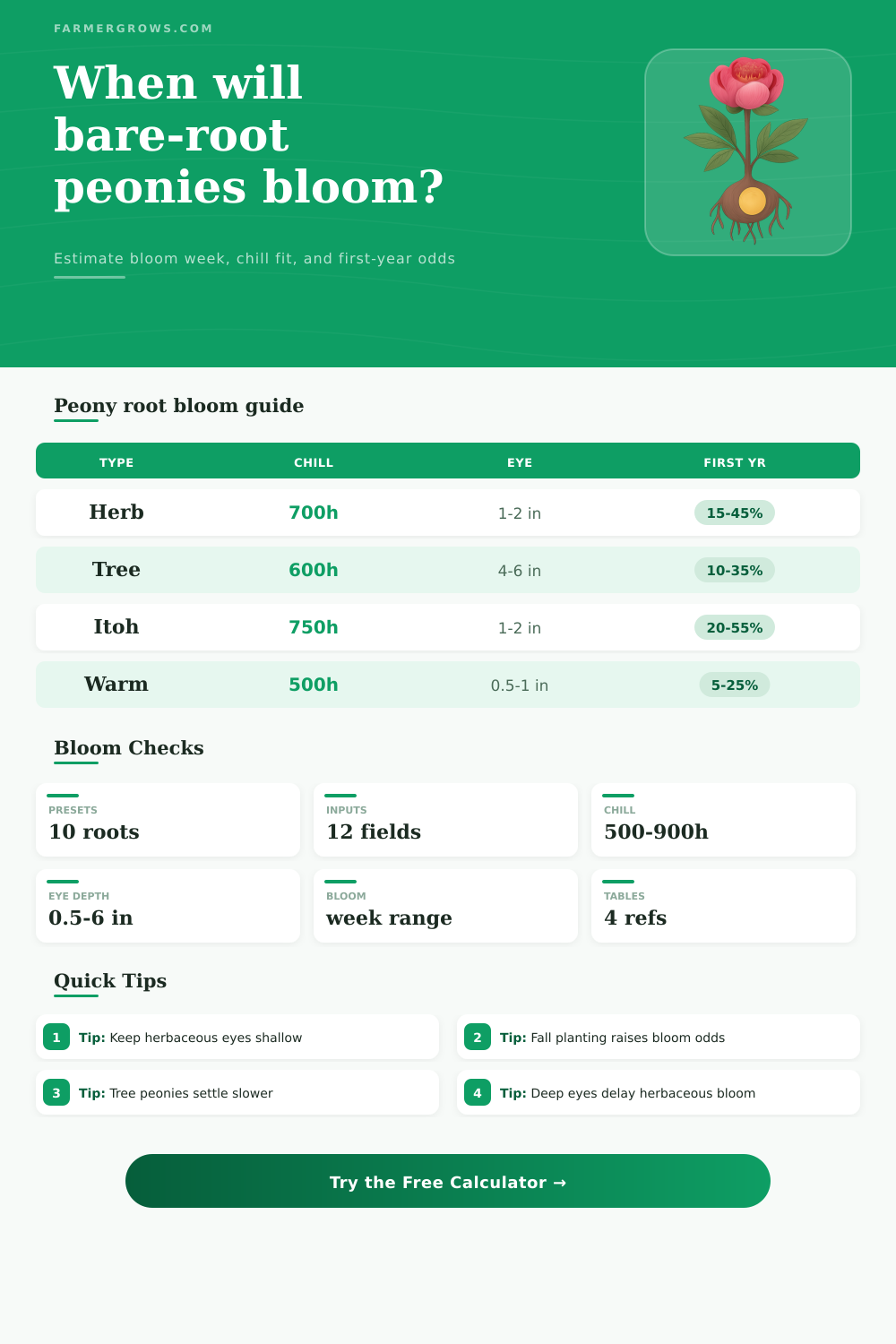
| Peony root type | Typical bloom season | Chill target | Planting depth focus | Establishment habit |
|---|---|---|---|---|
| Herbaceous peony division | Late spring to early summer | About 700 to 900 chill hours | Eyes usually 1 to 2 inches below soil, shallower in warm zones | Often blooms lightly year 1 or 2, then strengthens |
| Tree peony bare-root graft | Often 1 to 2 weeks before herbaceous peonies | About 600 to 800 chill hours | Graft union is commonly buried deeper so the scion can root | Usually slower to settle, with 3 to 5 years to full size |
| Intersectional Itoh division | Mid to late peony season | About 700 to 900 chill hours | Eyes are treated much like herbaceous peony eyes | Often strong after 2 to 3 growing seasons |
| Recently divided mature clump | Depends on retained eyes and root mass | Same as its type | Replant at proper eye depth immediately | Bloom can pause while feeder roots rebuild |
| Warm-zone peony planting | Earlier calendar bloom, often late spring | Chill is the limiting factor | Eyes may need to sit near 0.5 to 1 inch deep | First-year bloom odds are usually lower |
| Zone band | Herbaceous peonies | Tree peonies | Intersectional peonies | Planning note |
|---|---|---|---|---|
| Zones 3 to 4 | Mid June to early July | Early to mid June | Mid to late June | Late thaw and cool spring push bloom later. |
| Zone 5 | Late May to mid June | Mid to late May | Early to mid June | Classic peony timing with reliable winter chill. |
| Zone 6 | Mid May to early June | Early to mid May | Late May to early June | Fall planting gives roots time before spring growth. |
| Zone 7 | Early to late May | Late April to mid May | Mid to late May | Plant eyes shallow and avoid hot afternoon stress. |
| Zones 8 to 9 | April to May if chill is sufficient | April to early May | Late April to May | Choose low-chill tolerant cultivars and shallow eye depth. |
| Division size | Visible eyes | Root mass signal | First-year bloom expectation | Best use |
|---|---|---|---|---|
| Small root | 1 to 2 eyes | Few storage roots or trimmed pieces | Low; foliage and roots usually come first | Patient home planting where bloom can wait |
| Standard division | 3 to 5 eyes | Good storage roots with plump crowns | Moderate if planted in fall at correct depth | Most bare-root garden peony orders |
| Large field-dug division | 5 or more eyes | Heavy crown with several thick roots | Higher, though buds may still abort after stress | Display beds and faster clump building |
| Dry or delayed root | Variable eyes | Shriveled roots, broken eyes, late planting | Low until feeder roots recover | Pot or nurse carefully before judging failure |
| Recently moved mature peony | Many possible eyes | Lost feeder roots after division | Variable; one skipped bloom year is common | Resetting an old crown at proper depth |
| Symptom | Likely peony-specific cause | Calculator input to check | Practical adjustment | Bloom impact |
|---|---|---|---|---|
| Leaves but no flowers | Herbaceous eyes planted too deep or low chill | Eye depth and chill hours | Reset crown depth in fall if eyes are buried too far | May delay blooms 1 to 2 seasons |
| Small buds dry up | Young division, root stress, or uneven moisture | Root grade, age, and moisture | Keep even spring moisture and avoid moving again | Often improves after establishment |
| Strong foliage, late bloom | Cold zone, shade, or late cultivar | Zone, sun hours, cultivar timing | Give more spring sun if possible | Bloom week shifts later |
| Tree peony slow start | Grafted plant building own roots | Peony type and establishment years | Keep graft buried and avoid crown disturbance | Full performance may take several years |
| Warm-zone weak bloom | Insufficient chilling for bud initiation | Chill hours and zone | Use early low-chill cultivars and shallow eyes | First-year odds and bud count fall |
It is sad news if you have peonies that make foliage but no blooms. If you are expecting blooms because you waited out winter and made sure the soil was prepared, you will be heartbroken. Why won’t this plant bloom? One reason might be too little chilling, while other might be planting them at wrong depth. Forget about neglect as the culprit.
Peonies is fussy about how deep they get bare-rooted, and calculator tells you based off your particular situation. The biggest misstep is burying the eyes too much. “With herbaceous peonies, you want the point of growth an inch or two under ground.” (That’s why the tool wants it buried there, the way they grows depends on it.)
Why Your Peonies Are Not Flowering
Plant them too far down (three or four inches) to secure a root, and plant will focus on producing leaves, not flower buds. Survival becomes its priority; not blooms. Do this and your plants will go silent, dead silent.
The location of peony planting matter: Winter chill is also key. To set their buds correctly, peonies needs a certain number of hours under 45 degrees F, meaning they count on signal of cold to get moving out of dormancy. The calculator adjusts downward the chance of seeing blooms from plants planted in warmer zones. First-year flowers are less likely, since plant didn’t have sufficient exposure to cold to do its thing. This is not a sign of any defect in the plant. It is just a biological demand that’s hard to satisfy in warm climates without some form of microclimate adjustment or specific cultivar selection.
Division size and root grade is also factors that the tool takes into account. Clearly a big division with multiple eyes (five or more) fare better than a tiny cutting with only one eye. Because of its bigger root system, it’s able to build up feeder roots while making flowers. Little guys needs to focus on surviving. Plan on no blooms for a year or two. It’s not a case of “failure to thrive” but rather getting settled. Be patient. Eventually a well-established clump will outshine other plant.
Transplant shock is also factor in springtime planting. An extra month or two of growing time in the ground before the start of spring activity allows fall-planted roots to establish their connection to soil. Roots that go into action right away (as they must in spring planting) will spend more energy creating top growth instead of establishing new roots. The calculator takes the time of planting into account when calculating the chance of blooming. Fall is best; if you didn’t get it in fall, don’t despair, but set your expectations accordingly.
First, there will probably be leaves, then… And then there’s sunlight and water. For peonies: They require good drainage (no wet feet; they rot from the roots up, which you can’t diagnose fast enough); and they want morning sun to dry dew quickly. That reduces risk of botrytis blight, a fungal problem that stains the blooms as they’re coming into full form.
The calculator considers all this; and more, and comes back with a practical estimate. Are they ready to bloom today, or are they still a few years out? Knowing that will avoid the frustration of assuming the plant has a disease when actualy it just needs time to get established.
With peonies, less is more: grow them, but not too much. Know when enough is enough; learn the art of not overparenting. You should of known when enough is enough.
Root size, cold tolerance, and depth combine to turn guesswork into strategy. Knowing how to work with plants rather than against them is knowing why they’re doing what they do. And it’s the difference between an annual show and the same kind of sure-to-return bloom, year after year. Flowers come from eyes up top, not down deep where it feels cozy.