Peony Bloom Time Calculator
Estimate first bloom, peak bloom, display length, and confidence for herbaceous, tree, fernleaf, species, and Itoh peonies using zone, bloom class, bud stage, chill, sun, and spring weather.
Choose a real peony scenario, then tune the zone, bud stage, and microclimate for your own garden.
Peony Bloom Forecast
Your forecast will appear after the first calculation.
Use woody, species, and very early hybrids to begin the peony season before standard garden types.
Plant very early, midseason, late, and Itoh peonies to stretch bloom over a month or more.
Cut most herbaceous stems when buds feel like a marshmallow and show petal color.
Low-chill gardens usually do better with early bloomers, shallow planting, and cool winter exposure.
| USDA zone | Midseason peak baseline | Common bloom span | Notes |
|---|---|---|---|
| Zone 3 | June 16-20 | Early June to early July | Late spring warmup; bloom can arrive fast after heat |
| Zone 4 | June 8-12 | Late May to late June | Strong chill and reliable bud set in most years |
| Zone 5 | May 29-June 2 | Mid May to late June | Classic baseline for many herbaceous peonies |
| Zone 6 | May 20-24 | Early May to mid June | Warm springs can move bloom a week earlier |
| Zone 7 | May 10-14 | Late April to early June | Early classes help avoid hot flowering weather |
| Zone 8 | April 26-30 | Early April to mid May | Choose early cultivars and avoid deep planting |
| Zone 9 | April 10-16 | Late March to early May | Bloom is less reliable without enough winter chill |
| Bloom class | Shift from midseason | Typical examples | Garden use |
|---|---|---|---|
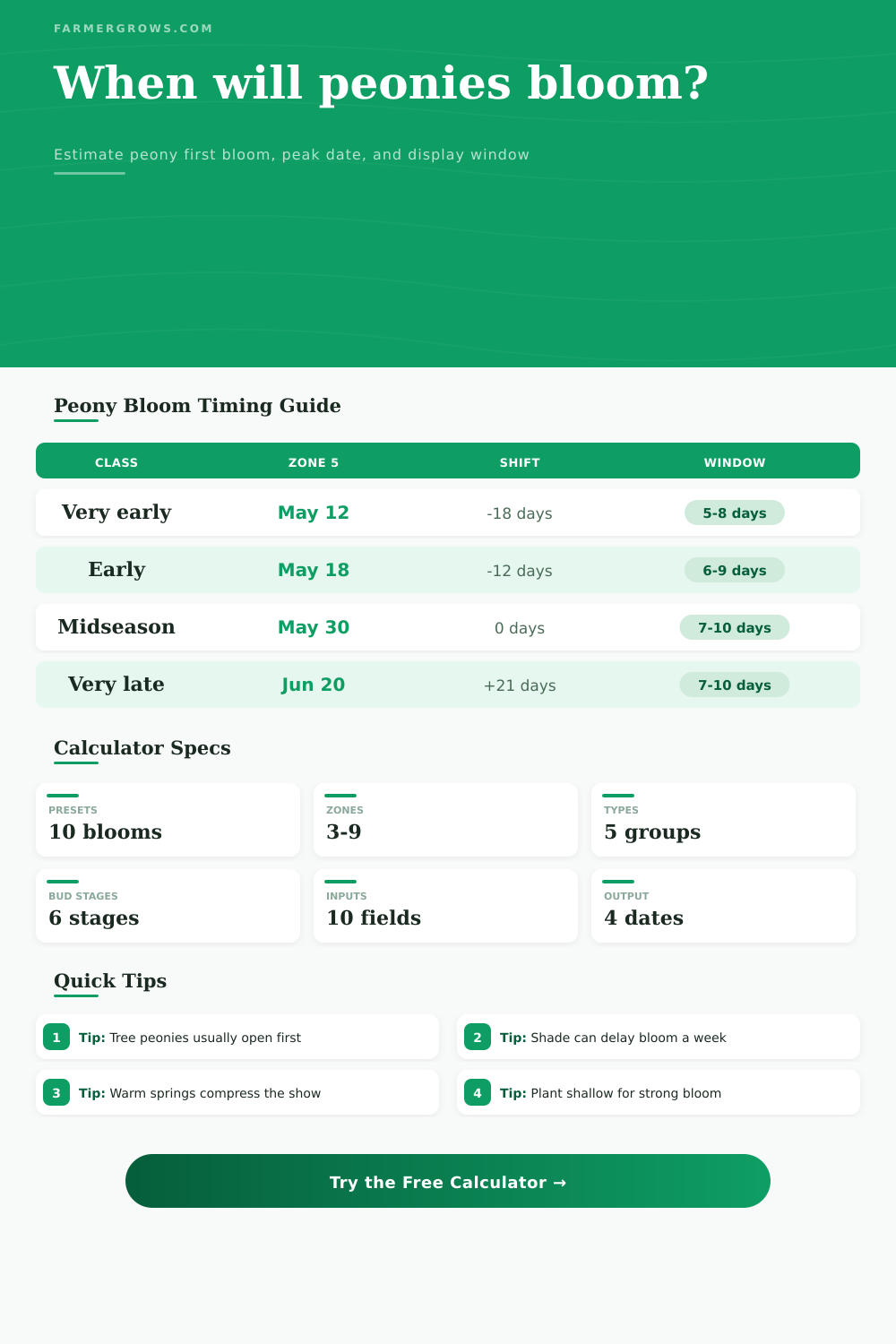
| Very early | About 18 days earlier | Fernleaf, Early Scout, some tree types | Start the peony season |
| Early | About 12 days earlier | Coral Charm, Red Charm types | Bridge bulbs and iris |
| Early midseason | About 6 days earlier | Duchesse de Nemours types | Reliable first cutting stems |
| Midseason | Baseline timing | Festiva Maxima, Kansas types | Main garden flush |
| Late midseason | About 7 days later | Bowl of Beauty, many Itoh types | Extend color after main flush |
| Late | About 14 days later | Late lactiflora cultivars | Carry bloom toward summer |
| Very late | About 21 days later | Sarah Bernhardt types | Final peony display |
| Bud stage | Typical days to first bloom | Best action | Forecast note |
|---|---|---|---|
| Red shoots emerging | 35-50 days | Keep crowns uncovered | Weather still dominates timing |
| Pea-size flower buds | 24-35 days | Begin staking tall doubles | Good early-season checkpoint |
| Marble-size tight buds | 14-24 days | Watch irrigation during dry wind | Useful two-week forecast |
| Soft buds showing color | 5-12 days | Cut stems at marshmallow stage | Best short-term forecast |
| First petals opening | 0-3 days | Enjoy or cut immediately | Peak is close |
| Microclimate factor | Typical date shift | Bloom effect | Management note |
|---|---|---|---|
| Full sun, south exposure | 1-3 days earlier | Earlier opening, shorter flowers in heat | Mulch soil, not the crown |
| Morning sun, light shade | 3-5 days later | Often longer individual flowers | Good for warm climates |
| Heavy crown mulch | 3-6 days later | Cooler soil delays shoots | Pull mulch off herbaceous eyes |
| Deep herbaceous planting | 4-10 days later | Can reduce or prevent bloom | Keep eyes near 1-2 inches deep |
Use bloom classes like a planting calendar. A single peony may flower for about a week, but very early, midseason, late, and Itoh cultivars can stack into a much longer spring display.
Let the crown warm naturally. Herbaceous peony eyes planted too deep or buried under heavy mulch often leaf out late and may make fewer buds, especially in mild-winter gardens.
One little red shoot comes up in soil in early spring, and it can make you panic. It’s saying it’s time to start growing, but who knew? Time doesn’t always seem connected to biological changes. Even if the calendar say it is Memorial Day, all you might see are green stalks without any signs of bloom. Or the flowers arrives three weeks ahead of when you thought they’d be here.
Once you input your zone and where on the buds you are, the calculator do the math for you, saving you from having to guess whether that little sprout means you will be canceling plans next week or next month. Here’s the key: Peonies respond to a combination of light, winter chill, and accumulated heat. It is not necessarily what the calendar says.
How to Know When Your Peonies Will Bloom
That’s why the tool want to know about your USDA hardiness zone. It also needs to know if you’re trying to grow a fernleaf variety or a tree peony, which tend to flower weeks ahead of typical herbaceous types. Planting everything at once mean missing the tree ones altogether. Tree peonies and fernleaf varieties often bloom weeks before the classic herbaceous types you see in garden catalogs. The chart on the page detail how much this can affect the timing; nearly three weeks earlier for early varieties versus those blooming into the late season.
The other common mistake most gardeners make: They plant them too deep. Though seemingly a minor detail, how shallowly an herbaceous peony is planted makes a huge difference. Typically, the “eyes” should of be buried only an inch or two beneath the surface of soil (no more). Why? They stay cooler that way longer into the spring, which delays breaking dormancy and can mean far fewer flowers as a result. Especially in warm zones, where forcing the plant to push upward through thick earth may mean no bloom at all. The plant just expends energy doing that instead. The calculator take this into account. It considers how deeply the peony’s crown was planted.
Another variable that feels abstract until it hits your garden: Winter chill. Some plants (like peonies) needs a minimum amount of cold hours to break dormancy well. A warm spell last month? Milder winter where you live then the previous one? The plant may never have gotten the necessary chill. This results in an uneven or perhaps even delayed bloom. The tool asks whether your winter conditions were such that this happened. And that’s accounted for.
Why are your peonies blooming later this year than last? Chances are it was a too-warm winter. So do fluctuations in spring weather. A quick run of warmer than average days in April may shorten that time frame… Accelerating the opening of those flowers, and make them fade even quicker. Conversely, a cooler, cloudier spring will extend the show, allowing you to enjoy their glory over a longer period of time.
Soil warmth, especially, makes a difference: The earlier it get warm, the sooner the peonies will bloom. The opposite is true if there’s some afternoon shade (which could delay things a few days). For example, if you’re hoping for a prolonged display, interplant early and late varieties, and try to stagger their sun exposure a bit.
Then there’s seeing what the plant does, which improves the estimate based off the early bud stages. Waking-up red shoots? The plant is waking up. Pea-size buds? The clock is ticking. Colorful soft buds? Best sign that it will be flowers soon. Watch for those and adjust your expectation to match as time goes on.
When it comes to the peonies, forget accurate predictions; it’s more a matter of knowing what’s going on. If all that data helps, the actualy trick is learning to read the pace of your own garden. After a few years, you’ll know which types of peonies thrive in your particular microclimate, and you won’t be following the calendar anymore. You won’t wonder why that one red shoot appeared, either. You’ll have a good idea of what’s ahead, right after that.