Pelletized Lime per Acre Calculator
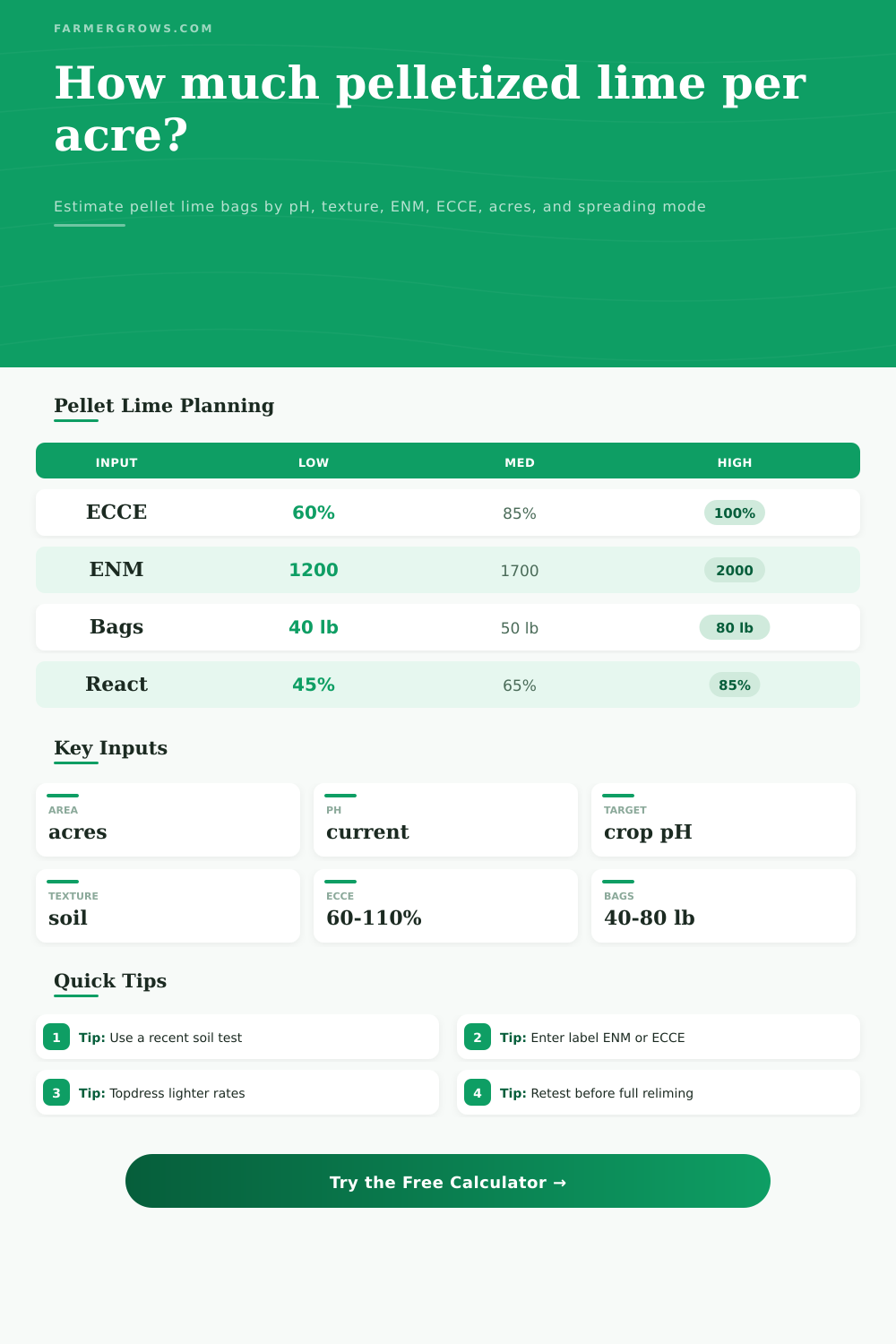
Estimate pelletized lime per acre from current pH, target pH, soil texture, acreage, bag size, pellet lime ENM or ECCE, short-term reaction factor, and broadcast or topdress mode.
Load a field situation, then adjust the pH target, soil texture, label ENM or ECCE, acreage, bag size, topdress mode, and short-term correction factor.
Pelletized Lime Estimate
Your pellet lime bag plan will appear here.
Fine lime pressed into pellets for easier handling. Good for touch-ups, gardens, food plots, and small-acre spreading.
Usually the practical choice when a soil test calls for several tons per acre across larger fields.
Useful when surface access is the main limit. Reaction still depends on rainfall, soil contact, and actual ECCE.
Best when pH is only slightly below target and the goal is to avoid a larger lime correction later.
| Label value | Equivalent value | Calculator meaning | Rate effect |
|---|---|---|---|
| 1200 ENM lb/ton | 60% ECCE | Moderate effective neutralizing strength. | Needs more product per acre. |
| 1600 ENM lb/ton | 80% ECCE | Common strong pellet lime planning value. | Rate is divided by 0.80. |
| 1800 ENM lb/ton | 90% ECCE | High-quality fine material assumption. | Fewer bags for the same pH gap. |
| 2000 ENM lb/ton | 100% ECCE | Pure calcium carbonate benchmark. | Matches the 100% CCE lime basis. |
| Soil texture | Approx 100% lime for 1.0 pH unit | Why it changes | Pellet lime note |
|---|---|---|---|
| Sand or loamy sand | About 1.15 ton/ac at 6 inches | Low reserve acidity and low clay content. | Use smaller, more frequent rates. |
| Sandy loam | About 1.45 ton/ac at 6 inches | Moderate buffering but still changes fairly quickly. | Topdress can be practical for small gaps. |
| Loam or silt loam | About 1.85 to 2.20 ton/ac at 6 inches | More exchange sites hold acidity. | Check whether bulk lime is better for large gaps. |
| Clay loam or clay | About 2.65 to 3.15 ton/ac at 6 inches | High buffering and slower pH movement. | Split or lab-guided rates matter most. |
| Bag size | Bags per ton | At 500 lb/ac | At 1000 lb/ac |
|---|---|---|---|
| 25 lb bag | 80 bags/ton | 20 bags/ac | 40 bags/ac |
| 40 lb bag | 50 bags/ton | 12.5 bags/ac | 25 bags/ac |
| 50 lb bag | 40 bags/ton | 10 bags/ac | 20 bags/ac |
| 80 lb bag | 25 bags/ton | 6.25 bags/ac | 12.5 bags/ac |
| Application mode | Typical use | Short-term depth basis | Planning caution |
|---|---|---|---|
| Broadcast and lightly incorporated | Seedbed, renovation, or open soil. | 3 to 6 inches | Best contact and most reliable reaction. |
| Broadcast on surface | No-till fields before rainfall. | 2 to 4 inches | Surface reaction is slower below the top layer. |
| Topdress over crop or sod | Established forage, orchard lanes, or food plots. | 1 to 3 inches | Keep rates light and avoid leaf burn from dust or overlap. |
| Maintenance touch-up | Small pH gap after a soil test. | 1 to 2 inches | Do not use it to replace a multi-ton correction. |
Use pelletized lime where bags make sense. If the calculator shows hundreds of bags, bulk ag lime is usually the more practical field correction.
Match the short-term factor to expectations. A fast green-up response is not the same as fully correcting reserve acidity through the whole root zone.
With lime and a soil test kit in hand, you’re standing in the field wondering exactly how much to add. Until you convert those numbers on the report back into real-life bags, they seem like abstractions. Most gardeners get tripped up there: Oh, it says 5.8 pH, so I must need all this stuff! You must factor in whether your soil is sandy, or if you will add lime as a topdressing to the lawn instead of working it into a seedbed that you will till.
Enter the calculator. You plug in your desired pH and acres to cover, and it does the math for you (instead of requiring that you guess at conversions and coefficients). This all boils down to how much acid your soil retains, and why texture realy does matter. Soil with many clay particle holds onto hydrogen ions tightly and has high reserve acidity, while sandy soils do not.
How to Use the Lime Calculator
This means adding lime will raise the pH of a sandy loam pretty easily, but not a heavy clay field, which soaks up the alkalinity but doesn’t change very much in character. That’s where the tool comes into play: It knows that the clay soil need less lime, so adjusts the rate accordingly when you choose that type of soil. Remember, it isn’t as simple as just making the number higher; it’s about overcoming the soil’s ability to resist change.
But what about the quality of the lime? Pelletized lime is not all alike. When you read the label it’ll say something like ECCE or ENM. Those look like alphabet soup, but those letters represent measures of purity and reactivity. ENM stands for Effective Neutralizing Material per ton. ECCE stands for the percentage of effective Calcium Carbonate Equivalent.
A 90-percent ECCE has near-pure calcium carbonate for its neutralizing power. 60-percent ECCE is less powerful. You need to use more of that stuff to get the same results. The calculator factors the quality measure in terms of actual bags/lbs. No head-division needed there.
The way you apply also matters. Broadcast Lime reacts faster and more effectively when it touches the soil, this happens when you apply it as a broadcast prior to planting by incorporating it gently into the soil. In contrast, top dressing a hayfield or other established clover patch is less effective because the pellets simply sit on top until rain or moisture dissolves them and carries them downward.
The calculator adjusts based off placement: When not all will immediately come into contact with soil, it calls for using a higher rate on each pass. It might be better to use multiple lighter treatments rather than one big one that gets washed off.
And then there are practical limitations: No one wishes to carry around eighty-pound bags up and down the hilly road in an orchard. Forty or fifty pound bags works well for most small farmers and gardeners.
How many bags do I have to order? That’s what this tool will tell you. It will calculate how many bags of product you’ll need to buy, including a tiny little buffer (five percent!) so that you don’t run out halfway through bagging the final acre or fail to cover a spot or two. Five percent doesn’t sound like much but it makes all the difference.
There’s one variable that no spreadsheet can account for: time. Lime isn’t magic, and doesn’t work overnight. Pelletized lime, made to be broken down quicker than ground ag lime, take weeks to months to really get to work. Don’t count on a quick bump up in pH just because you had a rain. Re-test in early summer or spring.
It may take another pass if the pH hasn’t budged, and if it overshoots, you’ve got yourself a whole other issue with nutrient lockout. But most of this is simply knowing what you are measuring. PH is a logarithmic scale. From 5.0 to 6.0 is a ten-fold difference in hydrogen ion concentration. Chemically that’s huge but seems like nothing when you see it written down.
That is why precision math is needed. There’s no room for guesswork here, because that means going too far (waste) or not far enough (under-correction). You should of known that.
Enter your starting pH and desired pH. Enter your soil texture. Enter your ENM (or ECCE) from the bag label where you’re going to purchase the product. Let the calculator do its thing. Bag count is outputted.
Buy just what you need, apply it gently, and see how the soil responds. You began by asking “how much?” But ended up with an action plan: soil-health improvement.