Peach Tree Lifespan Calculator
Estimate realistic peach tree life, remaining productive years, age stage, borer and canker pressure, tree class, pruning renewal, crop-load stress, winter injury, and replacement timing.
Choose a realistic tree profile, then adjust tree class, current age, disease pressure, pruning quality, soil drainage, crop load, vigor, sun, and winter or spring frost risk.
Fruits quickly, but heat, crop stress, and limited roots shorten the window.
The common home-orchard profile when pruning, borers, and drainage are managed.
Can last longer on good soil, but fruiting wood still needs yearly renewal.
Trunk injury and bacterial canker often bring replacement forward.
The longest practical peach life when borers, pruning, and crop load are handled.
Peach Tree Lifespan Estimate
Results update after calculation.
| Tree class | Typical useful life | Peak productive period | Main lifespan limit |
|---|---|---|---|
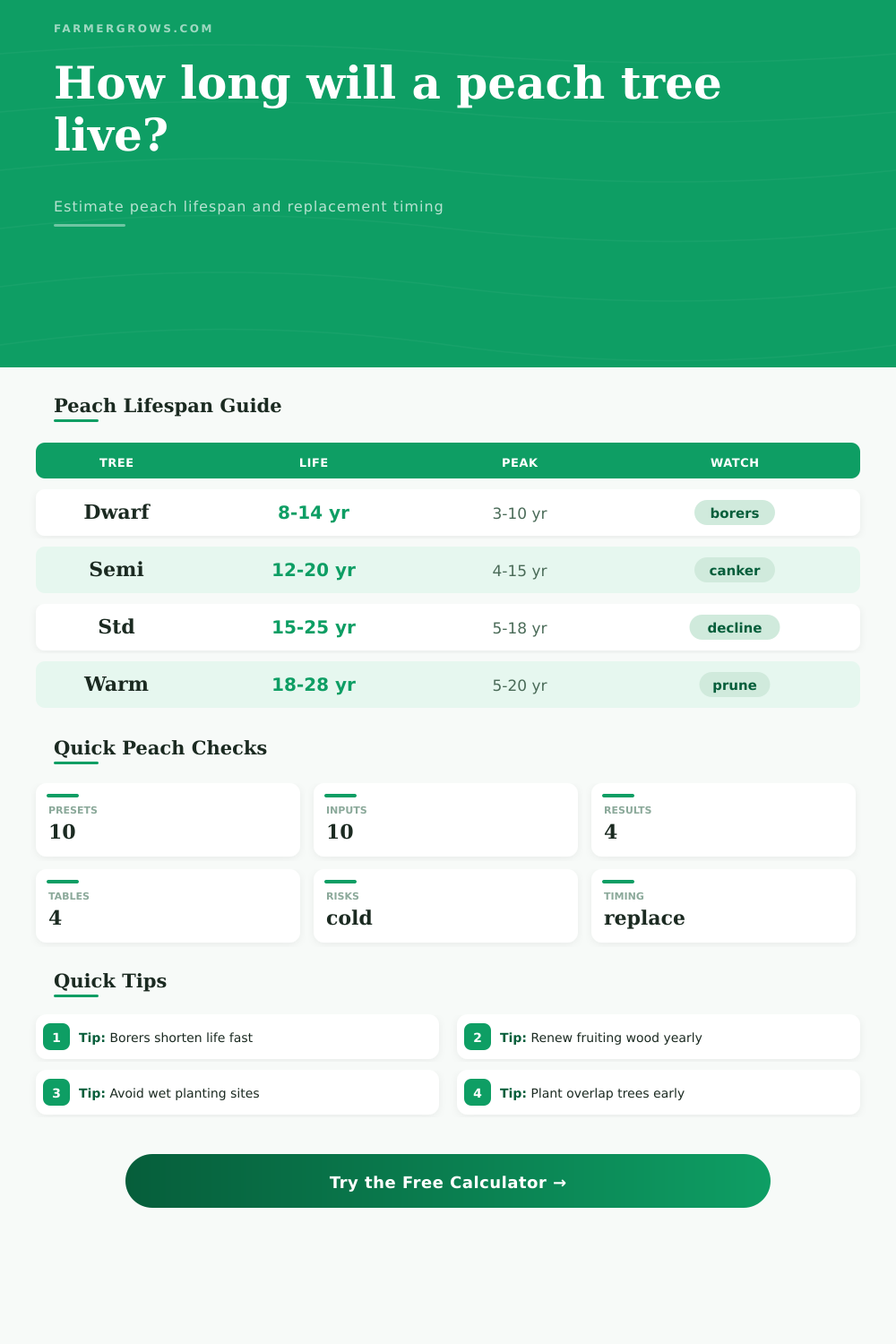
| Dwarf peach | 8-14 years | 3-10 years | Plan replacement when vigor or fruit size drops. |
| Semi-dwarf peach | 12-20 years | 4-15 years | Common backyard range with good pruning. |
| Standard peach | 15-25 years | 5-18 years | Longer on deep, drained soil. |
| Cold-stress peach | 8-18 years | 4-12 years | Trunk injury and canker shorten life. |
| Warm dry site | 18-28 years | 5-20 years | Lowest rot pressure, still prune yearly. |
| Factor | Low pressure | Moderate pressure | High pressure |
|---|---|---|---|
| Disease pressure | Clean bark, minor scab, active sanitation | Recurring scab, mildew, small cankers | Fire blight, borer injury, scaffold canker |
| Soil drainage | Roots dry down after rain | Occasional wet feet or compacted layer | Standing water, root rot, heavy clay pocket |
| Pruning | Annual renewal cuts and open canopy | Irregular pruning with some crowding | Large wounds, shaded interior, neglected limbs |
| Crop load | Fruit thinned and limb load managed | Heavy years corrected after bloom | Repeated overload, biennial bearing, broken limbs |
| Vigor | Healthy shoots and leaf color | Short shoots or inconsistent growth | Dieback, sparse leaves, shrinking canopy |
| Stage | Approximate share of lifespan | Production behavior | Replacement action |
|---|---|---|---|
| Establishment | 0% to 15% | Framework growth, few peachs | Protect trunk, train scaffold, avoid overcropping |
| Young bearing | 15% to 35% | Yield climbs quickly if vigor is balanced | Thin fruit and keep leader or trellis structure strong |
| Prime production | 35% to 70% | Best balance of fruit size and reliable bearing | Maintain renewal wood and monitor canker points |
| Mature decline | 70% to 90% | Yield may stay fair but recovery slows | Start replacement planting or graft renewal plan |
| Late life | 90% plus | Hollow limbs, lower vigor, irregular harvest | Replace if safety, disease, or yield goals matter |
| Scenario | Keep and prune | Plant overlap tree | Remove soon |
|---|---|---|---|
| Healthy dwarf tree | Age under 70% of adjusted life | Age 70% to 85% or yield falling | Major canker, broken union, or poor support |
| Semi-dwarf home tree | Good vigor with clean scaffolds | Decline begins but trunk is stable | Root rot, unsafe limbs, repeated bacterial canker |
| Large old standard | Structure safe and annual renewal works | Harvest height or fruit quality becoming difficult | Hollow trunk, storm splits, severe dieback |
| Commercial block | Yield and fruit size still meet target | Return per tree drops below block goal | Training system failure or chronic disease hotspot |
Peach trees are naturally shorter-lived than many fruit trees. Plan replacement early for dwarf trees, borer-prone trunks, and declining orchard blocks.
Track peach tree borers, bacterial canker, gummosis, brown rot pressure, and repeated dieback. Chronic structural disease often matters more than calendar age.
Peach roots dislike wet, compacted soil. Good drainage often matters more than fertilizer when you are trying to extend tree life.
Plant the next tree before the old one fully fails when space allows, so first bearing overlaps with the old tree's decline.
Peaches are not ancient-oak-type trees, don’t make them act like one. They’re meant to bear quickly but not necessarily live long. How much longer?
The calculator at top predicts how many more years your particular peach may has. It looks at factors most of us forget until we regret it, such as rootstock class, drainage, disease pressure, and pruning. It crunches all these variables to tell you just how soon to plan to plant again. Avoid wasted effort by understanding their boundaries, such as avoiding planting in shade or neglecting borers.
How Long Do Peach Trees Live?
Dwarf trees is designed to fruit early and stay compact, and they typically last eight to fourteen years. Depending on ideal circumstances, a full-size tree on vigorous rootstock could reaches 25 years. Ideal circumstances never happen in home garden soils; the tool takes into account your particular location’s challenges and changes those blanket estimates for match.
Bad drainage? High disease susceptibility? You’ll probably see much less longevity then the textbooks suggest. Peaches don’t last long on soggy ground; their roots don’t like to breathe in waterlogged conditions. Heavy clay prevents enough oxygen from reaching the roots. This invites peach-killing troubles like root rot and bacterial canker, which explain why moisture is such an important factor in how long a peach lasts. So even if you feed a young peach just right, it won’t live beyond its prime if its roots are drowning. This fact shows in the calculator’s lowered estimate of expected life span if drainage is rated poor or even fair; soil problems kill the tree from within.
The second part of the equation of productivity is pruning. Peach trees bears only on wood produced the prior year, so they needs their structure renewed each year. If allowed to self-shade and close off canopy, interior branches will die out and become ways for disease to enter. How good a job do you do at pruning? That’s one of the questions the calculator poses to get an idea of whether tree has a chance to hold itself together structurally. Neglect speeds up decline. Since older wood is more likely to break or get sick, good pruning keeps the wood healthy and young and adds years to the productive period.
Because peaches are early-blooming, they’re susceptible to late frost, which can shorten life of a tree. This makes them vulnerable not only to winter injury but also to springtime frosts that can shorten a tree’s life. Over time, repeated damage will weaken the trunk, providing entry points for canker and borers. To estimate the point at which yield begins to decline, the tool factors in both current vigor and your local frost risk. For instance, you may enjoy a nice decade-long run of good harvest, but if the tree has been damaged by borers or some other kind of stress (cold), that last drop-off comes sooner than expected. Catching on to that pattern early helps you make sure you have an overlap tree planted before it’s entirely lost.
How does this apply? In other words, where is the action? The answer comes down to replacement timing, again, it’s when the tree ceases all production, rather than when it has already died, leaving an exposed hole in your harvest. The calculator tells you when to begin planning for replanting (in most cases), years ahead of death. Overlapping trees guarantee that there will always be something growing. This also gives you time to condition soils and choose better varieties. It reframes removal from a reaction into a management tool. It changes it from a way to replace dead trees instead of healthy ones. This makes you think about consistent yield and health as the real measures of value.
Peach trees are an investment; they require more than passive watching but active stewardship. Pruning, rootstock and soil all has an impact, and with some knowledge about these elements you’ll get the most out of each productive year. The framework that the tool offers will help you turn that fuzzy feeling into something real, with concrete steps and timelines. Know when it’s time to say goodbye, and know how to say hello.
Whether you grow a few trees in your backyard or manage a small orchard, how you plant them is only half the equation. The “when” to replacing matters, too. Take time to plan, prune well, and remember the limitations of your chosen species: Your harvest will reflect the care you took beforehand.