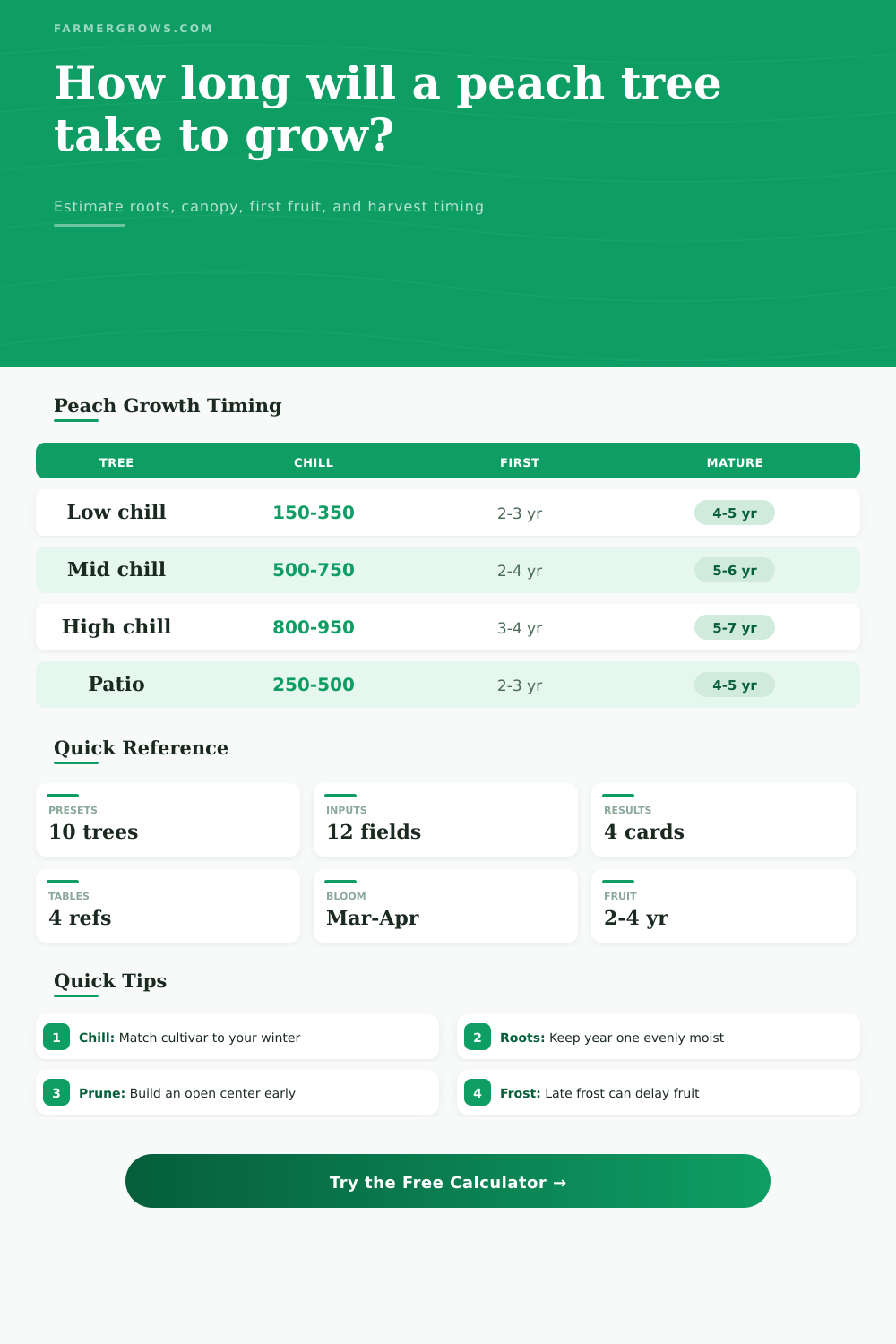
Peach Tree Growth Time Calculator
Estimate how long a peach tree takes to establish roots, push annual shoot growth, reach first useful fruit, fill a trained canopy, and hit its next harvest window using cultivar chill fit, rootstock vigor, nursery size, planting season, frost pressure, irrigation, soil, pruning, and sun.
Choose a real peach scenario, then tune the tree age, target canopy, chill match, planting season, and care level for your site.
Peaches need enough winter chill to wake evenly. Too little chill stretches bloom and can delay the first dependable crop.
A feathered container tree usually starts closer to fruiting than a small whip, but roots still need a full establishment season.
Dwarf and patio trees fill smaller targets sooner. Standard trees take longer because the trained canopy is larger.
Late spring frost can erase flower buds, while hard pruning can trade one season of fruit for stronger scaffold wood.
Peach Growth Estimate
Your estimate will appear after calculation.
| Cultivar | Typical chill need | Common harvest window | Growth timing note |
|---|---|---|---|
| Flordaprince | About 150 hours | Very early season | Fits warm-winter sites; late frost and low chill mismatch are the main timing risks. |
| Desert Gold | About 250 hours | Early season | Low-chill selection that can crop early when irrigation supports summer growth. |
| Saturn donut | About 500 hours | Mid season | Moderate chill; good care can produce useful fruit in the third leaf. |
| June Gold | About 650 hours | Early to mid season | Often vigorous; bare-root trees still need establishment before heavy cropping. |
| Redhaven | About 800 hours | Mid season | Classic home-orchard benchmark for balanced growth and cropping in suitable climates. |
| Elberta | About 850 hours | Late season | Large standard trees need a longer canopy-building window than patio peaches. |
| Belle of Georgia | About 850 hours | Mid to late season | Strong grower; bloom reliability depends on chill completion and spring frost escape. |
| Reliance or Contender | About 1000+ hours | Mid to late season | Cold-hardy choices that still slow down where winters, frost, or short seasons are severe. |
| Tree class | Common trained height | Canopy spread | Time to full frame |
|---|---|---|---|
| Patio dwarf or container peach | 5 to 7 ft | 4 to 6 ft | About 4 to 5 years with regular root and water management. |
| Dwarf peach rootstock | 6 to 9 ft | 6 to 8 ft | About 4 to 5 years because the final canopy target is compact. |
| Semi-dwarf peach | 10 to 14 ft | 10 to 14 ft | About 5 to 6 years for a productive open-center backyard tree. |
| Standard peach | 14 to 18 ft | 14 to 18 ft | About 6 to 7 years where summer growth is strong and pruning is balanced. |
| Nemaguard or vigorous rootstock | 14 to 18 ft | 14 to 20 ft | Fast annual extension, but a larger final frame can still add time. |
| Citation semi-dwarf rootstock | 8 to 12 ft | 8 to 12 ft | Moderate canopy target; avoid wet soil because root stress slows establishment. |
| Stage | Typical timing | What to watch | Calculator adjustment |
|---|---|---|---|
| Root establishment | 8 to 14 months | New leaf push, firm anchoring, and steady summer shoot growth. | Water, soil drainage, nursery form, and planting season affect this most. |
| Scaffold formation | Year 1 to 3 | Three to four main limbs selected for an open-center vase shape. | Good pruning can speed structure; hard correction can add a season. |
| First useful fruit | Year 2 to 4 | Manage bloom, frost risk, and thinning so fruit does not stunt a young tree. | Chill fit, frost pressure, crop load, and cultivar timing set the fruit window. |
| Mature trained canopy | Year 4 to 7 | Annual renewal pruning maintains fruiting wood without enlarging the tree forever. | Rootstock size, target height, sun, soil, and irrigation control the final pace. |
| Factor | Speeds growth | Slows growth | Why it matters |
|---|---|---|---|
| Sun exposure | 8+ hours | Less than 6 hours | Peaches need high light to mature fruiting wood and flower buds. |
| Water pattern | Deep, steady moisture | Drought or saturation | Young trees drop growth quickly when roots cycle between dry and waterlogged. |
| Soil drainage | Loam or raised mound | Compacted wet clay | Peach roots are sensitive to poor aeration and can stall after transplanting. |
| Training | Annual open-center cuts | Crowded or delayed cuts | Early scaffold choices affect how soon the canopy becomes productive. |
| Crop load | Fruit thinned early | Heavy early fruit | Overcropping a young peach diverts energy away from permanent wood. |
| Frost exposure | Slope or protected site | Cold pocket | Bloom loss can push the first dependable crop into a later season. |
Chill and bloom: A peach that is too high-chill for your winter may leaf and bloom unevenly. A peach that blooms too early for your frost pattern may grow fine but crop late because flowers are lost.
First fruit caution: Letting a very young tree carry a heavy crop can make the first harvest look exciting while delaying scaffold growth. Thin early fruit hard until the frame is strong.
These estimates assume a grafted peach tree, not a seed-grown peach. Local pest pressure, disease, winter injury, and summer heat can shift growth by a season or more.
In late winter, you order or go to nursery to buy a bare-root whip with dreams of eating it in summer. And then you wait; and wait as everything else in the yard leap to life. It’s maddening. But all that quiet is most important part of the life of a fruit tree: the period when tool above will do the math (after you input your soil conditions and local chill hours).
No more guesswork about whether your patient waiting will be rewarded (or was there ever any chance of success?). What happens under ground before you even lift your eyes up to where branches are explains why it takes so long. Peach trees is rooted in real world: They’re focused on building their roots, not growing verticaly. The root system must stay in contact with the ground for eight to 12 months to hold up a heavy canopy.
Why You Should Wait for Your Peach Tree
During that period, site prep is everything; if your winter isn’t cold enough (doesn’t align with the cultivar’s required chill hours), or your soil don’t drain well, that eight-to-12-month mark will stretch into longer. Those factors mean your young tree will spend that initial year just staying alive, not getting bigger. The tool acknowledges those factors and adjust the starting date to match, depending off how consistently you watered and what kind of soil you planted it in. Instead of showing you an overly rosy best-case scenario, it provides a more realistic baseline.
From then on, you must race against time to get the scaffold structure made because everything downstream from it will depend on this. Your goal is an open-center vase shape (no dense umbrella!). That requires some tough cuts right away followed by removal of competing limbs in the center of canopy for life of tree; they’ll steal light and cause disease, and also make picking harder. It’s brutal-looking at the time, but so worth it.
The page has reference tables showing how quickly each dwarfing rootstock reaches its eventual full size. They are all different. This is compared to a standard tree, which may take six years to fill up its space. For patio dwarfs, the process of filling out that structure occur in four, not six. It’s not as much about speed as the ultimate size you’re aiming for.
The other main frustration for home gardeners choosing trees by taste rather than how they match the local climate is chill hours. A variety requiring nine hundred hours in winter when yours averages only three hundred, will never rest its buds sufficiently. They’ll flower too late (or not at all) and/or swell out of kilter in spring, then drop. You see, that’s where humans go astray. They think because something’s hardy it will grow fast; it won’t start producing until the biology matches winter temperature of location. This mismatch is included in the first-fruit timeline, which show that you may have years to wait for your first crop.
Spring frost is another silent killer. No matter how well you prune, nothing can lessen the effects of this one. Because peaches long for warm days, they bloom early; and they put those vulnerable flowers smack in way of late-spring cold snaps. Freeze the blooms and all your careful work on growth chart is irrelevant.
Here’s where good tree choice meets good site choice. Plant on a slight slope, and cold air will run off instead of lingering up near canopy. This saves you a few degrees and perhaps the crop. Can’t do anything about the weather? Choose where you plant. Thin out first fruits aggressively, so the tree isn’t worn down by carrying too heavy a load too early.
Sooner or later, though, the tree reach its maturity (five to seven years in common varieties), and then stops getting bigger (though not dead; just maintaining). From that time on, it’s all renewal pruning: removing older wood to let sunlight reaches into canopy. Why? Because light equals good fruit; if it’s too dark inside, they’ll be small and taste worse. Sounds easy, but takes discipline, year after year.
Working with stone fruit, or any kind of fruit, really, is a lesson in managing impatience. You offer up the cuts, the sun, and the water. But the tree set the pace, and it waits while you learn to wait. It is for those first peaches. The sweetness. That goodness doesn’t just show up exactly when it is supposed of. It grows. One quiet step at a time…necessary, always necessary.