Pea Seeds Per Hole Calculator
Estimate how many pea seeds to plant in each hole, station, or trellis row using seed tag germination, cool-soil emergence, target plants, spacing, reserve seed, and stand reliability.
Peas are usually direct sown close together along a trellis or short support. One seed per spot can work with fresh seed, while cold soil, older packets, and uneven beds often justify two or more seeds per hole.
Pea seed plan
Your pea planting results will appear here.
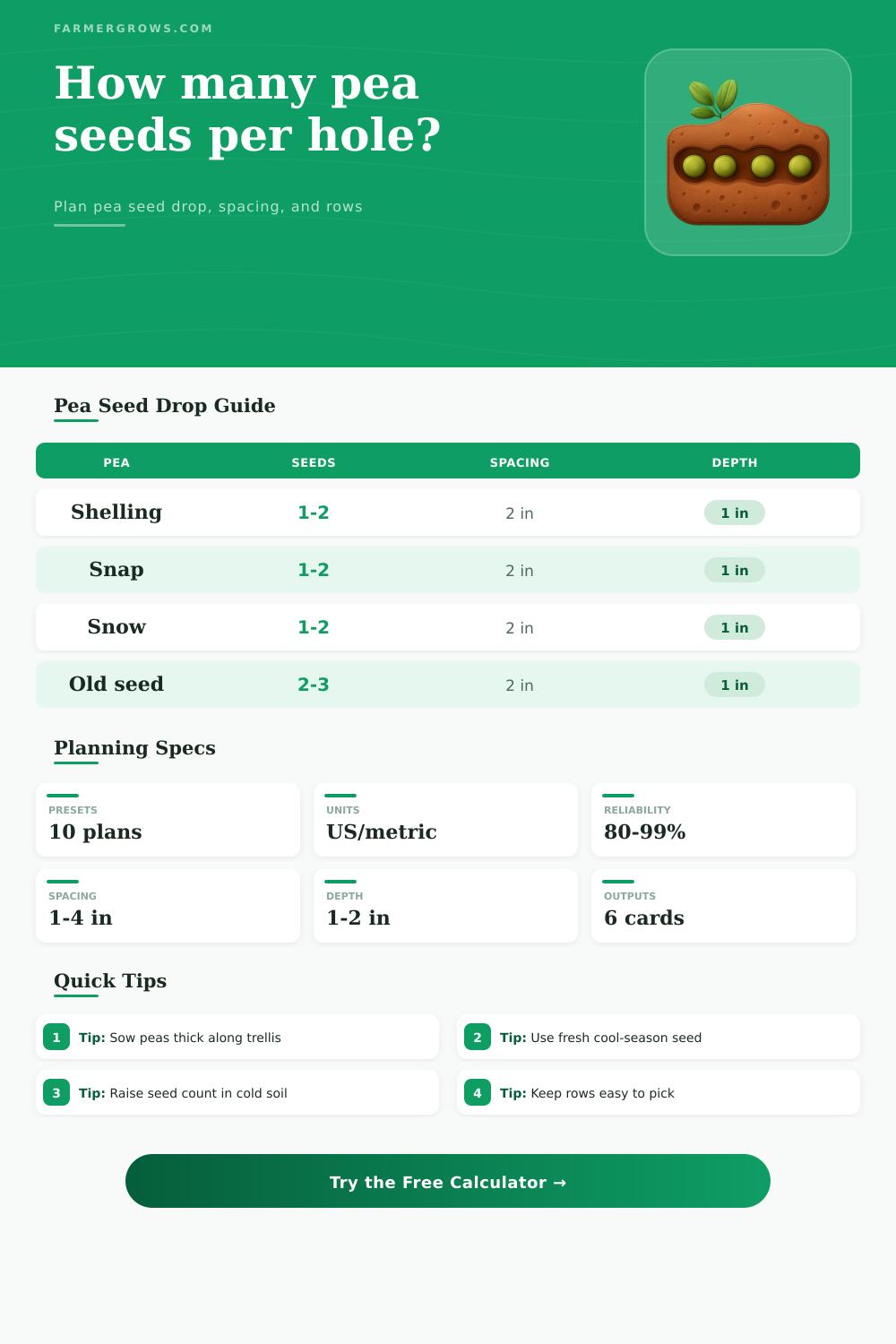
| Pea type | Typical seeds per hole | In-row spacing | Row habit | Usual depth |
|---|---|---|---|---|
| Snap pea | 1-2 seeds | 2 in | Trellis or net | 1 in |
| Shelling pea | 1-2 seeds | 2 in | Short or tall support | 1-1.5 in |
| Snow pea | 1-2 seeds | 1.5-2 in | Dense trellis | 1 in |
| Dwarf bush pea | 1-2 seeds | 2-3 in | Low brush or self-support | 1 in |
| Older pea seed | 2-3 seeds | 2 in | Any layout | 1 in |
| Live emergence per seed | 1 seed succeeds | 2 seeds succeed | 3 seeds succeed | Best use |
|---|---|---|---|---|
| 95% | 95.0% | 99.8% | 99.99% | Fresh seed, good soil |
| 85% | 85.0% | 97.8% | 99.7% | Normal spring sowing |
| 75% | 75.0% | 93.8% | 98.4% | Cool or uneven bed |
| 65% | 65.0% | 87.8% | 95.7% | Older seed or pests |
| 50% | 50.0% | 75.0% | 87.5% | Test before planting |
| Layout | Dimensions | Rows | Hole spacing | Approx holes |
|---|---|---|---|---|
| 16 ft snap pea trellis | 16 ft long | 2 rows | 2 in | 192 |
| 10 ft shelling pea strip | 10 ft long | 2 rows | 2 in | 120 |
| 8 ft container railing | 8 ft long | 1 row | 2 in | 48 |
| 4 ft x 4 ft dwarf bed | 16 sq ft | 6 in rows | 3 in | 112 |
| Succession short row | 6 ft long | 1 row | 2 in | 36 |
| Condition | Suggested emergence factor | Seed count effect | Planting note |
|---|---|---|---|
| Moist, friable, cool soil | 88-95% | Lowest seed count | Ideal pea seedbed |
| Very cold early bed | 70-82% | Often adds seed | Watch rot and delays |
| Crusted clay surface | 65-80% | Raises gap risk | Keep surface loose |
| Dry top inch | 70-85% | May need reserve | Water before sowing |
| Old packet, unknown vigor | 50-75% | Test or oversow | Paper towel test helps |
Close rows are normal for peas: A double row on each side of netting can look crowded, but peas are commonly planted thick and guided upward.
Use reserve seed quickly: If gaps appear, re-sow early while the weather is still cool enough for peas to establish well.
Planting pea seeds along a trellis is a recipe for panic: Plant too many, and you have tangled vines impossible to harvest; plant too few, and you’ll have bare spots with no crop at all. It is a question of probability versus soil conditions and seed age. It is a math problem involving germination rates that most home gardeners hasn’t thought through before guessing how far apart to space their seeds.
After setting seed quality (which enters the calculation as percent germination from your seed packet) and row length, the calculator do all the math for you, without having to remember emergence factor coefficients. Because it knows the real world isn’t a lab, it includes a field emergence factor that incorporates actual variables such as cool soil. That’s important, since great lab germination doesn’t help if the seeds drown in wet clay. The calculator adjust its recommended number of seeds per hole to help you reach your target, ensuring that each station has a plant, even when there is less than a 100 percent chance of emergence.
How to Plant Pea Seeds Correctly
Fresh seed is predictable and strong. Usually just one or two seeds per hole will work (because it’s so vigorous). Seed that’s aged: Not so much. Viability of older seeds can be erratic; they may appear to be fine, but won’t sprout if stressed. To compensate, up the number of drops for older packets or tough conditions (as a safety net against the unknown). You’re not squandering your seed; you’re insuring against gaps in your row.
Peas need different amounts of space than most vegetables. Peas will stand closer together, with a little help from trellis netting, then nearly anything else; four inches apart in a double row between two fences is typical. Why? Because peas don’t overgrow; they make a tight curtain of foliage. That foliage protects the plant and allows full use of vertical growing space, plus holds up the entire structure. Climbing snaps requires more space than do dwarfs (see chart). Knowing this can save you from planting too few seeds to avoid gaps, which could let in wind and cause damage.
And all of this hinges on a secret: the temperature of the soil. Cool season crops like peas love really cold early spring ground. But really cold wet soil mean slower germination; also slower decomposition. That’s the kind of condition that raises your odds of having a seed go rotten, or come under some fungal attack. It’s the thing that most people don’t think about, since they figure that whatever my seed can take, it can take. With the emergence factor input, you tell it that you expect less success in tough conditions. Then the calculator tells you to plant more per hole to make up. This is a practical adjustment to the real world, not the perfect lab.
And then there’s having reserves, meaning seed, too. A little extra allows you to fill in gaps as they appear. This prevents you from having to go back and spread out whatever is left just because one row look thin compared to another. Knowing how many seeds you need up front saves you trips to the nursery midseason (or rifling through forgotten jars). It makes the whole planting exercise less frantic, more measured, each seed going exactly where needed.
Perfect isn’t as important as consistent. Evenly spaced peas make for an even yield, and one that remains manageable all season long. When some areas are empty-handed, and other holes hold multiple lusty plants, it’s hard to harvest. The tool helps to level the playing field by making the seed count match its chances of surviving. It goes from you taking a gamble with luck to you taking control and farming with intent. It translates springtime planting-to-harvest guesswork into a predictable routine. In return, you get a steady supply of sweet, crisp pods; instead of a patchwork quilt of dissapears.