Pea Gravel Calculator
Plan patios, walkways, play areas, dog runs, fire pit pads, and garden paths with depth, settling, density, bag counts, weed fabric, and border edging included.
Choose a patio, path, or play-area starting point, then adjust the shape, depth, containment, fabric, and gravel density for the actual site.
Comfortable underfoot and attractive for patios, but it needs edging because rounded stones roll outward.
Angular stone packs more firmly for drive edges and bases, but it is sharper for barefoot spaces.
Larger rounded rock works in borders and drainage bands, not as well for chairs or small-wheeled carts.
Finer material forms a tighter path surface, but it has a different look and usually needs compaction.
Pea Gravel Estimate
For the selected area, depth, density, fabric, and border containment.
| Depth | Coverage per yd³ | Coverage per m³ | Best pea gravel use |
|---|---|---|---|
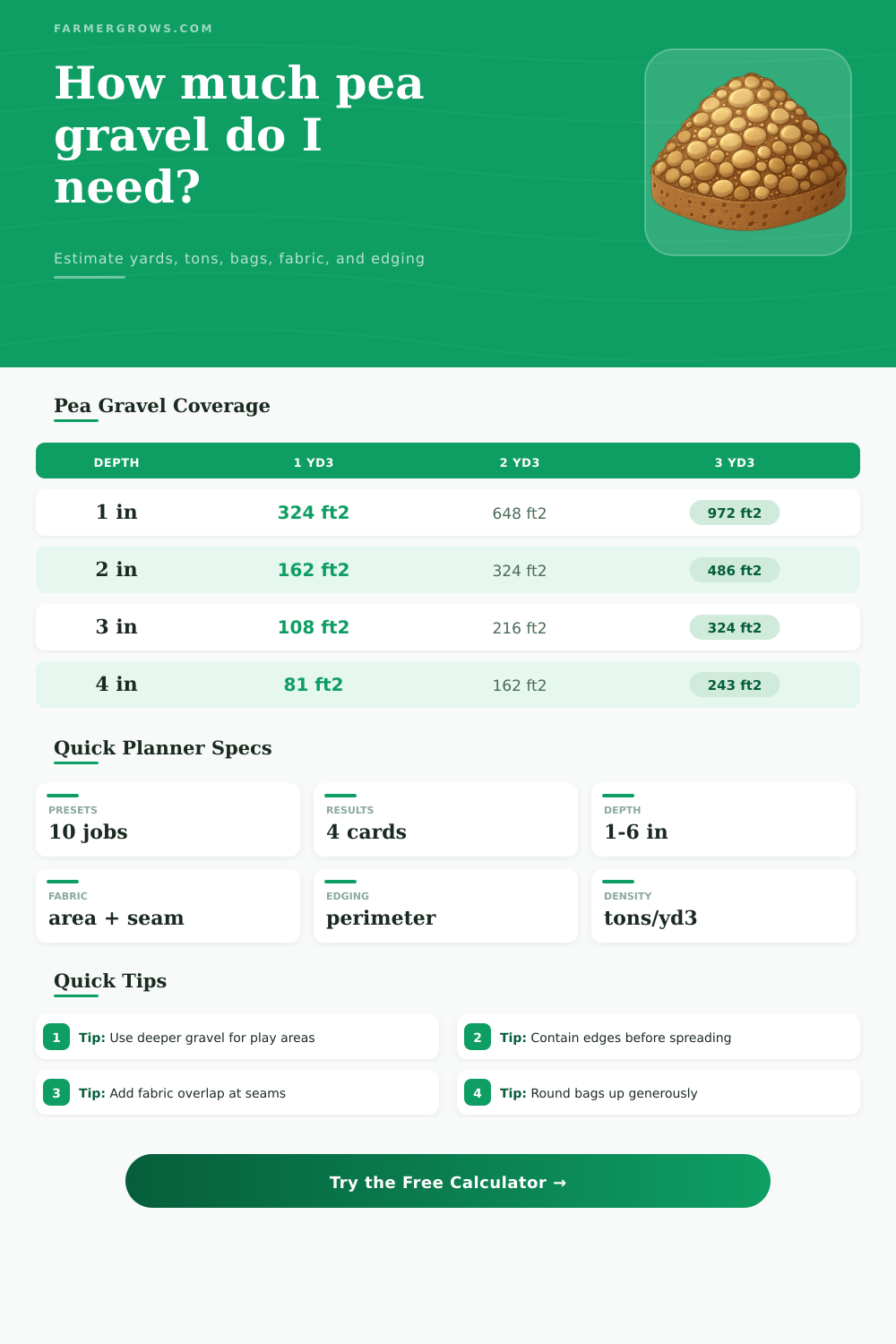
| 1 inch | 324 sq ft | 39.4 sq m | Decorative refresh over existing gravel |
| 2 inches | 162 sq ft | 19.7 sq m | Light garden paths with firm base |
| 3 inches | 108 sq ft | 13.1 sq m | Patios, walkways, and seating areas |
| 4 inches | 81 sq ft | 9.8 sq m | Dog runs and deeper walking surfaces |
| 6 inches | 54 sq ft | 6.6 sq m | Play areas needing deeper loose cover |
| Project type | Typical depth | Containment need | Fabric note |
|---|---|---|---|
| Patio seating pad | 2.5 to 3 inches | All sides recommended | Use fabric over compacted base |
| Garden walkway | 2 to 3 inches | Both long sides at minimum | Overlap seams before spreading gravel |
| Play area | 4 to 6 inches | Rigid border strongly recommended | Check local safety needs before use |
| Dog run | 3 to 4 inches | All sides with gate gap removed | Choose washable fabric and drainage |
| Decorative bed | 1 to 2 inches | Low edging or existing border | Fabric helps keep soil from mixing |
| Bag or bulk unit | Volume | Bags per yd³ | Coverage at 3 in |
|---|---|---|---|
| 0.5 cu ft bag | 0.019 yd³ | 54 bags | About 2 sq ft |
| 1 cu ft bag | 0.037 yd³ | 27 bags | About 4 sq ft |
| 2 cu ft bag | 0.074 yd³ | 14 bags | About 8 sq ft |
| 3 cu ft bag | 0.111 yd³ | 9 bags | About 12 sq ft |
| 1 cubic yard bulk | 27 cu ft | 1 yd³ | About 108 sq ft |
| Example area | Perimeter | 3 in pea gravel | Fabric with 6 in overlap |
|---|---|---|---|
| 10 by 10 ft patio | 40 ft | 0.93 yd³ | About 121 sq ft |
| 3 by 40 ft path | 86 ft | 1.11 yd³ | About 162 sq ft |
| 15 ft diameter circle | 47 ft | 1.64 yd³ | About 255 sq ft |
| 18 by 18 ft play area | 72 ft | 3.00 yd³ | About 361 sq ft |
| 4 by 60 ft side path | 128 ft | 2.22 yd³ | About 305 sq ft |
Pea gravel is smooth and mobile, so patios and paths usually need a firm border before the material is spread and raked to depth.
Fabric under pea gravel keeps soil from pumping into the rock, but it needs overlap at seams and clean cuts around posts, steps, and drains.
Calculating an corect amount of pea gravel is a necessary step in the process of installing pea gravel in your desired area. Pea gravel can be difficult to measure when placed in a project. Furthermore, pea gravel require specific depth to perform correctly in the project in which it is being installed.
The volume of the pea gravel will dictate how much pea gravel will be required to cover the area and how much the pea gravel will weigh. A pea gravel calculator can help you find the correct amount of pea gravel to fulfill your project need. Furthermore, a pea gravel calculator will make it more easier for you to calculate these variable for pea gravel.
How to Calculate How Much Pea Gravel You Need
The depth of the pea gravel is one of the primary factor in determining how much pea gravel you will need for the project. The depth will change based on the use of the area. For instance, seating area may require a depth of two to three inches of pea gravel.
However, areas used for play by children may require a depth of four to six inches of pea gravel. The depth that you choose for the area must meet the requirement of the area’s use. Additionally, the type of pea gravel will affect the weight of the pea gravel.
For example, washed pea gravel will have a specific density. However, pea gravel with fine or river stone will have a higher density then washed pea gravel. The density of the pea gravel will help the pea gravel calculator to convert the measurement in cubic yard of pea gravel to tons of pea gravel, as pea gravel is typically delivered in tons.
The third variable to consider when using a pea gravel calculator is the settling of the pea gravel. The depth of pea gravel will settle into the ground over time due to the weight of the pea gravel and the weight of individual that walk on the pea gravel. Thus, the initial volume of pea gravel that you spread will not remain the same as the final volume of pea gravel in the area.
A pea gravel calculator will account for this settling of the pea gravel so that you dont find yourself with pea gravel that run out after it settles into the ground. Furthermore, pea gravel calculators will overestimate the amount of pea gravel that will be needed for your project. This is to account for the pea gravel that may become spread out beyond the border of the area that you intend to cover in your project.
Weed fabric and edging must also be considered in the gravel calculation process. Weed fabric prevent soil from mixing with the pea gravel. However, for the weed fabric to perform as necessary, the seam of the fabric must overlap by six inch.
Edging is used to contain the pea gravel so that it does not spread out beyond the border of the area to be covered in pea gravel. This is necessary because pea gravel is rounded and will spread out if not contain by edging. The pea gravel calculator can also show how much weed fabric and edging will be needed for your project so that you can purchase them at the same time as the pea gravel.
Another factor that will play a role in determining how much pea gravel will be needed for the project is the shape of the area. Different shape of areas require different mathematical calculations to calculate the volume of pea gravel needed. For example, rectangular area will be easier to calculate than circular or triangular area.
A pea gravel calculator will account for these different shape of areas. Furthermore, pea gravel calculators can switch from imperial measurement to metric measurement or vice versa to make it easier for individual to use the calculator in whatever system they are most accustomed to. Finally, reference table can be used to verify the calculation made by a pea gravel calculator.
Reference tables will show how many square feet of area one cubic yard of pea gravel will cover at specific depth. For example, a reference table may show that one cubic yard of pea gravel will cover one hundred eight square feet at a depth of three inches. This information can be used to verify the calculation made by the pea gravel calculator.
Many individual will make mistake when purchasing pea gravel for their projects at home. The most common mistake is forgetting to account for the settling of the pea gravel. If you do not account for settling, the pea gravel will settle into the ground and create a low area on the grounds surface after it rain.
You will have to purchase additional pea gravel to fill in these low spot. Another common mistake is to purchase pea gravel without using weed fabric. If you do not use weed fabric, the soil will mix with the pea gravel.
Furthermore, you will have to replace the pea gravel once the soil and pea gravel become mixed.