Pasture Fencing Cost Calculator
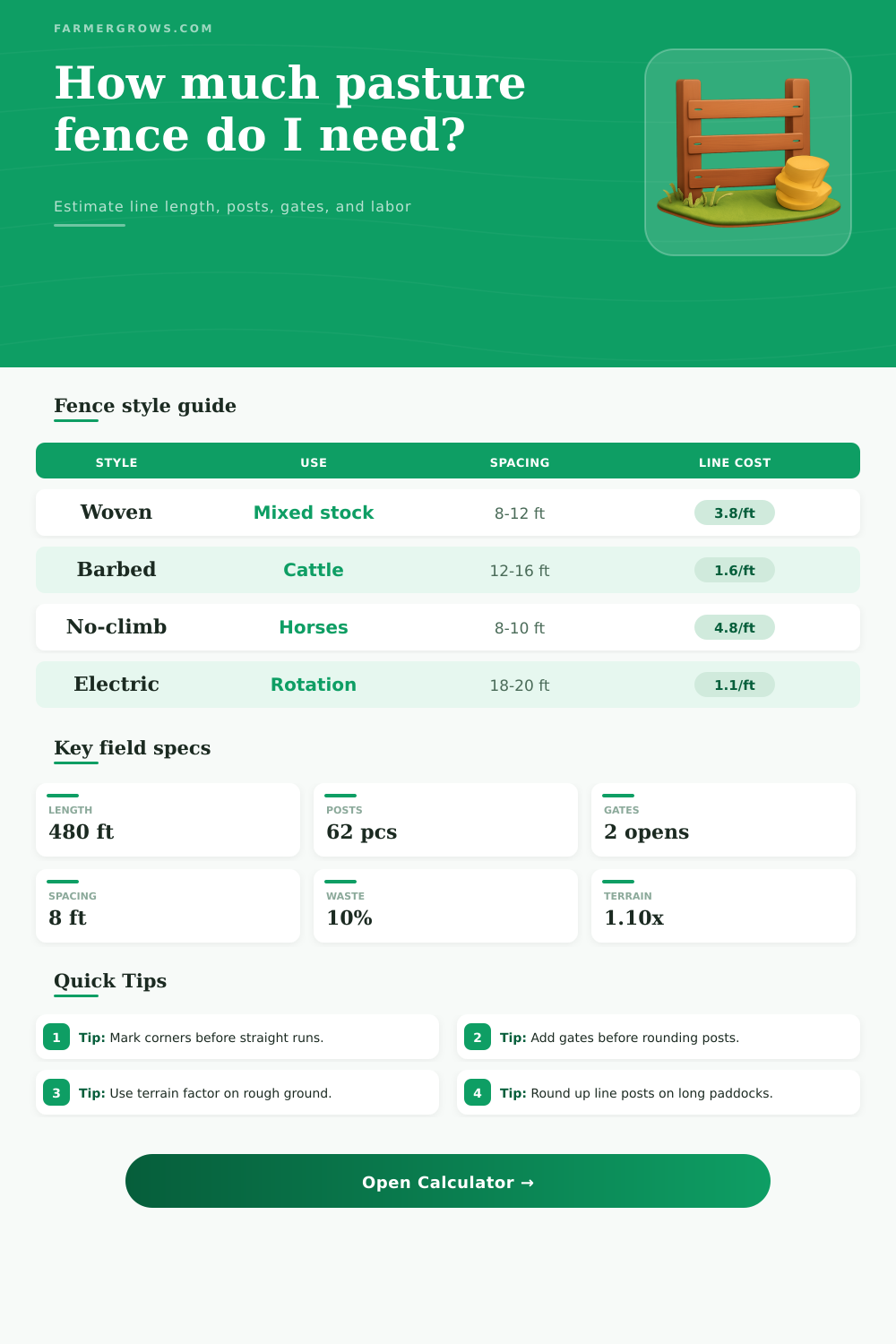
Estimate pasture fence length, post counts, gates, and installed totals from a measured paddock layout. Compare fence styles, terrain, and spacing before you order materials.
Pick a real field setup to seed the calculator. Each preset loads the fence style, layout, spacing, gates, corners, waste allowance, terrain factor, and labor rate.
Pasture Fence Output
Based on the selected layout, style, spacing, gates, corners, waste allowance, and terrain factor.
The cards below update from the current estimate so you can see the main materials and hardware before you place an order.
| Style | Best use | Spacing | Line cost |
|---|---|---|---|
| Woven wire | Mixed stock | 8-12 ft | 3.8/ft |
| Barbed wire | Cattle | 12-16 ft | 1.6/ft |
| High tensile | Rotation | 10-12 ft | 2.2/ft |
| No-climb | Horses | 8-10 ft | 4.8/ft |
| Board fence | Show horses | 6-8 ft | 8.9/ft |
| Electric poly | Temporary | 18-20 ft | 1.1/ft |
| Pipe rail | Heavy use | 10 ft | 13.5/ft |
| Horse rail | Horses | 8 ft | 5.9/ft |
| Livestock | Line posts | Corner sets | Note |
|---|---|---|---|
| Cattle | 12-16 ft | 4 | Strong corners |
| Horses | 8-12 ft | 4 | Tighter lines |
| Goats | 8-10 ft | 4 | Small openings |
| Sheep | 10-12 ft | 4 | Mesh helps |
| Rotational | 18-20 ft | 0-2 | Light moves |
| Mixed stock | 10-12 ft | 4 | Balanced layout |
| Opening | Best use | Hardware | Note |
|---|---|---|---|
| 8-10 ft | Walkways | Light latch | Small access |
| 12 ft | Utility lane | Standard set | Common size |
| 14 ft | ATV access | Heavy latch | Good clearance |
| 16 ft | Pickup pass | Heavy set | Wide opening |
| 20 ft | Equipment | Double brace | Big entry |
| 24 ft | Machinery | Brace kit | Wide route |
| Condition | Material | Labor | Note |
|---|---|---|---|
| Flat ground | 1.00x | 1.00x | Easy staking |
| Rolling hills | 1.08x | 1.08x | More layout |
| Brushy edges | 1.15x | 1.15x | Clear line |
| Rocky soil | 1.22x | 1.22x | Slow setting |
| Gate-heavy | 1.05x | 1.10x | More hardware |
| Long runs | 1.10x | 1.06x | Extra slack |
To estimate the cost of pasture fencing, a person must measure the perimeter of the pasture. The measurement of the perimeter will determine how many roll of wire will be needed to purchase for constructing the fence. Additionally, a person must identify the locations of all of the gates and corner of the pasture to determine how many posts and hardware will be needed.
It is important for a person to account for the waste that will occur in purchasing the fencing materials; extra purchases will be made for mistakes in the construction of the fence. Ten to fifteen percent more fencing materials should of be purchased to allow for waste in the construction of the fence. The type of fencing that will be constructed will impact the total cost of the fence.
How to Estimate the Cost of a Pasture Fence
Woven wire fencing are useful for those who keep small livestock in there pastures as the mesh of the woven wire will prevent the small animals from being able to escape the pasture. Barbed wire fencing is often less expensive than other types of fencing but is often used for pastures with only cattle as barbed wire fencing require specific spacing of the fence posts. Horses require no climb mesh fencing as they may get injured on flimsy fencing.
No-climb mesh fencing is more expensive than barbed wire fencing. Electric polywire fencing is a lightweight fencing option for rotational grazing. Electric polywire fencing is also easy to move since electric polywire fencing use lightweight fence posts.
Each fencing type have a different cost and each fencing type requires different hardware to secure the fencing to the fence posts. The posts for the fence will be another purchase for the farmer to consider in constructing the fence. The posts will provide the structure for the wire for the fence.
Line posts will be placed equally along the length of the fence while the corner posts will be stronger to prevent the fence wire from pulling the posts out of the ground in which they is placed. Double or triple bracing on the corner posts will ensure that the wire does not pull on the fence posts. Additionally, gates require the purchase of extra fence posts and hardware for those gates to open and close.
The location of the gates will change the length of the wire runs for the fence. The location of the gates should be planned before a person entirely measures the pasture perimeter. The terrain for the pasture will impact the cost of materials and the labor for constructing the fence.
Pastures that has flat terrain are easier to construct fences on. Flat terrain requires less labor for constructing the fence. Pastures that have rolling terrain or rocky terrain require more labor to construct the fence.
Labor will also be required to clear brush in brushy pastures before constructing the fence. An increase in the estimate for the labor requirement should be made for pastures with difficult terrain. A person can either install the fence themselves or hire a professional to install the fence.
Installing the fence themselves will save money on labor costs but will require an extensive amount of time to complete the fence installation. Hiring professionals to install the fence will increase the cost of construction but professionals can often complete the fence in a shorter period of time than an individual. A strong fence is an investment for the farmer as the fence will keep the animals contained within the pasture and protect the pasture from predators.
Finally, using a well planned fence layout to control which areas of the pasture the animals will graze upon will allow the grass to recover. Allowing the grass to recover will improve the productivity of the pasture.