
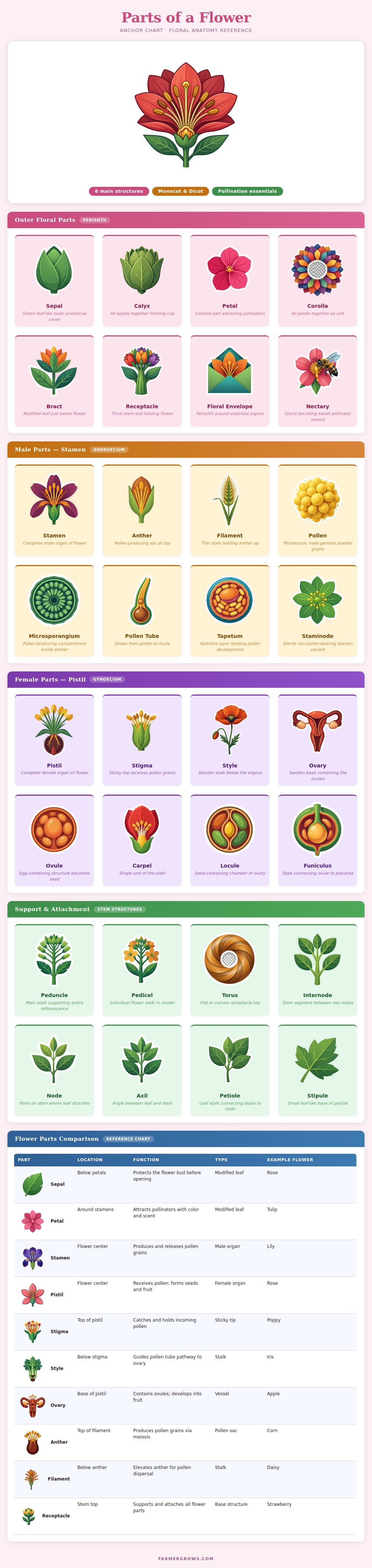
If you went to school at all, you probably got the flower 101 lecture early: there are petals; there’s pollen; there are bees (who go to flowers). This simplistic model gets us by as gardeners if we’re doing this for pleasure, but it falls apart if we want to make sense of why a particular cross doesn’t work or how a plant will set fruit. Knowing the mechanics of what happens inside a flower is the line between guessing and understanding. It is not just about color; it is biology in action, a reproductive machine.
What is on the outside of this machine? The non-reproductive part is perianth. That’s where the sepals forms a protective cup called the calyx. They form a protective cup called the calyx. Before the bud is open, the sepals guard it. When they drop off after opening, the petals step in (or out). That is the corolla, or the petals.
How Flowers Work
Their job is to market to pollinators. They use color, scent, and nectar guides to entice them to come calling. Poor nectar, dull-colored petals; pollinators say thanks but no thanks, and go elsewhere. No pollination, no visitors. It is a simple transaction.
And then there’s the good stuff. The real engine are inside that colorful envelope. Androecium (the male parts) include stamens. An anther sits atop each stamen, and it contain pollen grains produced by meiosis. These grains hold male genetic material. To get it up into the air where insects or wind might carry it, the plant raises the anthers.
The female parts are called gynoecium, or pistil. The part we can see, at the top, is the stigma, a sticky landing pad for arriving pollen. Beneath that, a pollen tube grow downward through the style toward the base, called the ovary. This ovary contains the ovules that will turn into seeds once they are fertilized. Often the ovary enlarge and becomes what we call fruit.
Think about this layout, and it changes how you see every plant in your garden. A big, flashy petal is calling out: Come here butterfly or bee. A tiny green one riding the breeze need help getting around. How does that all work? That’s what the chart above explains. It also details the structure of a flower, with the receptacle tying it all together.
And then there are those stems, so simple, so often overlooked… And yet…they’re important. Each one holds an individual flower by its pedicel; the whole cluster sits atop the peduncle, which hold up the lot. Know the location of your axil and node, and you know where that next year’s bloom will come from. What about pruning? Cut at the correct point, or no more flowers next time.
Now there are two different ways of doing this, depending on whether you’re looking at the anatomy of a monocot (such as a lily) or a dicot (such as a rose). Generally speaking, the former will be parts in three; the latter four or five. Knowing this can help with ID… but again: what’s it all about? Moving DNA.
And for the pollen to do its job, it has to be fed by the tapetum within the anther and become viable. When that doesn’t occur (because the tapetum didn’t), the pollen is sterile. A little thing. But not a trivial one. Without viable pollen, reproduction cannot happen genetically.
The bloom is what most people pay attention to, but there’s more than just that. There’s the support structure of stipules at the base of each leaf and the funiculus connecting the ovule. Seeing the flower as an assembly line. With every piece needed for it to function, makes you begin noticing where things fail. Dropped blooms or misshapen fruit are signs of poor pollination. Trace back: Was the stigma receptive? Did the pollen tube make its way through the style?
This knowledge makes gardening more strategic. Instead of merely “watering and waiting,” you know what you’re doing: helping a complicated biological process. When I see a tulip, or a rose, look beyond its color. See the pistil, ready to recieve, and those stamens stretching upward toward the air. Knowing about this transforms a casual observer into a player in the life of the plant.
The flower isn’t just decoration. It is a destination.