Pallet of Mulch Weight Calculator
Estimate a pallet of bagged mulch from bag count, bag volume, mulch type, moisture, pallet tare, compression, wet exposure, pallet count, payload rating, and stacking height.
Choose a starting pallet layout, then adjust the bag count, bag size, material, moisture, and load rating to match the shipment sitting in the yard.
Mulch Pallet Weight Results
Results update from your pallet inputs.
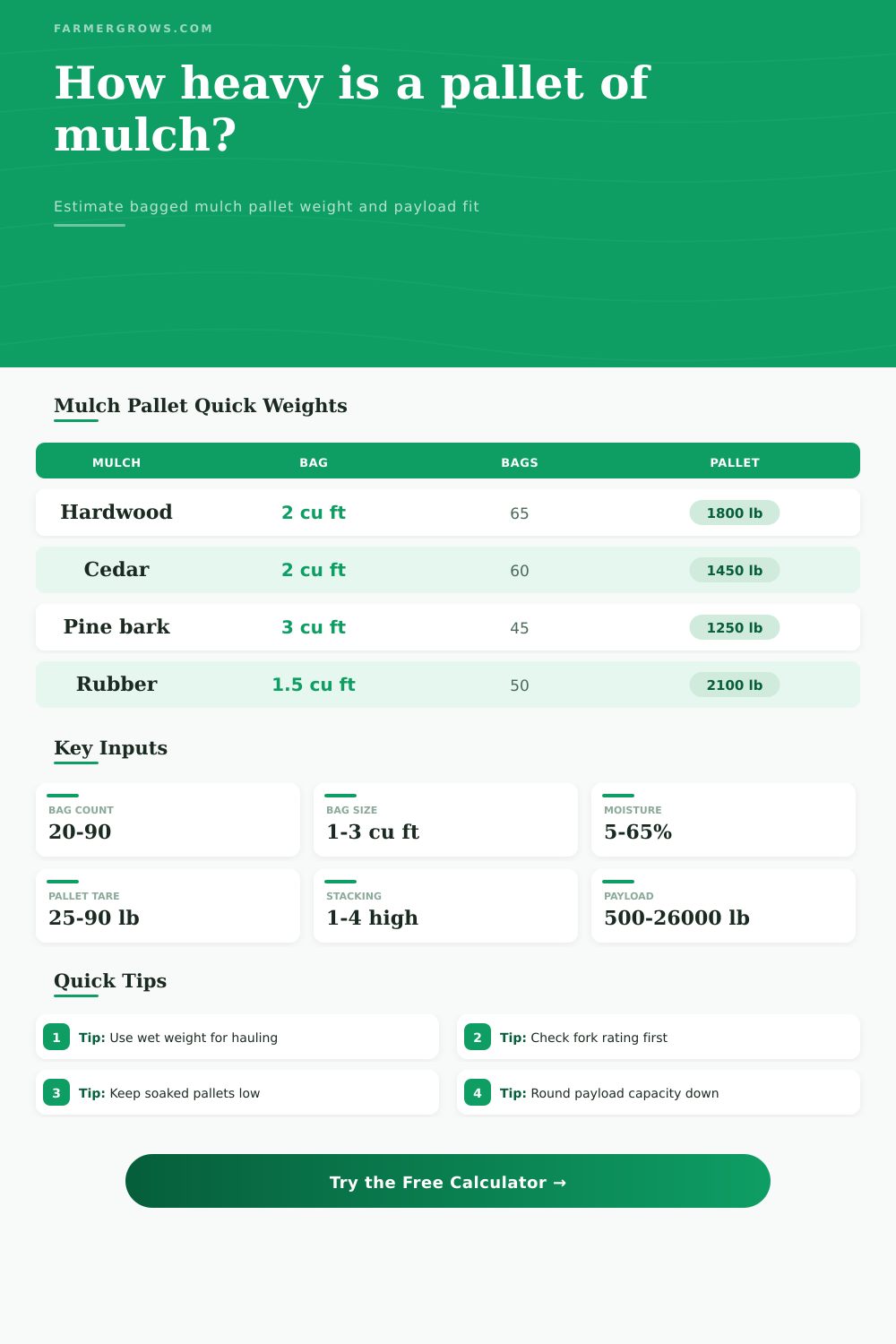
These cards show common bagged mulch density ranges. Actual weight shifts with chip size, bark species, moisture, and how tightly the bags are packed.
Most retail hardwood pallets land near 110 to 150 cubic feet before pallet tare and wrap are counted.
Fewer larger bags can hold similar total volume, but each bag is harder to hand unload when wet.
Rainwater in torn bags, pooled wrap, and saturated outer rows can push the load over trailer capacity.
Compare loaded pallet weight with fork rating, trailer payload, tailgate lift rating, and ramp limit.
| Preset | Bag setup | Typical moisture | Approx loaded pallet |
|---|---|---|---|
| Hardwood 2 cu ft Retail | 65 bags x 2 cu ft | 35% | About 1,820 lb |
| Cedar Garden Bags | 60 bags x 2 cu ft | 28% | About 1,420 lb |
| Pine Bark 3 cu ft | 45 bags x 3 cu ft | 22% | About 1,290 lb |
| Rubber Mulch Bags | 50 bags x 1.5 cu ft | 5% | About 2,360 lb |
| Landscape Crew Load | 72 bags x 2 cu ft | 38% | About 2,170 lb |
| Bag size | Bags per cubic yard | 60-bag pallet volume | 75-bag pallet volume |
|---|---|---|---|
| 1.5 cu ft bag | 18 bags | 3.33 cu yd | 4.17 cu yd |
| 2.0 cu ft bag | 13.5 bags | 4.44 cu yd | 5.56 cu yd |
| 2.5 cu ft bag | 10.8 bags | 5.56 cu yd | 6.94 cu yd |
| 3.0 cu ft bag | 9 bags | 6.67 cu yd | 8.33 cu yd |
| Condition | Use this when | Multiplier | Hauling note |
|---|---|---|---|
| Covered storage | Bags kept under roof or tight wrap | 1.00 | Best case for payload planning |
| Humid yard | Outdoor pallet with intact bags | 1.03 | Small buffer for damp plastic |
| Light rain | Surface bags wet, no pooling | 1.08 | Useful trailer safety margin |
| Soaked outer bags | Leaky wrap or torn corners | 1.15 | Check axle and fork limits |
| Standing water | Pallet sat in water or mud | 1.22 | Split loads if near capacity |
| Equipment or trailer | Typical payload range | Best use | Watch point |
|---|---|---|---|
| Compact utility trailer | 1,000-2,000 lb | Partial pallet or light pine bark | Tire and axle rating |
| Half-ton pickup bed | 1,200-2,200 lb | One dry pallet only if rated | Payload sticker, not tow rating |
| Skid steer forks | 1,500-3,500 lb | Yard loading and unloading | Rated load at lift height |
| Landscape trailer | 5,000-10,000 lb | Several pallets per trip | Axle balance and tongue weight |
| Flatbed or box truck | 10,000-26,000 lb | Multi-pallet delivery | Stack height and tie-downs |
Use the wet number for hauling. A dry sales tag can understate a pallet that has sat through rain, especially if shrink wrap traps water at the bottom.
Confirm the lowest rated part of the move. Trailer payload, fork capacity, liftgate rating, ramp rating, and axle load can each become the practical limit.
Mulch on a pallet isn’t simply wood chips; its a compaction of all that stuff plus trapped air, absorbed water from rain events, and a lot of heavy packaging. A forklift tipped over with such load can spoil a day; so can bending an axle on a truck trying to haul one in. The calculator does all the math for you, but knowing how those variables move the needle will save your equipment.
The first lesson is to know your material. Hardwood mulch is heavier then cedar, which is in turn heavier than say pine bark nuggets, due to the airspace between each nugget. Finally, rubber mulch are much heavier than any wood product.
How to Calculate Mulch Weight Safely
The tool factors in the initial base densities, but it also requires you to think about moisture… A variable that frequently surprises folks. Like a sponge, mulch absorbs water. A bag size that is easy to manage at 20% moisture content could became a dangerous, heavy weight if it soaks up rainwater. You can adjust for the wet factor using the calculator, which adds weight (for standing water or soaked outer bags). It makes sense, since shrink wrap prevents that moisture from escaping the bag and keeps the bag heavy even after the storm.
The inputs here are pretty simple: bag count and size. These determine physical load size. Even with equal weights, a pallet loaded with two cubic foot bag contains more total volume than a pallet loaded with 20-cubic-foot bags. Know this so you know whether or not your trailer has sufficient square feet.
Then there’s stacking height, which adds another problem to the physics equation. When you’re stacking pallets, the bottom one carries burden of all those stacked on top of it. That means the bottom pallet of a four-pallet-high stack is carrying almost four times the load of a non-stacked pallet. The stack load is made explicit by the calculator so that you don’t mistakenly think that just because your forklift is rated for one pallet, it will be safe at the bottom of a column of four.
Nobody worries about the boring side of the equation until the math starts adding up: Tare weight. That means everything that contributes to the weight beyond just the product. All those strapping, corner boards, stretch wrap and even the pallet itself add masss. A single empty wooden pallet might weigh upwards of 50 lbs. Multiply that by several hundred pounds of tare across ten pallets, and you have exceeded your trailer’s payload capacity without realizing it.
The page lays it out in easy-to-understand terms with their preset tables for various types of materials. This shows the difference between denser Rubber loads versus Hardwood Retail Pallets. While using presets will save you time, be sure to check against your specific supplier’s specs.
You probably don’t know about payloads. There is a big difference between the amount of weight you can pull (tow) versus the amount of weight your vehicle can hold. For example, some people has half-ton pickups rated at 5,000 pound towing capacity, but they can only carry one thousand pounds in their beds. That means mulch is heavy enough to bridge that gap easily. The calculator requires your payload rating and then it calculates how many pallets you can safely haul. It rounds this number DOWN to be safe. Why? Overload causes brake fade and tire blowouts. So it’s good they does this.
Precision meets reality: Moisture multiplies. How much moisture was on the pallets? Did it sit out in a light rain? Was it under cover, so its base density applies? Or did it get soaked? That’s a significant multiplier. And then there’s not just weight but also stability. A bag of wet mulch is heavier and slippery. It is more difficult to strap down tightly. It has less friction and more mass to account for.
Patience is a virtue when stacking for logic. Don’t stack wet pallets high; the bottom row bears the burden. That’s why the calculator displays load weight on the bottom pallet. When it gets close to your equipment’s maximum capacity, back off and lower the stack. Two trips are better then a lost load.
Check your truck’s payload sticker. Don’t guess what your truck can handle; check it instead. The source does not state that most trucks is under-rated for payload capacity. Measure Trailer Bed, Before you even start loading, use the tool to run different scenarios. Knowing how much water you’re carrying will help you avoid overloading your equipment.
Check the weather before the haul. Don’t wait until the morning of the haul. Forget it. Bring the hose out, prime the pump and apply the buffer while it’s still dry outside…just like it would of been if you’d checked the prediction in advance. Save yourself time and money with some planning. You must respect the hidden weight of water and wrap. This stuff realy makes a big difference when it comes to a smooth haul versus a busted axle.