Paddy to Rice Calculator
Estimate milled rice, head rice, broken rice, husk, bran, moisture shrink, storage loss, and process loss from one paddy lot.
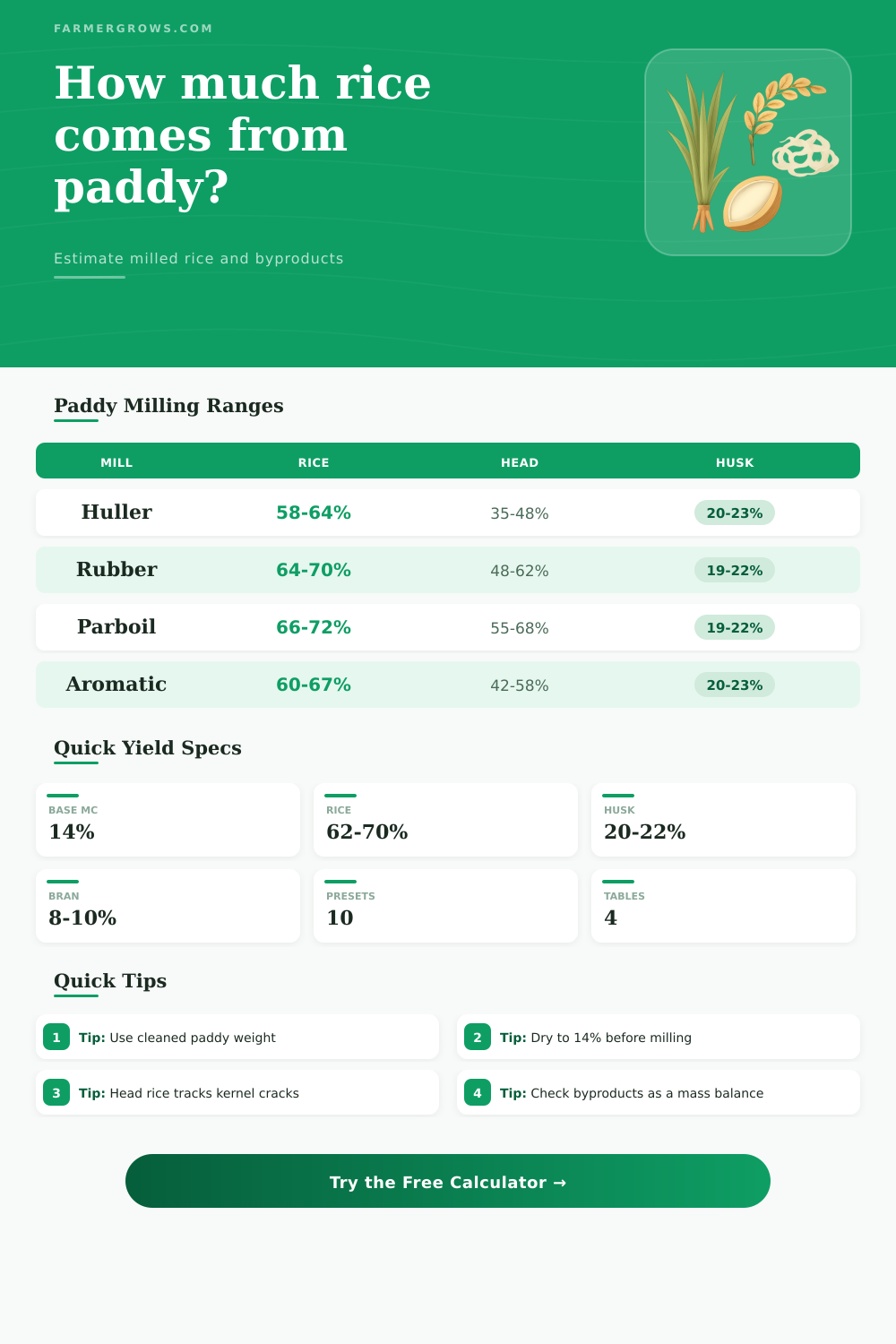
Commercial rice mills often report total milled rice near 62-70% of clean paddy at about 14% moisture, with husk around 20-22% and bran or polish near 8-10%. Adjust the inputs to match your variety, dryer, huller, sheller, and whitener performance.
Paddy Milling Estimate
Your calculated rice and byproduct balance will appear here.
| Mill or rice type | Total milled rice | Typical head rice | Field note |
|---|---|---|---|
| Traditional steel huller | 58-64% of paddy | 35-48% of paddy | Higher breakage because shelling and whitening happen together. |
| Rubber-roll sheller line | 64-70% of paddy | 48-62% of paddy | Good target for clean paddy dried evenly to the milling range. |
| Parboiled rice line | 66-72% of paddy | 55-68% of paddy | Parboiling can strengthen kernels and reduce breakage. |
| Aromatic long slender rice | 60-67% of paddy | 42-58% of paddy | Tempering and gentle drying matter because slender kernels crack easily. |
| Starting moisture | Equivalent at 14% | Shrink from wet paddy | Use case |
|---|---|---|---|
| 18% moisture | 953 kg per 1,000 kg | 47 kg | Freshly dried paddy after field harvest. |
| 16% moisture | 977 kg per 1,000 kg | 23 kg | Near-safe storage, still above common milling basis. |
| 14% moisture | 1,000 kg per 1,000 kg | 0 kg | Standard basis used by many mills for yield checks. |
| 12% moisture | 1,023 kg per 1,000 kg | Moisture gain basis | Over-dry grain may break more and often needs tempering. |
| Stream | Typical share | What changes it | Calculator input |
|---|---|---|---|
| Husk or hull | 20-22% of paddy | Variety, grain size, hull thickness, and cleaning level. | Husk fraction |
| Bran and polish | 8-10% of paddy | Whitening degree, polish passes, and bran collection efficiency. | Bran fraction |
| Head rice | Often 65-85% of milled rice | Cracks, fissures, immature grain, dryer heat, and mill pressure. | Head rice share |
| Broken rice | Often 15-35% of milled rice | Kernel length, drying stress, huller setting, and whitening pressure. | Broken rice share |
| Paddy lot | Milling setup | Expected rice | Expected byproducts |
|---|---|---|---|
| 1,000 kg long-grain paddy | 67% recovery, 72% head | 670 kg rice, 482 kg head | 210 kg husk, 90 kg bran |
| 1,000 kg parboiled paddy | 70% recovery, 84% head | 700 kg rice, 588 kg head | 205 kg husk, 85 kg bran |
| 1,000 kg aromatic paddy | 64% recovery, 65% head | 640 kg rice, 416 kg head | 220 kg husk, 90 kg bran |
| 1,000 kg huller batch | 61% recovery, 58% head | 610 kg rice, 354 kg head | 220 kg husk, 95 kg bran |
Moisture tip: Calculate recovery on a consistent moisture basis. A wet harvest lot can look heavier before drying, while over-dry paddy can crack and lose head rice during whitening.
Mass-balance tip: Total rice, husk, bran, and residual process loss should stay plausible together. If the sum goes above the paddy basis, recheck recovery and byproduct fractions.
When a farmer or a mill manager weigh a truck of paddy, the weight of the paddy is not the most important measurement. The most important measurement is the amount of usable rice that the paddy will produce after it undergoes drying, storage, and milling processes. The amount of usable rice will determine the contracts for the paddy, the amount of usable rice will determine the setting for dryers, and the amount of usable rice will determine if the season is to be profitable for the managing farm or mill.
The calculation of the amount of usable rice from a truck of paddy is challenging due to the impact of moisture levels, rice varieties, drying processes, and milling equipment on the amount of usable rice. Paddy contain water within the rice grain. As such, paddy that measures eighteen percent moisture weigh more than paddy that contains only fourteen percent moisture levels.
How to Calculate Usable Rice from Paddy
Most rice mills use fourteen percent as the moisture level for calculations of the amount of rice that can be produced from the paddy. The extra weight of paddy that is caused by the extra moisture isnt usable rice; it will travel with the paddy to the dryer until the moisture is removed. If the calculator does not adjust the percentage of moisture within the paddy, the calculator will overestimate the amount of rice that can be produced.
The calculator allows the user to input the moisture level of the incoming paddy, and the calculator display the dry weight of that paddy. The amount of rice that can be extracted from the paddy is referred to as the recovery. Recovery is not a constant number, but differs according to the type of rice that is being process, the evenness of drying of the paddy prior to milling, and the type of milling equipment that is used to remove the husk from the rice.
Rubber-roll sheller equipment is gentle on the rice, but steel hullers are more aggressive milling equipment that create cracks in the rice grains. Long-grain rice varieties are more prone to the development of cracks than short-grain rice varieties. Parboiled paddy contains cracked grains that were subjected to steam within the parboiling process, so fewer fracture occur in that type of rice.
The tool allows for the percentage of recovery of the rice to be set, as well as the split between head rice and broken rice percentages. Head rice is the most valuable portion of the paddy. Buyers will pay more for head rice that contains whole kernels rather than broken rice.
Broken rice will fetch a lower price from buyers, and it may be used as feed for animals. The percentage of head rice within the paddy is more important than the total weight of the rice that undergoes milling. The mill can increase it’s revenue by increasing the percentage of head rice that it produce.
It does not need to purchase additional paddy to accomplish this goal; it can accomplish the same goal by adjusting the settings of the mills milling equipment. Many managers pay close attention to the drying speed and tempering time of the paddy; very fast drying rate will create cracks in the rice grain that will eventually break during the milling process. Husk and bran is removed from the rice during milling.
The husk accounts for approximately one-fifth of the weight of the original paddy. Bran and polish accounts for eight to ten percent of the weight of the paddy. The husk can be used as fuel for a boiler, and the bran can be used to extract oil from bran or to provide feed for livestock.
The percentages of husk and bran is visible on the calculator. The total weight of the rice, husk, and bran is compared with the weight of the original paddy. If the total weight of the products is greater than the weight of the paddy, then at least one of the input percentage must be adjusted.
During storage of paddy, there will always be a small loss of weight. Percentages of one or two percent may be lost due to the amount of paddy that is lost to dust, insects, or spillage. While the percentage may seem small, when applied to thousands of tonnes of paddy, such a percentage becomes a large number of tonnes lost during storage.
The input field for storage loss allows for different percentages to be entered to reflect the different conditions within the warehouses where the paddy is store. The reference tables include percentages according to the type of mill. A village huller will have a different percentage of head rice than a moddern rice milling operation.
Modern rice operations separate the process of shelling the rice from the polishing process to produce more head rice. Parboiled rice tends to have high recovery percentages due to the steam process that occur in the parboiling process; aromatic rice varieties have lower recovery percentages because of the fragility of their long and thin kernels. These percentages are a means of providing a standard by which the results from the calculator may be judged.
The percentages may not always match the averages for rice farms and mills that operate under real-world scenarios. Consideration must be given to variables like weather during the harvest, as high moisture levels can lead to increased breakage. A new rice manager may not have the same level of experience in milling as the previous manager for that farm; he or she might use settings for the rice that will create more broken rice.
A delay in the delivery of the paddy to the mill will lead to a loss of paddy during transportation. While the rice calculator cannot account for these variables, it can provide a foundation upon which to base any adjustment to the settings of the rice and milling equipment. Prior to and after any major change to a farms paddy management processes, it is advantageous to calculate the percentages of each type of rice.
By comparing the percentage estimates from the calculator to the actual tickets that are released from the paddy scales at the mill, the manager can fine-tune the processes within the farm and the mill. If the percentage of head rice is less than estimated, it is likely that the drying process or the settings of the milling equipment are the cause of the low percentage of head rice. If the percentage of total rice that is recovered from the paddy is less than expected, the paddy may contain foreign matter or immature rice grains.
By making small adjustments to the drying process and settings within the mill, it may be possible to pay for these adjustments with the increased revenue that can be generated from the mill. With repeated use of this calculator, a manager will form intuition of the relationship between the variables. For instance, a manager will develop an understanding of how the weight of the rice will change with changes to the moisture percentage of the paddy.
It will become second nature for a manager to understand that some rice varieties require more gentle handling during milling than others. While intuitions cannot replace measurements, intuitions will allow a manager to quickly recognize variables within the milling process that might otherwise be overlooked if relying solely upon the measurements. While the goal of this calculator is not to create a perfect estimation of the percentages of rice components that will be produced from a truck of incoming paddy, the calculator aim to provide a reliable starting point for the calculations that are essential to the operation of a rice farm or mill.
By providing a reliable starting percentage, contracts between the farms and rice buyers can be kept honest. Furthermore, the reliable percentages will ensure that the settings for the rice and milling equipment are informed of the potential yield of that paddy. If the description of the paddy matches the percentages indicated on the calculator, and if the percentage of rice of each type matches the tickets that are printed from the scales within the mill, then the assumptions of the variables of the incoming paddy is accurate.
Thus, the calculator can be of great aid to the rice farms and mills to which it is provide.