Onion Seed Germination Time Calculator
Estimate onion seed emergence, usable stand count, thinning timing, and transplant readiness from seed-zone temperature, seed age, storage quality, day-length class, sowing depth, and nursery setup.
This calculator is for bulbing onion seedlings grown from seed. It does not model green onion cut-and-regrow crops, red-onion-only schedules, sets, or full bulb harvest timing.
Onion seed loses vigor faster than many garden seeds. Storage quality can change the stand more than cultivar name.
Warm enough for quick roots, but not so hot that the tray dries or weak seedlings struggle after emergence.
Day length does not sprout the seed, but the wrong class can make transplant timing and bulb success misleading.
The output separates emergence from thinning and transplant readiness so a good tray is not pushed too early.
Onion Germination Results
Estimated from seed-zone temperature, seed age, storage, cultivar class, depth, and nursery method.
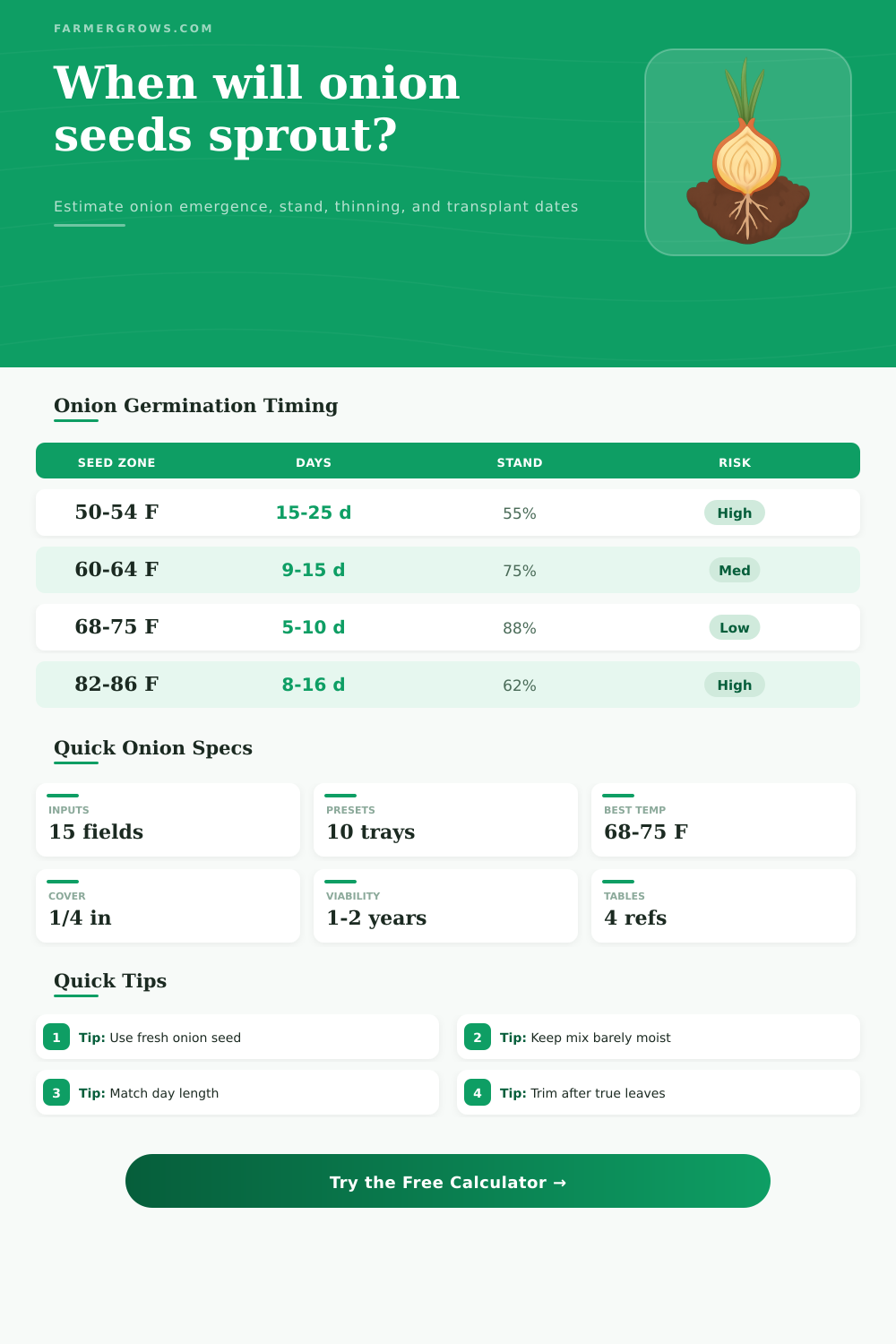
| Seed-zone temperature | Expected emergence | Stand effect | Nursery note | Calculator effect |
|---|---|---|---|---|
| 45 to 49°F / 7 to 9°C | 18 to 30 days | Weak to fair | Useful only for patient outdoor seedbeds. | Large delay and stand penalty. |
| 50 to 59°F / 10 to 15°C | 11 to 25 days | Fair | Cool room trays need steady moisture. | Moderate to large delay. |
| 60 to 67°F / 16 to 19°C | 8 to 14 days | Good | Reliable for home flats if seed is fresh. | Small delay from ideal. |
| 68 to 75°F / 20 to 24°C | 5 to 10 days | Best | Fast onion loops without excessive heat. | Best timing and stand. |
| 76 to 82°F / 24 to 28°C | 6 to 12 days | Good to fair | Watch tray drying and sealed domes. | Slight heat risk. |
| Above 85°F / 29°C | Erratic | Lower | Cool the chamber or vent covers. | Delay and higher stand risk. |
| Seed condition | Typical viability | Timing effect | Stand risk | Best use |
|---|---|---|---|---|
| Fresh current-season seed | 80 to 95% | Baseline | Low | Main onion transplants and dense flats. |
| 1 year old, cool and dry | 70 to 88% | Add 1 day | Low to medium | Still useful when packet was sealed well. |
| 2 years old | 45 to 70% | Add 2 to 4 days | Medium | Increase sowing rate or test first. |
| 3 years old | 25 to 50% | Add 4 to 7 days | High | Use for a germination test, not a critical tray. |
| Warm or humid storage | Variable | Adds delay | High | Expect patchy loops and extra blank cells. |
| Day-length class | Bulb trigger | Where it fits | Germination note | Planning warning |
|---|---|---|---|---|
| Short-day | About 10 to 12 hours | Southern and mild-winter regions | Sprouts like other onion seed. | Plant too far north and bulbs may form too early. |
| Intermediate-day | About 12 to 14 hours | Middle latitudes | Good general seedling behavior. | Choose transplant date to avoid tiny premature bulbs. |
| Long-day | About 14 to 16 hours | Northern summer gardens | Often grown in flats under lights. | Too far south may grow leaves without proper bulbing. |
| Giant exhibition | Usually long-day or special strain | Carefully scheduled starts | May need more seedling days. | Do not judge by storage-onion timing alone. |
| Unknown packet | Unknown | Risky for bulb planning | Can still germinate normally. | Calculator adds planning risk to transplant result. |
| Nursery method | Seed density behavior | Thinning cue | Transplant cue | Calculator note |
|---|---|---|---|---|
| Open nursery flat | Forgiving and easy to trim | Loops upright, first true leaves starting | Pencil-lead thickness or 3 to 4 leaves | Best for many home onion starts. |
| 288-cell plug tray | Small cells dry quickly | Thin weak doubles early | Move before roots stall | Adds slight stand and timing risk. |
| 128-cell plug tray | More root room | Thin to strongest seedling per cell | Good plug integrity after hardening | Balanced plug option. |
| Soil blocks | Air-pruned, slower if coarse | Trim tops if they flop | Block holds together when watered | Useful for market trays. |
| Outdoor seedbed | Weather-dependent | Thin after rows are visible | Lift carefully before crowding | More temperature and crusting spread. |
| Paper chain strip | Dense and uniform | Remove weak gaps before transplant | Set when roots bind the chain lightly | High target count, watch old seed. |
Do not save critical onion starts for old seed: If the packet is older than two seasons, run a small towel test or sow extra. Onion seed often drops faster than tomato, brassica, or lettuce seed.
Keep the seed zone steady after the first watering: Onion seed needs oxygen as well as moisture. A barely moist, fine mix beats a sealed, soggy tray even when the temperature is perfect.
Onions are fussy about early conditions. They want warmth and oxygen, too. Unlike generic packets of hope (the way you treat onion seeds), onion seeds don’t last as long as those of peppers or tomatoes. And you did nothing wrong: Old seed, combined with cold soil and poor air circulation, probably meant you had empty cells.
These variables is all calculated by the calculator. It will tell you when the onion seeds will sprout, when to thin the sprouts, and when they’re finally ready to go out into the open air. Most people focus entirely on the emergence date, but that’s a mistake. In fact, that’s the danger zone, getting those onion seedlings from sprouted to big enough to transplant. Those who hurry the process just because the ground has gotten warm tend not to have bulb later in the growing season, or maybe even bolts.
Tips for Growing Onion Seeds
Germination depends on temperature, but not linear. In fact, onion seeds germinate best when kept within a narrow range of about sixty-eight to seventy-five degrees Fahrenheit. Outside those limits: one way or another things start going wrong. Too cold? Fungi will get the better of them. Too hot? Above eighty, things move quickly; enzymes do their thing, making for thin, weak growth.
The trick is to look not just at air temperature in your room, but at seed-zone temperature. Seeing where you fall on the map can help you find sweet spot. If your house is chilly, a heating mat will keep the soil snug. Remember: It’s roots, not leaves, that power germination.
There’s also the question of seed age. Onion seed is among the shortest-lived of all familiar garden crops. That 2-year-old packet may be just as pretty as the day you bought it, but its energy reserves are greatly depleted. They’re mere kernels that have lost much of their fuel. The calculator takes into account both the seed’s age (and how it was stashed) and adjusts your anticipated stand accordingly. Moist storage conditions is especially bad. If yours sat in a warm, humid garage, it will have started out at a disadvantage… And so you’ll need to sow thicker to make up for blanks. Knowing the estimated germination rate beforehand can spare you the weeks-long agony of waiting to find out otherwise.
Day length plays no role in whether the seed sprouts, but it dictates whether the resulting plant will ever produce a bulb worth eating. But day length matters to the plant that grows from the seed: Will it even develop a bulb big enough to eat? The Day-Length Calculator uses this variable to calculate how soon it will be ready to transplant. However, it doesn’t change how fast the seed itself sprouts. Long-day onion plants are genetically programmed for growing in northern states, and short-day ones for places with a shorter day length, such as the South. If you plant an onion of the wrong type for where you live, yes, it will still sprout. You’ll just get an onion plant that produces only green leaves, never swelling out into a bulb. That’s a sneaky little trap for lots of people. It catches those of us who think all onions grow on the same schedule, regardless of their genetic triggers.
Another factor is depth, which most of us assume wrongley. Remember that onion seed is small. A depth of a quarter-inch is typically sufficient. Bury it deep enough in a moist but not soggy medium-fine mix so the tender sprout can push its way up. Use more depth if you are using heavier soil. The tool factors that depth into the wait time, too. The more deeply you sow, the more energy the seed will expend and the longer it will take to emerge.
Note the thinning instructions in results page. They are about more than just space. They’re about weeding out weaker individuals to give those who’ll make it room and air. A crowded tray left too long risks the crop being wiped out by damping off disease. This can happen faster then even bad weather can do it.
Planting onion seeds isn’t rocket science (but then again), neither is planting anything else. But unlike many other things, onions requires precise timing, not brute force. Let nature take its course and she’ll do her job; try to rush things and it’s game over. There’s no getting around the role of temperature, moisture, and seed age in all this. With these factors in mind, turn guesswork into a plan… And get ready for those first signs of life: the tiny green loops. They’re just the beginning. What matters most? What matters is whether you can nurse those precious starts past their early fragility and out into the garden, where they’ll face another challenge.
Here’s what we know: Fresh seed is best. Keep soil evenly moist but not sodden. Use the numbers to help you stay patient.