Onion Growth Time Calculator
Estimate onion sowing, transplant, bulbing, harvest, cure, frost risk, bed spacing, and plant count from daylength type, variety, USDA zone, planting method, and your dates.
Onions are calendar crops and light-sensitive crops at the same time. This planner uses daylength class, establishment time, maturity days, frost dates, and spacing to build a practical harvest window; confirm exact local dates with your seed packet and local extension guidance.
Onion Growth Plan
Enter your onion dates and spacing to estimate the harvest window.
| Onion class | Typical latitude or USDA fit | Bulbing daylight | Usual planting season |
|---|---|---|---|
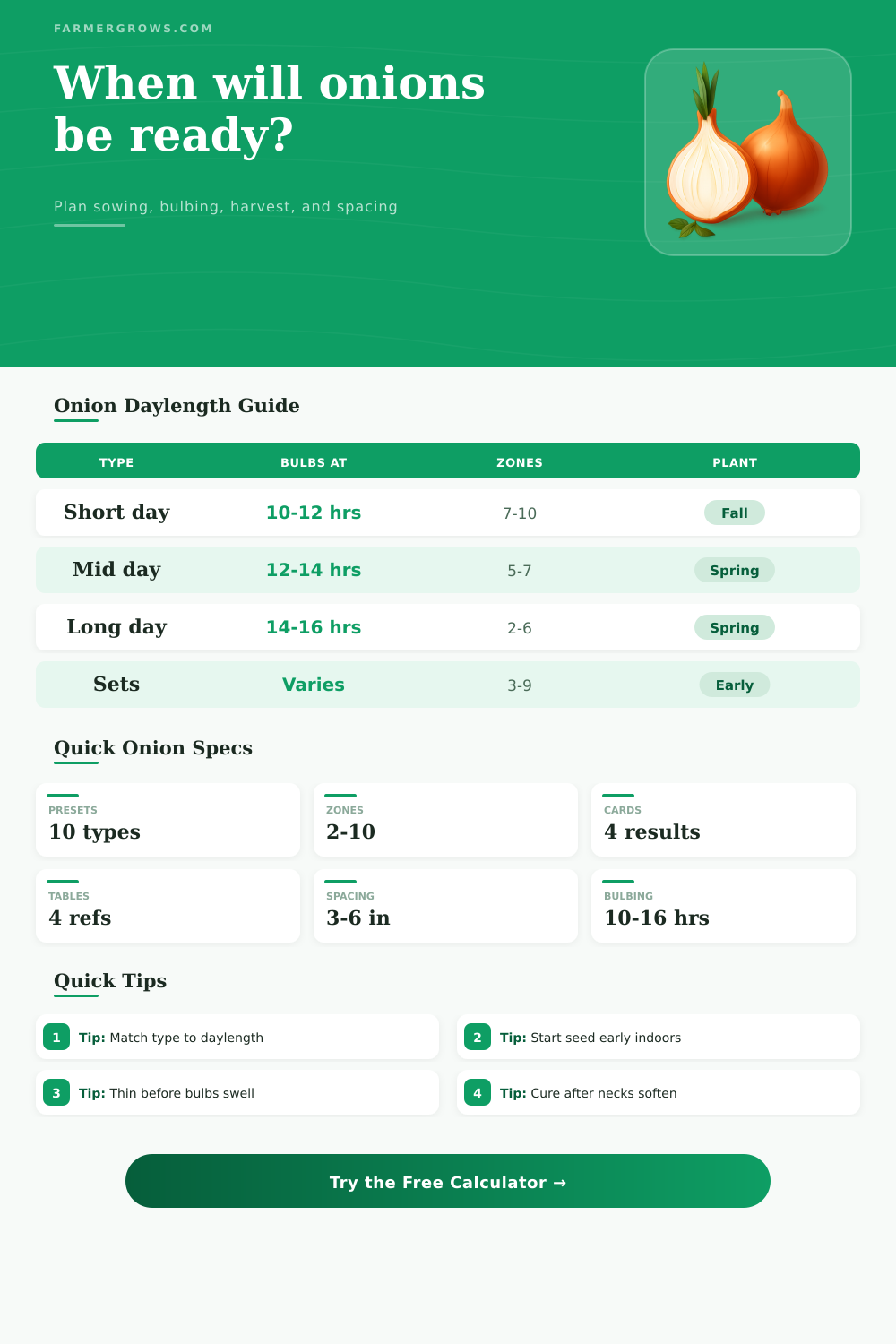
| Short-day | Southern zones 7 to 10 and low-latitude gardens | About 10 to 12 hours | Fall to winter planting for spring bulbs |
| Intermediate-day | Middle zones 5 to 7, often 32 to 42 degrees latitude | About 12 to 14 hours | Early spring or mild fall starts |
| Long-day | Northern zones 2 to 6 and high-latitude summers | About 14 to 16 hours | Very early spring transplants or seed starts |
| Day-neutral | Flexible garden use, especially mixed climates | Usually around 12 to 14.5 hours | Use local packet timing and frost window |
| Variety | Daylength class | Typical maturity | Best use |
|---|---|---|---|
| Texas 1015Y | Short-day | 105 to 115 days | Large sweet bulbs in mild southern seasons |
| Yellow Granex / Vidalia style | Short-day | 100 to 110 days | Sweet fresh onions, not long storage |
| Red Burgundy | Short-day | 95 to 110 days | Red fresh onions in warm regions |
| Candy | Intermediate-day | 85 to 100 days | Broad-adapted sweet yellow bulbs |
| Walla Walla | Intermediate to long-day | 90 to 110 days | Sweet overwinter or spring transplants |
| Patterson | Long-day | 105 to 115 days | Firm yellow storage onions |
| Copra | Long-day | 100 to 110 days | Long-keeping northern yellow onions |
| Redwing | Long-day | 110 to 120 days | Red storage crop for northern gardens |
| Crop target | In-row spacing | Row spacing | Planning note |
|---|---|---|---|
| Green onions / scallions | 1 to 2 inches | 6 to 8 inches | Harvest young before bulbs need shoulder room. |
| Medium bulb onions | 3 to 4 inches | 10 to 12 inches | Good home garden balance of size and count. |
| Large sweet onions | 5 to 6 inches | 12 to 18 inches | Use wider spacing for large, mild bulbs. |
| Storage onions | 4 to 5 inches | 12 to 15 inches | Even spacing helps uniform neck drying and curing. |
| Starting material | Typical bulb timing | Harvest signal | Curing window |
|---|---|---|---|
| Sets | 70 to 95 days after planting | Half or more tops have fallen naturally | 10 to 14 days in dry airflow |
| Transplants | 85 to 120 days after transplant | Bulbs sized and necks soften | 14 to 21 days for storage onions |
| Direct seed | 110 to 160 days from sowing | Seedlings reach full leaf count before bulbing | Start curing after tops lodge |
| Overwintered short-day | 180 to 240 days from fall sowing | Spring bulbs swell as days lengthen | Cure before summer humidity if possible |
Tip: Long-day onions planted too far south may wait for daylight they never receive, while short-day onions planted too far north can bulb before the plant has enough leaves for a large onion.
Tip: For storage onions, stop heavy nitrogen after bulbs begin swelling and cure only sound bulbs with tight necks; thick-necked or damaged onions should be eaten first.
Onions are a timed crop: Plant too soon or too late, or miss the window of cold weather they need (called “frost windows”) and you’ll have small bulbs. They rely on daylength to grow. Planting at the wrong time for your location can provide wrong daylength type. This results in small bulbs because the plant bolts before it has enough leaves to produce a good bulb. That’s why getting this right, bulb trigger matching the calendar, is important for an onion that lasts a long time in storage. Too many onions fails at this point, soften prematurely and thus don’t last very long.
The initial choice is daylength class. To bulb, short-day onions requires days of 10-12 hours; they’re for areas with mild winters where plants can grow through the cool months and swell before summer heat arrives. Grow bulbs before summer heat arrives. Conversely, long-day types needs 14-16 daylight hours to trigger bulb formation, which happens further North where days in June are already long. Intermediate onions (zones five through seven) falls in between and offer some adaptability. Use the calculator to see whether your latitude offers enough daylength, sparing you the guesswork about variety requirements.
How to Plant Onions at the Right Time
The timing is very different depending on how you plant. Direct-seeding takes longer because seeds germinate outdoors. Starting indoors gives you a headstart in variety selection and spacing. However, you has to factor in how long it takes for the plants to be ready to go out after starting under lights. If you overwinter crops, it pushes things into fall. And that’s fine if your first frost date is late enough for your seedlings to still harden off. With sets, it all depends on getting ones that hasn’t grown too big. Bolting also happens fast.
Spacing decisions affect bulb size and overall yields. Wider spacing is better for larger bulbs, but it mean fewer plant in a bed. With scallions or smaller bulbs, space them tightly to get more of them. Or space closely for any variety, if you want less likelihood of thick-necked bulbs (which are harder to cure). The tool takes row dimensions into account when calculating how many plants will fit. So you know your options, more bulbs or bigger ones? Mark it on the bed first.
And then there’s the matter of frost: Will a late spring frost delay planting, or set back transplants that has been put into ground? Or will an early fall frost shorten the curing window? The calculator compares your harvest window to both sets of frost dates, and flags it if margin appears too small. That’s helpful, since curing requires low humidity and steady air flow, which are hard to find on cold, damp nights.
If you plan in this manner, it will prevent you from planting onions like set-it-and-forget-it crops. You’ll have a sense of timing, when to expect bulbs to start forming based off changes in day length. You’ll understand how long it takes for whatever method of establishment you use. You will also learn if there is enough time to cure them under frost conditions in your area.
It makes the rest of the year a sequence of little tweaks rather than a crapshoot, and it would of been better to start earlier. Actually it should be moddern.