
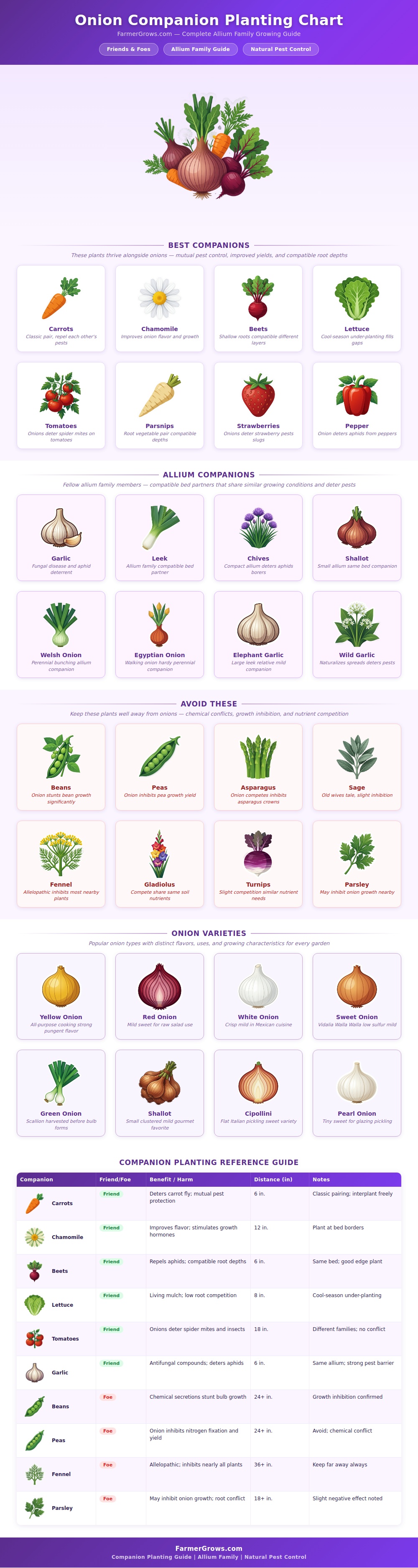
To understand what’s going on in a vegetable garden, go underground. Plants is considered good neighbors, sticking to their own beds; most gardeners believe this and it’s comforting. In truth, some do get along (onions make great companions); others battle one another at a chemical level. Knowing who gets along, and why, can help you create a strong ecosystem in your garden. Those relationships are illustrated nicely in the graph above.
First: Onions (and alliums) gets their family name because they contain sulfur-rich compounds, which repel many garden pest. That’s how onions mostly protect themselves. And you can use this trait to help protect some crops that may be attacked more easily by insects.
How Onions Help Your Garden
Why are onions and carrots a good combination? For one thing, carrot-root flies is attracted to the aroma of carrots, but onions mask it with a powerful odor of their own, keeping the flies at bay. Bonus: the onions gets something out of it, too. Onion roots don’t compete with carrot roots, which are growing deeper than onions, instead each crop gets what it needs without tussling over same space. It is a smart use of space with no competition, creating a win-win scenario.
Leeks, chives, and garlic are other good companions. Why? They are like-minded because they all prefer similar growing conditions. And they also work against pests similarly: Planting garlic among your onions multiplies the sulfur barrier; that’s great against fungal diseases and aphids. The chart says plant it within six or so inches from them; a closer planting is better than farther apart. That way you get a thick zone of protection. It is an aromatic fortress, no pest can break through that wall easily. Plant close: think team defense.
But not all plants like what’s good for the onion; in fact, beans and peas are big no-no’s due to that very same sulfur. The sulfur interfere with the bacterium required by peas for growth. Keep them at least two feet apart to prevent your legumes from being slow-growing and having low yields. Keep them separated to avoid chemical interference.
In fact, pretty much any plant doesn’t like fennel, an anti-growth agent that stops nearby plant development. Again, keep it in its own bed, well away from everything else.
Consider nutrient requirements and root size, too. Shallow-rooting lettuce is great under larger plants that need to be mulched. It will prevent weeds and retain moisture on the soil. Other shallow-rooters include onions. These fare well when growing alongside deeper-rooted things such as parsnips or tomatoes, which provides a different level of nutrients. Tomatoes also appreciate onion’s pest-protection properties (particularly from the spider mite). The two roots don’t interfere with each other.
It is also important to know what kind of onion you are using. Onions with higher sulfur content (like yellow) is stronger tasting. Those lower in sulfur, like Vidalia sweet onions, have a milder odor. That alters their pest-repelling power. The stronger the onion, the more it will protect adjacent plants.
There are no hard and fast rules to companion planting. It’s more that you understand the needs of plant. You want them to work together to create healthy soil, control pests, and provide nutrients. If you set up your beds for this, you’re creating a balanced community. That’s good gardening… Using their underground connections to help you, and it makes for a productive garden. You should of looked at the roots first.