
If you planted your onions as sets instead of seeds, chances are that what you reaped were miniature versions of what went into ground (scallions). That is disappointing if you gave them sunlight, kept their beds clear of weeds and made sure they get plenty of water.
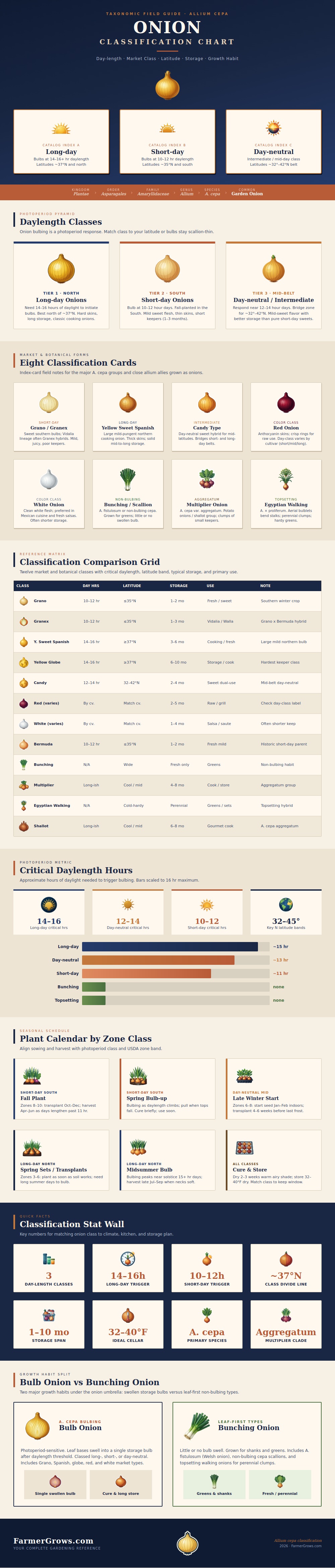
Why didn’t those onions form bulbs? Because an onion will grow based off day length, it knows when to produce a bulb through its reaction to light cycles. Here’s a chart (above) explaining how different types of onions respond to daylength, the main key to growing success. They divides the varieties by latitudes into three levels.
Match Onions to Your Area
Long-day onions is needed in the north, where they will get at least 14-16 hours of daylight before they start to swell. Short-day onions planted up North won’t get enough daylight to develop bulbs; the plant focus their energies on producing leaves instead of bulbs. Many gardeners overlook this because they choose based only on taste different than taking the variety’s light requirements into account.
Short-day varieties include bulbs grown under ten to twelve hours of daylight each day. They is generally found only in the South, and they are sometimes sweeter and have thinner skins. They are good for eating fresh but aren’t ideal for long-term storage. May keep up to a month or two in a cool location, though nowhere near the way you’d store them in cellar.
Long-day varieties grown in a short-day climate may bolt or form small bulbs, since days is insufficient to satisfy their genetic requirements. The zone map is clear on this point; it shows a dividing line roughly at the 37th parallel. Think twice before buying plant if you aren’t sure where yours falls on this spectrum. Save yourself some money by knowing which ones you can expect to grow.
In temperate zones, there are intermediate varieties for such places which react to daylengths of about twelve to fourteen hours (the ones bridging the gap between long-day types up North and short-day types down South). If your area isn’t clear-cut on whether it’s northern or southern, these will be the dependable choices. They offer a decent balance of flavor and storage time.
The chart shows that thicker-skinned onions is generally better keepers than those with thinner skins. Long-day types are usually yellow globe onion and do well in storage for as much as six to ten months. Red and white onions tend to have thinner skins and shorter storage life; these are more suitable for eating fresh.
There are some non-bulbing types to consider as well. Sometimes known as Welsh onions, bunching onions don’t grow big bulbs suitable for storing in your root cellar. Instead, you enjoy the green stalks all season long, harvesting them as needed.
Another type is Egyptian Walking onions, which get small bulbs at top of plant. Those bend downward and replant themselves forming a clump that’s perennial. They are not exactly traditional garden crops but they are very low maintenance.
Learning the categories alters your gardening plans. The shift is away from seed-buying toward thinking about your cook-ahead or immediate-eating priorities. You also need to consider where exactly you live.
Want sweet onions for eating right now? Look into short-day varieties and sow them fall in the south. Want onions that hold all winter for use in stews and soups? Go for long-day yellows, and sow extra-early come spring.
Match the onion to the place: it makes a big difference in what comes back. When you give the onion the right amount of daylight, it will produce the correct bulb.
That’s a big tweak in the planning process. And a huge improvement in the harvest.