Olive Trees Per Acre Calculator
Estimate olive orchard density, productive acres, total planting spots, order reserve, pollenizer count, row length, and trees per irrigation zone from spacing and management assumptions.
Use this calculator before staking rows or ordering trees. The base formula is 43,560 square feet per acre divided by row spacing times in-row spacing, then adjusted for orchard system, productive area, access lanes, mortality, and reserve.
Olive orchard density plan
Adjust inputs to calculate spacing density, total tree order, and row planning numbers.
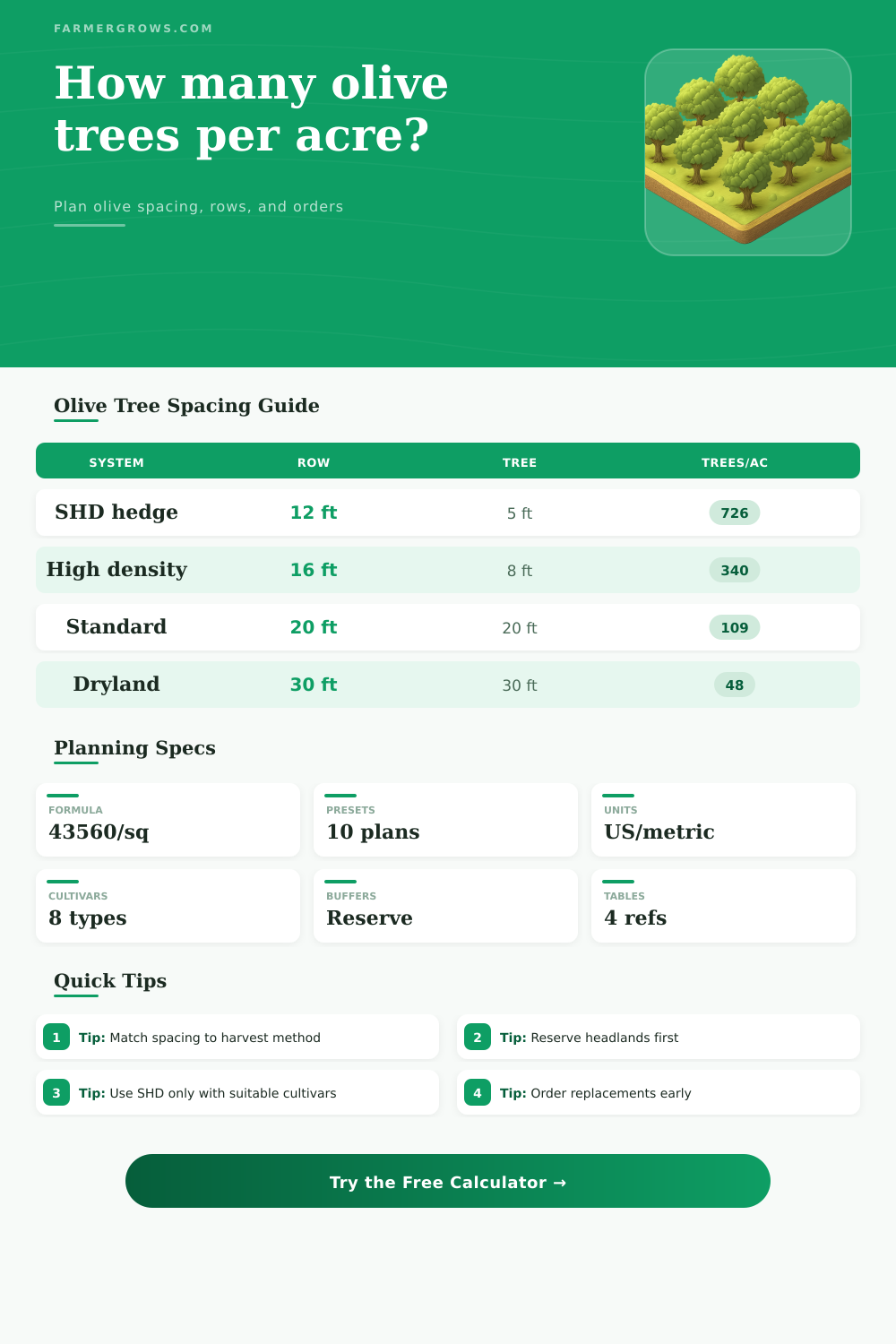
| Olive system | Typical row spacing | Typical in-row spacing | Approx trees per acre | Best fit |
|---|---|---|---|---|
| Super-high-density hedge | 10 to 13 ft | 4 to 6 ft | 560 to 1,089 | Mechanical over-row harvest, drip irrigation, low-vigor cultivars |
| High-density hedgerow | 13 to 18 ft | 6 to 10 ft | 242 to 558 | Early bearing, pruning discipline, moderate machinery access |
| Intensive open orchard | 16 to 22 ft | 12 to 18 ft | 110 to 227 | Table olives, dual-purpose cultivars, shaker or hand harvest |
| Standard open-vase grove | 20 to 25 ft | 20 to 25 ft | 70 to 109 | Large canopy training, older grove layouts, wider equipment lanes |
| Traditional dryland grove | 28 to 35 ft | 28 to 35 ft | 36 to 56 | Low rainfall, low-input systems, broad mature trees |
| Cultivar profile | Vigor | Common use | SHD fit | Planning note |
|---|---|---|---|---|
| Arbequina | Low to medium | Oil | Strong | Popular for hedgerow systems because canopy stays manageable. |
| Arbosana | Low to medium | Oil | Strong | Often used in SHD systems with careful annual pruning. |
| Koroneiki | Medium | Oil | Moderate | Can work in hedges but needs training to avoid excess height. |
| Picual | Medium to high | Oil | Limited | Better for high-density or standard spacing than the tightest SHD rows. |
| Manzanillo | Medium | Table | Limited | Plan enough canopy room for fruit size, picking, and spray coverage. |
| Mission | Medium to high | Dual purpose | Limited | Often needs more space than compact oil cultivars. |
| Frantoio or Leccino | Medium | Oil | Moderate | Useful in mixed oil groves with moderate density and pruning. |
| Spacing | Rectangle grid | Hedge adjustment | Triangular grid | Typical read |
|---|---|---|---|---|
| 12 ft x 5 ft | 726 trees/ac | 764 trees/ac | 839 trees/ac | Super-high-density olive hedge |
| 13 ft x 5 ft | 670 trees/ac | 705 trees/ac | 774 trees/ac | Dense Arbosana or Arbequina block |
| 14 ft x 6 ft | 519 trees/ac | 546 trees/ac | 599 trees/ac | Hedgerow oil olive orchard |
| 16 ft x 8 ft | 340 trees/ac | 358 trees/ac | 393 trees/ac | High-density intensive system |
| 20 ft x 20 ft | 109 trees/ac | 115 trees/ac | 126 trees/ac | Standard open-vase grove |
| 30 ft x 30 ft | 48 trees/ac | 51 trees/ac | 56 trees/ac | Traditional dryland spacing |
| Allowance item | Low | Typical | High | Use when |
|---|---|---|---|---|
| Headlands and turn rows | 4% | 8% | 15% | Harvesters, bins, mowers, and sprayers need end-row movement. |
| Roads and irrigation blocks | 2% | 5% | 12% | Main lines, valve stations, access roads, and sumps cross the orchard. |
| Establishment loss | 3% | 6% | 15% | Raise it for heat, salinity, wildlife, poor drainage, or distant sites. |
| Order reserve | 3% | 5% | 12% | Extra trees cover weak plants, planting damage, and early gaps. |
| Alternate cultivar share | 0% | 10% | 25% | Use for pollenizers, oil blend blocks, or table and oil cultivar mixes. |
For SHD olives: Keep the spacing tied to the harvester window, cultivar vigor, pruning plan, and irrigation reliability. Dense hedges fail quickly when canopies outgrow the row.
For wide groves: The trees-per-acre formula is exact, but dryland performance depends on stored soil moisture, slope, soil depth, and how much canopy the site can support.
“Growing olives is not something you do lightly; it’s going in for the long haul. It’s committing your labor and land to a long-term investment. The way you plant your landscape determine what machinery you will buy and what your income stream will be for three decades.” Often new growers make mistake of beginning by deciding what kind of olive they want to grow. For instance, maybe they hear about Arbequina being popular and go from there, trying to fit as many olive trees as will fit onto acre. But they aren’t considering mechanical harvest which causes problems.
Begin by deciding how you’ll harvest and then work backward to figure out how many tree you can fit into that system. It’s just basic geometry, but there are some variables that demands concrete choices. You have 43,560 square feet per acre. Divide that by the number of rows and distance between them (or trees, if it’s a forest crop) and you’ll have your theoretical max capacity.
Plan Your Olive Trees Before Planting
In reality, theory is rarely matched on an actual working farm, take into consideration tree mortality in the first few years, width of headlands used for tractor turns, and space required between blocks for things like irrigation lines. Once you input your measurements, calculator will do all math for you, no need to try to convert units, no need to guess at the right coefficient. Before you invest in stock, let it show you what a five percent reduction in productive land would mean to your bottom line.
Some super-high-density systems reaches upwards of seven-hundred trees per acre (but that’s precise work). They want hedge made of cultivars that don’t mind close quarters, and respond favorably to regular trimming. Planting a vigorous type such as Mission in close quarters become a problem: Canopies will connect and form an impenetrable wall that blocks sun, and makes for hard disease control. So the tool lets you specify the desired vigor profile. It will then alert you if your space constraints don’t match your selected cultivar’s natural growth habit.
It’s not simply about fitting trees in; it’s about accommodating their healthful growth while still being able to access them with machinery. There are perhaps just forty or maybe even just fifty trees per acre in dryland. On paper that may seem like a sparsely planted orchard, but keep in mind the available water and nature of soil. The wider spacing mean less competition for moisture and more room for their root systems to expand into greater amounts of earth. Also it greatly reduces cost to plant initially.
But there is a trade-off. You will get slower returns and higher long-term management costs per pound of fruit, because each individual tree yield less than a group of trees in a densely packed block. Do you want cash now or do you want long term resilience if things get really dry? Plan ahead to have some trees in reserve. Any time a tree is planted, it has a set death rate due to planting mistakes, pest issues, or poor soil drainage. Then there are years like this, when the supply dries up and price soars. Order 5-10% more then you think you’ll need to keep things even and running down the row. It’s not only good insurance, but saves scrambling next year for what you won’t be able to find.
To achieve this balance between access and density in a plan, I’ve designed a series of reference tables (on that page). These tables lets you see various systems side by side and look at what each will do. For example, what’s the best row length for maximum harvest efficiency? How does it affect total number of trees when you add pollenizer blocks into equation? What is most productive layout to fit onto an acre of ground?
It’s not about filling up an acre with as many trees as possible; it’s about designing an entire system that functions as an ecosystem, appropriate to your climate and business model. When you figure out the spacing part, the rest usualy falls more easily into place. You should of wanted a grove that doesn’t fail in the first five years and breaks your bank, or a grove that doesn’t bear any fruit, either.