Olive Tree Growth Time Calculator
Estimate first olive crop date, meaningful bearing, mature production ramp, chill and heat fit, and yield potential from cultivar, rooted cutting or grafted tree, climate zone, irrigation, canopy training, and starting age.
Pick a named scenario, then adjust the planting date, tree age, cultivar, propagation type, chill hours, summer heat, irrigation, and training style to match your orchard or patio tree.
Compact, precocious, lower chill, and friendly for containers or high-density rows.
Small fruit, strong oil quality, warm-climate fit, and steady ramp when irrigated.
Useful table olive with moderate chill demand and better crop after canopy fills.
Slower traditional tree that rewards open-center training and patient ramp time.
Good oil cultivar with moderate vigor; give room and manage alternate bearing.
Your Olive Growth Timeline
Results update after calculation.
| Cultivar | First crop baseline | Chill need | Mature habit | Best use |
|---|---|---|---|---|
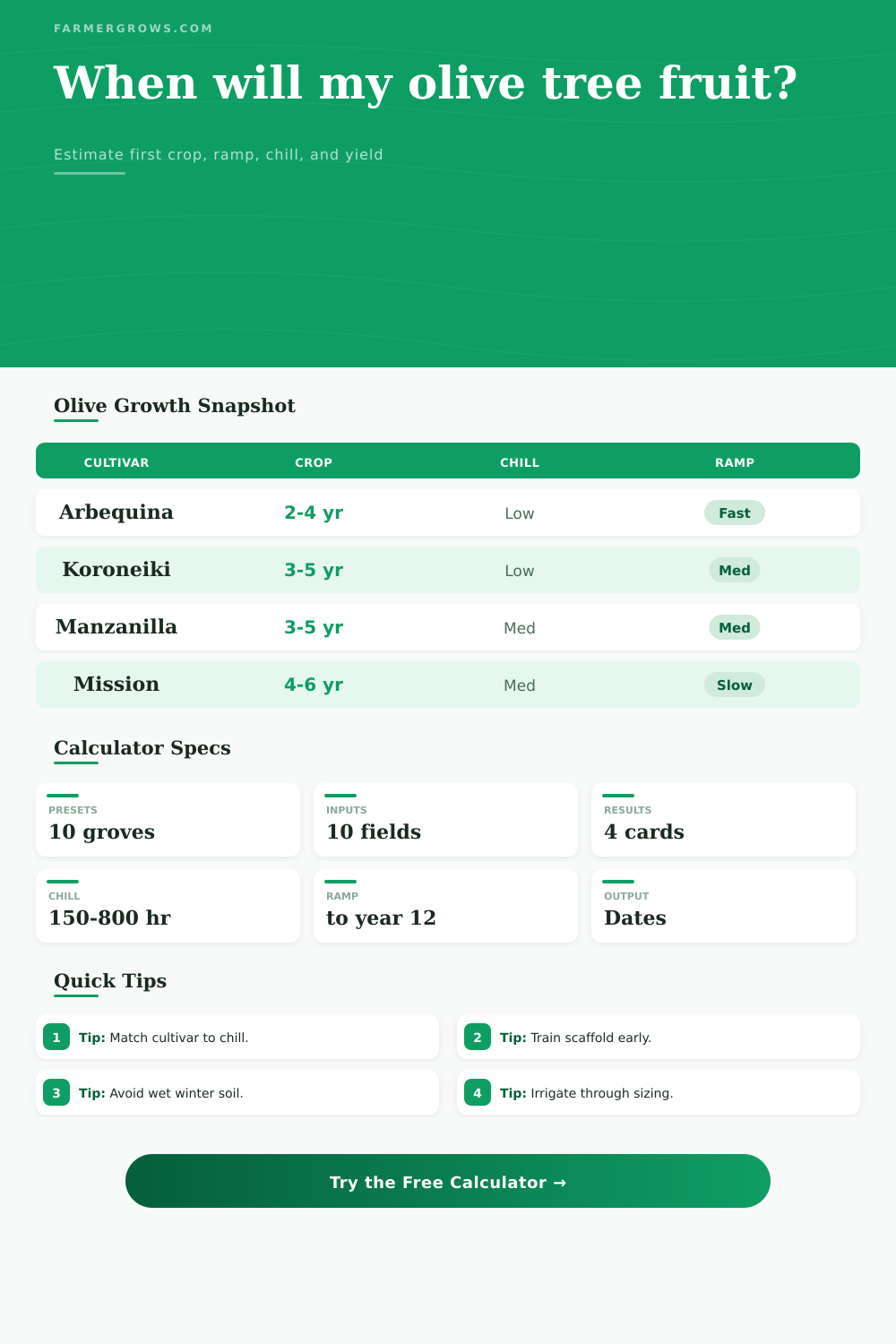
| Arbequina | 2 to 4 years | Low, about 150 to 300 hr | Compact, precocious | Oil, patio, high-density rows |
| Arbosana | 3 to 4 years | Low to moderate | Compact, upright | Oil and hedgerow systems |
| Koroneiki | 3 to 5 years | Low to moderate | Moderate vigor | High-quality oil in warm sites |
| Manzanilla | 3 to 5 years | Moderate | Medium canopy | Table olives and home orchards |
| Mission | 4 to 6 years | Moderate | Large traditional tree | Dual-purpose classic cultivar |
| Frantoio | 4 to 6 years | Moderate | Vigorous, spreading | Oil, blended groves |
| Picual | 3 to 5 years | Moderate | Vigorous, productive | Oil and dry summer climates |
| Leccino | 4 to 6 years | Moderate to higher | Medium vigor | Cooler olive margins |
| Kalamata | 4 to 6 years | Moderate | Medium to large | Table olives with warm fall |
| Picholine | 3 to 5 years | Moderate | Moderate vigor | Table or oil, trained rows |
| Source or system | Timing effect | Canopy goal | Watch point |
|---|---|---|---|
| Rooted cutting | Reliable baseline; often fruits after structure forms | Build trunk and scaffold limbs | Do not overcrop tiny trees |
| Grafted tree | Often 6 to 12 months earlier if vigorous | Balance rootstock vigor with cultivar shape | Remove rootstock suckers |
| Young liner | Usually 6 to 18 months behind a larger nursery tree | Fast establishment and straight trunk | Protect from heat and drying wind |
| Field-grown tree | Older canopy may crop sooner after transplant recovery | Rebuild fine roots, then carry crop | Water deeply during establishment |
| Open center | Slightly slower first crop, strong long-term bearing wood | Three to five scaffold limbs | Keep center light and airy |
| High-density hedge | Can bear early if cultivar is compact | Continuous fruiting wall | Needs pruning discipline |
| Condition | Good signal | Delay signal | Calculator effect |
|---|---|---|---|
| Winter chill | Meets cultivar need by 50+ hr | Short by more than 100 hr | Better flower set or 0.5 to 1.5 year delay |
| Summer heat | 80 to 95 F typical highs | Cool summer or 105 F dry stress | Faster growth or fruit sizing penalty |
| Frost margin | Zone 9 to 10 Mediterranean site | Zone 8 cold pockets | Recovery time and crop risk adjustment |
| Water | Moderate drip during establishment | Dryland first two summers | Changes first crop and mature yield |
| Drainage | Fast-draining mineral soil | Wet winter clay | Root delay and climate-fit warning |
| Tree age | Typical crop stage | Ramp share | Management focus |
|---|---|---|---|
| Year 1 to 2 | Establishment, roots, trunk | 0 to 5% | Water, staking, trunk selection, no heavy crop |
| Year 3 to 4 | First light olives on early cultivars | 5 to 25% | Scaffold training, remove weak interior shoots |
| Year 5 to 6 | Useful home harvest in good sites | 25 to 55% | Balance fruiting wood with renewal growth |
| Year 7 to 9 | Regular bearing begins | 55 to 85% | Manage alternate bearing, irrigation, and pruning |
| Year 10 to 12+ | Mature production band | 85 to 100% | Maintain light, airflow, harvest access, and vigor |
Olive yield varies widely by cultivar, spacing, pruning, climate, crop load, and alternate bearing. Use this as a planning estimate, then refine with your own harvest records.
Chill first: A warm coastal site can grow healthy trees but still miss enough winter chill for reliable flowering on some cultivars.
Train early: The first three years are mostly architecture. Choose scaffold limbs, remove low suckers, and keep light moving through the canopy.
Water wisely: Olives tolerate drought after establishment, but young trees size faster when drip irrigation supports summer growth without waterlogging roots.
Expect ramping: First fruit is not mature production. Plan for a slow build toward full bearing, especially with table cultivars and traditional trees.
When looking at that little nursery tree, you dream of a large crop, or maybe even some oil! Who wouldn’t love such an image (but Mother Nature has her own timetable), and you’re not on it. Years are required for an olive tree to develop its internal systems; only after all this does it begin producing fruit. Grow olives prematurely, however, and the tree will be stunted and never meet it promise.
How long do you wait? Use the calculator. It will do the math for your variables. No more guesswork.
Why Olive Trees Take Time to Grow
Some varieties of olive are patient; some aren’t. Precocious varieties (like Arbosana, Arbequina) bears early, within two to four years. They flower easily and generate fruiting wood fast. Slower-bearing varieties (such as Kalamata, Mission), by contrast, will be 6-plus years before they begins providing a worthwhile yield.
Why does this matter? Because when you do the math, the timing change your planning (and your cash-flow). The precocious tree would of been good if you have a small container you want to see fruit right now. For an orchard that you plan to maintain for a long time, the slower start is not so bad. Match your timeline with the tree.
Climate is also a big part of all of this. Setting proper flower buds requires winter chill hours, and if your area doesn’t provide enough chilly hours, the olives won’t flower at all; no matter how much you prune or water the tree. To help you understand: The tool will show you how many chill hours accumulate in your area compared to what’s needed for each cultivar. There is no fertilizer or watering that can absorbs this biological factor.
Then there’s the fact that even when there’s enough cold, too much hot (without an ample amount of water) can cause stunted growth and smaller fruits. In other words, you want just enough winter cold to force the tree into bloom without damaging its buds. You then need summer warmth to allow the crop to mature fully without stressing the canopy.
How you train the young tree also shifts the timeline significantly. You generally want to establish your vase shape or open center fairly early on by keeping three or four good scaffold limbs and removing everything else from the trunk below, which most growers will agree helps them develop. It’s counterintuitive: Cut back branches when you want more growth, right? But it funnels their energy into a tree with good structure to support coming crops. You don’t want a tree whose early crop was just on some weak wood, and then breaks down under load… Or that never fruits consistent later on. Trimming now invests in a stable structure, trading immediate biomass for ultimate dependability.
How you irrigate young plants the first several years will be make-or-break: do you have a tree on your hands or a straggly survivor? Young olives does not like sopping-wet feet, particularly when soil around them is cold. But neither do they want to go without regular moisture while they’re getting established, pushing along new growth. However, once they are mature, deficit irrigation can work in a dry climate because it forces the tree to seek out water, which produces better-quality oil. With a sapling, though, consistent but moderate watering help develop its root system to carry it through later periods of drought. You aren’t just keeping it alive, you are putting down a foundation.
If you look at the reference table, you’ll notice that it takes a decade for production to gradually ramp up. No instant bang for your buck. Rather, there’s a steady rise from nothing to some production to partial output to full capacity at about 10-12 years old. That slow build-up also prevents tiring the tree out, while helping it keep reproduction in balance with its vegetative growth. Adjusting one’s mind-set to accept this tempo alters expectations; you don’t demand results instantly but savor gains bit by bit every season.
Cultivating an olive tree is a matter of cultivating both soil and time. For the first five years, an experienced grower will help the tree get started. After that, let it do most things on its own. Water regularly, prune carefully, and avoid rushing nature. Let your tree develop naturaly, and it will reward your patience with decades of steady harvests. When you allow it to gradually strengthen itself based off its internal patterns, not yours, you’re really reaping what you sow, years before the first olive darkens.