Okra Growth Time Calculator
Estimate okra growth time from planting method, cultivar days, soil temperature, daily heat, transplant age, frost-free season, harvest span, pod picking interval, and cultivar height.
Load a cultivar and climate pattern, then adjust dates, heat, soil temperature, harvest span, plant count, and picking interval for your garden.
Best when soil is genuinely warm. Cool soil adds emergence delay before heat units build.
Useful in short seasons. The calculator credits part of transplant age toward first pod timing.
Pods size quickly in heat. Short picking intervals keep pods tender and plants producing.
Okra loves heat but stops with frost. Late plantings can run out of harvest span.
Your Okra Growth Timeline
Enter planting and heat details to estimate first pods, harvest rounds, and frost-season fit.
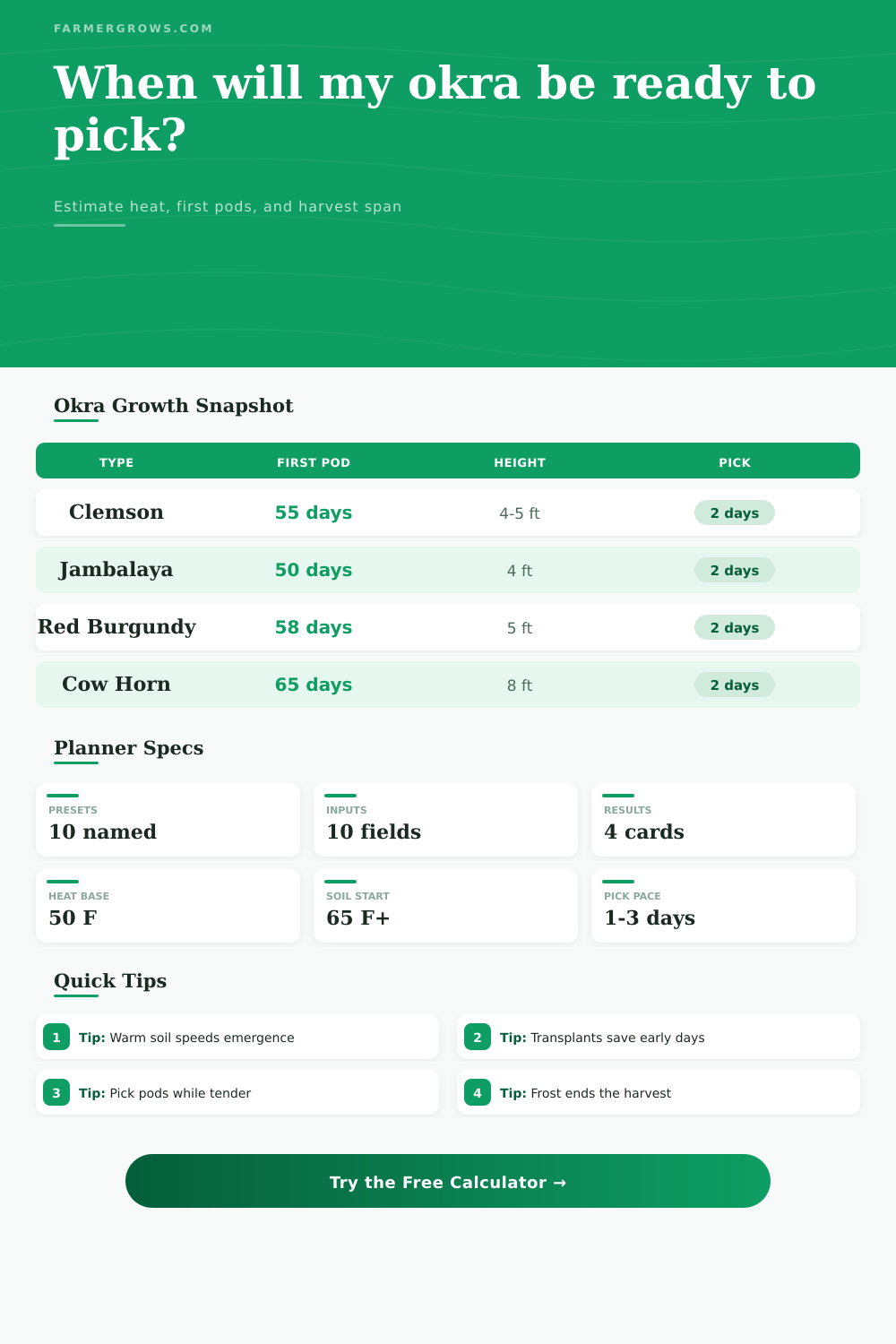
| Cultivar | Typical first pods | Plant height | Growth habit | Harvest note |
|---|---|---|---|---|
| Clemson Spineless 80 | 55 to 60 days | 4 to 5 ft | Standard home garden row | Pick 2.5 to 3.5 inch pods often |
| Jambalaya | 50 to 55 days | 3.5 to 4.5 ft | Early compact hybrid | Good fit for shorter frost-free windows |
| Red Burgundy | 55 to 60 days | 4 to 5 ft | Red pod ornamental edible | Pods toughen if left too long |
| Cow Horn | 60 to 70 days | 7 to 9 ft | Tall heirloom type | Needs heat, room, and frequent picking |
| Baby Bubba Hybrid | 52 to 55 days | 3 to 4 ft | Compact container type | Useful for patios and tight beds |
| Condition | Soil temperature | Daily heat pace | Timing effect | Grower action |
|---|---|---|---|---|
| Too cool for okra | Below 60 F | Slow GDD gain | Emergence can stall or rot | Wait, cover, or start transplants |
| Marginal start | 60 to 64 F | Low to moderate | Add several delay days | Use soaked seed and warm bed |
| Good planting soil | 65 to 70 F | Steady growth | Normal catalog timing | Direct seed works well |
| Hot summer soil | Above 70 F | Fast growth | Pods arrive sooner if moist | Keep irrigation even |
| Method | Usual timing | Calculator adjustment | Best use | Watch point |
|---|---|---|---|---|
| Direct seed | After frost, soil warm | Full emergence delay applies | Warm climates and long seasons | Cool soil delays first pods |
| Soaked direct seed | Warm soil only | Small emergence credit | Faster stand in settled weather | Do not soak into cold beds |
| Transplant | 2 to 4 week plants | Credits part of plant age | Short seasons and early crop | Avoid root-bound seedlings |
| Succession sowing | Every 3 to 4 weeks | Use each sowing separately | Long, steady pod supply | Late sowings need frost room |
| Picking interval | Pod quality | Labor rhythm | Plant response | Use case |
|---|---|---|---|---|
| Every day | Very tender | High attention | Keeps plants setting pods | Peak heat and small pods |
| Every 2 days | Good tender pods | Balanced routine | Common home garden rhythm | Most Clemson-style rows |
| Every 3 days | Mixed tender and large | Lower labor | Some pods may pass ideal size | Cooler weeks or large pods |
| 4 days or more | Often fibrous | Too slow in heat | Old pods can reduce new set | Seed saving only |
Heat-unit math is a planning estimate. Actual growth changes with soil moisture, fertility, pest pressure, day length, cultivar strain, and how often mature pods are removed.
Heat tip: Okra is not just counting calendar days. Warm nights, hot afternoons, and soil above 65 F move it much faster than cool spring weather.
Harvest tip: Once pods start, picking every 1 to 3 days matters. Overmature pods become fibrous and can slow the next flush of flowers.
Gardeners who sow too early an okra are doomed to a certain kind of letdown: The seed just sits there in the chilly wet earth, as nearby tomato plants climbs the fence, and then, when the weather finally warms up, the okra goes on it’s merry way. But not according to any calendar; it obeys only the ground temperature.
When’s the best time? It is not necessarily when you read it on your calendar, but when the soil has had time to work with you. Cool soil might even kills the seeds without letting them germinate. It’s all about the math; you input your climate data where you live (no guessing whether a mild day is “warm enough”) and the calculator do the rest.
How to Grow Okra Successfully
Days to harvest are listed on seed packets, but again: They’re assuming a perfect scenario of constant soil warmth and warm nights, never a cloudier week or chiller snap. In real life, nope, it isn’t that neat. Your garden has weeks like that, your own personal weather pattern; so what? The tool fills the space between catalog data and actual conditions, based off your average high and low. It take your weather pattern, and turns it into growth degree days, the tally of thermal energy accumulated by the plant.
The key to getting seeds to emerge is soil temperature. Ideally, 65 degrees Fahrenheit minimum are needed for okra to get going. Below that, things just go downhill. If you’re impatient (and who isn’t?), consider soaking seeds overnight before planting, starting them indoors as transplants, or… If you have a shortish frost-free season, remember that the calculator credits you with growth that happened while those seedlings were in your windowsill or greenhouse. Three-weeks-earlier indoors makes up for lost time when fall come on fast.
Once the plants are planted outside, the rate of change is very different. Picking daily, or at least every other day, is critical because okra love heat. The hotter it grows, the quicker the pods grow as well. Quickness not only means more harvests, but also better ones; pods goes woody within a couple of days of being ripe, particularly in high summer. If they leave any pods on the plant at all, it tells them to give up making flower buds and just work on ripening seeds. Pick every one or two day, and keep the plant happy. Based off the first frost date the calculator gives you an estimate of how long your harvesting will last: How many picking cycle do you have until winter?
The choice of cultivar also makes a difference. Some kinds (such as ‘Clemson Spineless’) grow tall and produce steadily; some (like Baby Bubba) are compact enough to fit into containers (so you can fit the plant’s biology into your space and labor capacity). The types vary in their days to first pod and final height (as you can see in the reference table).
Taller plants will mean a longer harvest time. They will also need more space and perhaps more staking if the wind is strong. Shorter plants may yield fewer total pods, but they are easier to keep up with in close quarters. That’s why it’s all about making the plant’s biology match what you’ve got physcially in the way of space and labor capacity.
Okra’s a lesson in timing and making the best of what you have: You can’t make the sun shine any hotter, but you can plant things where they get it best, and grow accordingly. You could of also pre-warm soil with the help of black plastic and cloches. So do the math, get out your calculators… And then go watch the plants. Pick the pods when young and crispy, and observe carefully how long they takes to form.
You wait and wait for the soil to warm up, feeling as if time has been wasted. But then those green shoots pushes through and remind us all that nature operates on its own schedule.