
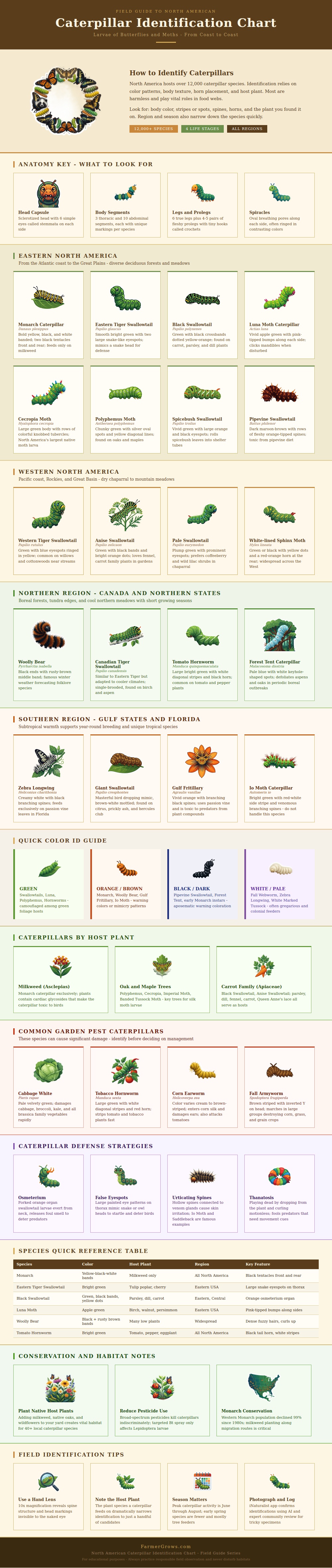
What is that fuzzy green thing on your tomato? Leaf, you say? No, that’s one of more than twelve thousand species of North American caterpillars; a very big group, but there is no need for a Ph.D. You just need to shift your perspective on what we mean when we say “garden” to learn how to identify them.
Breaking this down by where you live and the specific features of each animal help make it a bit more doable. Let’s start with: what does it eat? And what does it look like? Caterpillars is often particular eaters, so your best clue comes from host plant. Is it a striped worm on your milkweed? Chances are it’s a Monarch larval form. These larvae store their own poison to protect them from birds and help pollinators. You see the same pattern of stripes on a tomato plant? You’re probably fighting a hornworm, which will gobble up your garden, so knowing if it’s one or the other is not only helpful for your plants, but for the rest of your ecosystem.
How to Identify Caterpillars in Your Garden
The puzzle adds another wrinkle: regional variations. Some big species occurs in eastern forests. The Luna moth caterpillar is one, and its adult form is one of our biggest native moths. Other creatures, such as western fennel-feeding or scrub-blending swallowtails, fit an arid habitat. Specialists inhabits northern boreal zones, including the Woolly Bear caterpillar, which has bands that people have long used to predict the weather. Scientists don’t use those predictions, though seeing the caterpillar does signal that time of year is coming.
Depending on the species, they all defend themselves in different ways: some are perfect matches for the foliage; others use bluster and other forms of deception. The swallowtail larvae will show off a forked orange organ (called an osmeterium) that the caterpillar releases a foul odor from. It is dramatic for its size, but it is enough to make predators think twice before nibbling. Then there are those with venomous spines, like the Io moth caterpillar, which are best not touched at all, only admired. What is the defense? It may tell you when to take a step back, or forward.
Correct identification is also key to proper management: If you notice leaf-chewing damage, many gardeners grab can of all-purpose pesticide, killing not just pests but also valuable beneficials. If you’re selective (keeping certain plants tended), letting go in other areas. You’ll provide habitat for some things (native milkweeds, for instance, and oaks) while allowing local biodiversity to flourish on the rest. That’s good for caterpillar-eating mammals such as bats and birds, who needs them as a major source of food during breeding season.
And then there’s just plain paying attention, which is the most effective tool of all. With a hand lens, see what you couldn’t before; those ring patterns surrounding their breath holes; tiny hooks on their feet. Record where and when you saw something (early spring is different than late summer for feeders, for instance). Take some pictures along the way, and you’ll create a personal record. Your eye will get better with time. Confusion becomes recognition, which leads to appreciation.
You will notice that your Pipevine Swallowtail is actualy imitating a bird dropping. You know the garden gets trickier than you thought. It should of been a small thing, but it matters.