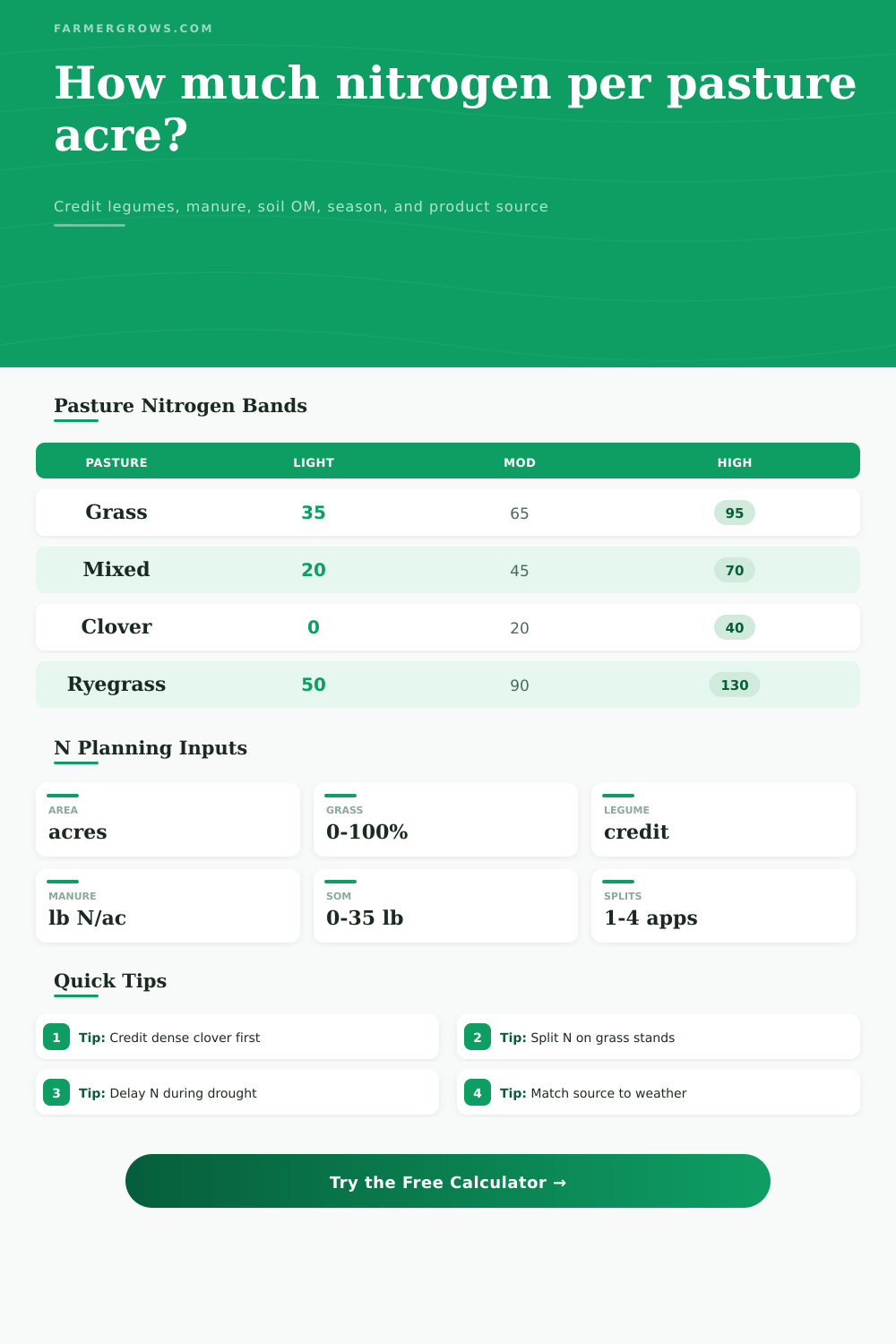
Nitrogen per Acre for Pasture Calculator
Estimate commercial nitrogen needs for grazed pasture after stocking pressure, grass and legume mix, season, soil organic matter credit, manure credit, source analysis, acreage, and split timing are all considered.
Choose a realistic pasture scenario, then fine tune the acreage, stocking intensity, grass-to-legume balance, soil organic matter credit, manure contribution, nitrogen product, and split schedule.
Pasture Nitrogen Results
Nitrogen recommendation after stand, soil, manure, and timing credits.
| Pasture situation | Base annual N | Typical split | Best fit | Watch point |
|---|---|---|---|---|
| Grass maintenance pasture | 35 to 70 lb/ac | 1 to 2 apps | Cow-calf, horses, moderate grazing | Soil test P and K still matter. |
| Improved grass rotation | 65 to 110 lb/ac | 2 to 3 apps | Managed rest periods and strong regrowth | Split N to avoid one large flush. |
| Hay plus grazing | 90 to 150 lb/ac | 3 to 4 apps | Fields where forage is removed | K removal often becomes limiting. |
| Winter annual grazing | 80 to 140 lb/ac | 2 to 3 apps | Ryegrass, small grain, sod-seeded pasture | Time N after summer grass slows. |
| Thin stand renovation | 25 to 70 lb/ac | 1 to 2 apps | Recovery fields needing canopy repair | Seed and weed pressure may matter more. |
| Legume share | N credit used | Commercial N posture | Common examples | Management note |
|---|---|---|---|---|
| 0 to 10% | 0 to 10 lb/ac | Treat mostly as grass | Grass sod with scattered clover | N response is usually visible. |
| 15 to 30% | 15 to 40 lb/ac | Reduce modestly | Mixed grass-white clover | Keep pH and K favorable for legumes. |
| 30 to 50% | 35 to 70 lb/ac | Use lighter N | Clover or lespedeza mixed stand | Too much N can suppress legumes. |
| 50% plus | 60 to 100 lb/ac | Often no spring N | Alfalfa-grass or strong clover | Focus on P, K, sulfur, and lime. |
| N source | N analysis | Product for 50 lb N/ac | Application note | Volatility risk |
|---|---|---|---|---|
| Urea 46-0-0 | 46% | 109 lb/ac | Use rain, incorporation, or stabilizer when surface applied. | Higher |
| UAN 28-0-0 | 28% | 179 lb/ac | Liquid band or stream application can reduce leaf burn. | Medium |
| UAN 32-0-0 | 32% | 156 lb/ac | More concentrated liquid source than UAN 28. | Medium |
| Ammonium sulfate | 21% | 238 lb/ac | Adds sulfur along with nitrogen. | Lower |
| Calcium nitrate | 15.5% | 323 lb/ac | Fast nitrate source with calcium. | Lower |
| Split pattern | Share pattern | Useful season | Why use it | Keep under |
|---|---|---|---|---|
| Single application | 100% | Maintenance or small total rates | Simple when total N is low. | 40 to 60 lb N/ac |
| Two equal splits | 50% / 50% | Spring plus regrowth | Balances early growth and later recovery. | 50 to 65 lb N/ac |
| Three seasonal splits | 40% / 35% / 25% | Long grazing season | Feeds growth windows without one large flush. | 45 to 55 lb N/ac |
| Four rotational splits | 30% / 25% / 25% / 20% | Intensive paddock rotation | Fits multiple grazing cycles. | 35 to 45 lb N/ac |
| Spring plus fall stockpile | 55% / 45% | Stockpiled fescue or fall reserve | Pushes late forage after summer stress. | 50 to 65 lb N/ac |
Use the calculator's higher base rate when grass is dense, legumes are below one-third of the stand, and moisture supports regrowth.
Moderate clover or alfalfa stands can supply meaningful nitrogen, so the commercial rate should fall before product is calculated.
When hay leaves the field, nitrogen demand rises, but potassium removal often becomes the limiting fertility issue.
Split N around establishment and late winter growth so ryegrass or small grain forage is fed when it can respond.
Use lighter rates unless the stand is managed intensively; excessive N can favor weeds and reduce stand balance.
N helps existing grass respond, but seedling establishment, pH, grazing rest, and weed competition may decide the outcome.
Credit legumes before buying nitrogen. A pasture with a strong clover or alfalfa component can supply enough N that a grass-only rate would overfeed the stand and weaken legumes.
Split N when rates climb. For grass pastures, smaller applications timed to active regrowth usually beat one large shot that risks loss, leaf burn, or a short-lived flush.
It’s Tuesday morning, and as you walk out to the pasture, a stand of perfect-looking green fescue catches your eye, but then you notice your herd trudging through it as if it were sawdust. There’s the grass all right, but no protein. And that, most likely, is your nitrogen story.
When you’re managing pasture, you don’t just grow grass. You grow animal feed, and engine that drives its protein content are nitrogen. Get the rate wrong and you’ll either be watching your forage quality crash as plants starve for nutrients, or else waste money on fertilize that turns into gas in air. But first, define your particular scenario. Then let the tool do the rest (above).
How to Use Nitrogen in Pastures
Begin with acknowledging what’s already occurring in soil. This is step most producers skip. Got alfalfa? Or clover? Those plant are fixing nitrogen out of air and putting it back into the soil, which should of been credited. Why pay for electricity when you’re standing in sunlight? The calculator credits the biological contribution and then you just buy what’s not present. It will also count manure and soil organic matter as credits. If you’ve got cattle rotating through that paddock, they drop a surprising amount of nutrient credit right back onto ground. You’ll never see it with your eyes, but it’s there, returning big on your investment.
Nitrogen does change with season. Fertilizing in early spring on cold, wet ground set you up for loss. It is too easy for rain to carry the soluble nutrients to first creek instead of letting them go to grass roots. The calculator accounts for this because you choose your window of growth. It’s one thing to have a flush of growth in the spring, another to try to push regrowth in the height of summer. Nitrogen in the heat of July travels quickly, good if you’re trying to take it up; bad if you’re hoping to store it. Ideally you’d have the fertilizer where the root system are actively seeking it out, not down in soil, ready to leach.
The most efficient solution is to split up those apps. “You’re taking your chances putting all 60 pounds down at one time.” Rain washes it out deep; the next day, the heat takes some away; and before long, the green stuff has grown so much more faster than you can chew. When you break that same load into two or three smaller doses, you maintain a constant supply. The chart that comes with this tool show the relationship between grazing intensity levels and split dosing schemes. For maximum effect, high-density rotations needs regular little shots to keep forage tender and full of protein. It is not a one-shot deal. It is a rhythm thing.
The math doesn’t care what form you buy; product choice is far less important than commonly believed. However, urea will evaporate if it’s sitting on top of dry soil, requires water to be effective, and is cheap and concentrated. Ammonium sulfate contains less percentage-wise nitrogen but adds sulfur (many soils is lacking this), so that’s a better bet. And the calculator shows how many pounds of each product you’ll need based off your requirement for elemental nitrogen. That eliminates the common mistake of buying the right weight of fertilizer but wrong amount of actualy nutrients.
Don’t run after high yields. Run after a good quality feed that lasts longer. Pastures full of excess nitrogen makes plants grow tall and leggy, but their nutritional value drop quickly. Time your fertilization to the grazing cycle and remember that you’re crediting the legumes. Respect the biology of soil and take a balanced approach. This will give you a stand that’s resilient. The grass will be greener, but what realy matters is that it will be denser (making it harder for the animal to tear up) and more digestible. This is what separates managing an ecosystem from maintaining a lawn. Long before your soil test tells you whether or not you got it right, your animals will tell you.