Nitrogen Per Acre for Hay Calculator
Estimate seasonal hay nitrogen from grass-legume mix, hay yield target, cutting schedule, manure and legume credits, nitrogen source, application efficiency, split applications, acres, bags, gallons, and product equivalents.
Pick a hay field scenario, then adjust the stand mix, cutting count, credits, nitrogen source, acres, and application efficiency for your records.
Hay Nitrogen Plan
Seasonal nitrogen estimate for the selected hay field.
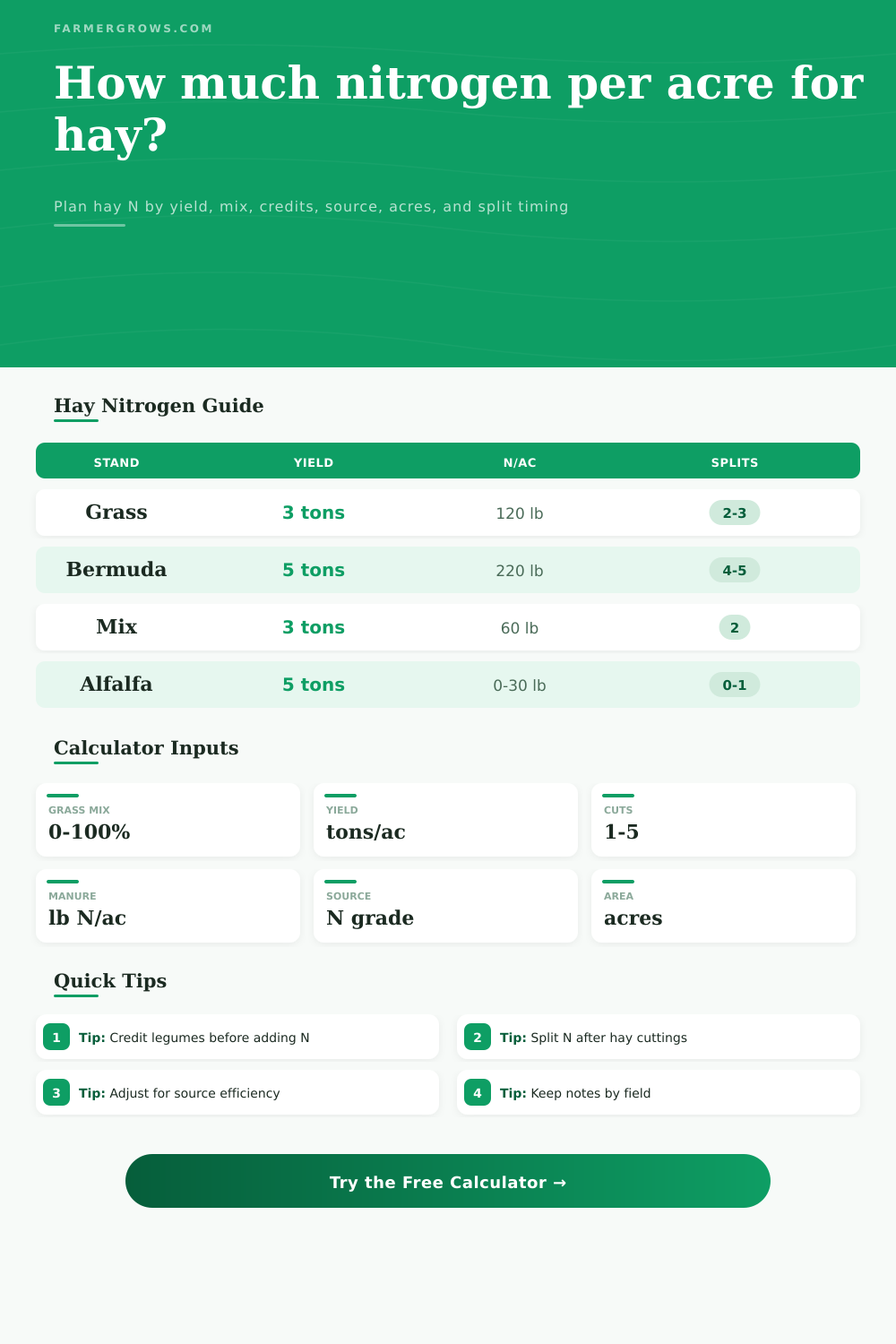
| Hay stand | Planning N per dry ton | Best split pattern | Calculator note |
|---|---|---|---|
| Mixed cool-season grass | 40 to 45 lb N/ton | Spring plus after first cut | Use grass percentage to adjust mixed stands. |
| Bermudagrass hay | 45 to 55 lb N/ton | After each cutting | High regrowth response in warm-season systems. |
| Timothy or brome hay | 35 to 42 lb N/ton | One to two spring doses | Lower yield systems often use fewer splits. |
| Grass-clover hay | 15 to 35 lb N/ton | Small early dose if needed | Legume credit can reduce most fertilizer N. |
| Alfalfa-dominant hay | 0 to 30 lb N/ac | Usually no seasonal N | Focus routine fertility planning on P, K, pH, and sulfur. |
| Cutting count | Suggested N split share | Typical timing | Field planning note |
|---|---|---|---|
| 1 cutting | 100% | Pre-greenup or early regrowth | Use for low-input meadow or single-cut hay. |
| 2 cuttings | 55% / 45% | Spring, then after first cut | Common for cool-season grass hay. |
| 3 cuttings | 45% / 30% / 25% | Spring, then after each cut | Balances early yield and regrowth. |
| 4 cuttings | 35% / 25% / 22% / 18% | After each harvest window | Useful for intensive grass hay programs. |
| 5 cuttings | 28% / 22% / 20% / 16% / 14% | Frequent regrowth doses | Keep per-pass N moderate and watch moisture. |
| Credit source | Low planning credit | Moderate credit | Strong credit |
|---|---|---|---|
| Legume stand under 25% | 0 to 10 lb N/ac | 10 to 20 lb N/ac | 20 to 30 lb N/ac |
| Legume stand 25% to 50% | 10 to 25 lb N/ac | 25 to 45 lb N/ac | 45 to 70 lb N/ac |
| Legume stand over 50% | 25 to 50 lb N/ac | 50 to 80 lb N/ac | 80 to 100 lb N/ac |
| Manure or slurry | Use tested available N | Credit first-year available N | Separate organic and ammonium N if known |
| N source | Analysis | Product for 60 lb available N/ac at 85% | Planning unit |
|---|---|---|---|
| Urea | 46-0-0 | 153 lb/ac | Dry pounds or bags |
| Ammonium nitrate | 34-0-0 | 208 lb/ac | Dry pounds or bags |
| UAN liquid | 32-0-0 | 221 lb/ac, about 20 gal/ac | Gallons at 11.06 lb/gal |
| Ammonium sulfate | 21-0-0 | 336 lb/ac | Dry pounds, includes sulfur |
| Balanced blend | 19-19-19 | 372 lb/ac | Also supplies P2O5 and K2O |
Split grass hay nitrogen around harvest. A smaller dose at greenup plus regrowth doses after cuttings usually fits hay uptake better than putting the whole seasonal rate out at once.
Keep legume stands from getting crowded out. Heavy nitrogen on clover or alfalfa mixes can favor grass growth, so credit legumes before sizing product pounds.
It seems like promise. In early spring, you see a hint of green. You picture yourself kicking at the soil across the pasture and then, in late summer, stacking bales. But all that hopeful vision hides bit of a logistical tightrope.
Hay making relies on nitrogen as its fuel; but failing to manage this precious element can make it evaporate into thin air (or even sink in the groundwater).
How to Use Nitrogen for Better Hay
The calculator up top will work numbers for you. It’ll take your field conditions and desired yield goal, and spit out a number representing your rate of product. What really guards your bottom line, though, is understanding why that number make sense.
Most growers think of nitrogen as volume problem. How many bales do I wish to grow? OK, I’ll back into my pounds of fertilizer. The problem with this approach is that it fails to account for what’s already occurring on the ground.
If your field contain even a modest proportion of legumes such as alfalfa or clover mixed in with grasses, those legume are working overtime to fix nitrogen from the atmosphere. Ignoring that biologic work means you are paying for something you do not need. This wastes money and runs the risk of overloading the crop with too much growth, which then rots while being cured.
The tool accounts for these credit calculations according to composition of your stand. As the legume percentage increases, the baseline requirement is adjusted downward. It is a small tradeoff, but it matters. You’re effectively trading nitrogen dollars for more stable forage quality. You also gain benefits to soil structure.
The other half of the equation is timing, which is when a lot of money gets leaked out. On paper, applying the full seasonal rate during greenup seems efficient; yet it’s beyond what the plants can absorbs all at once. That causes volatilization: Urea converts to gas and floats off. There’s also the risk of leaching (when excess nitrate wash through root zone).
By applying nutrients in stages, delivery matches the times when the plants actualy take them up. For many two-cutting system, that means putting down more in early spring to jump-start growth; then applying less and targeting it right after initial harvest, to spur regrowth. Your total need is divided between those passes. The calculator prevents overdoing things all at once.
The tool’s efficiency ratings don’t represent some penalty we made up out of thin air. They’re based off what happens in real life given your weather and fertilizer-source facts. Applying urea to the surface during dry conditions are risky. A urease inhibitor or irrigation/rain to help mix it in will dramatically increase its availability as plant-available N. Using liquid UAN shifts efficiency dynamics again. The ammonium form is less likely to immediately volatilize.
Choosing the correct source alters the weight of product you must carry. That impacts your bottom line, and your logistics.
On page, a reference table breaks down typical N requirements for various types of hay. The final authority: Your own soil test. These figures are meant as planning tools, connecting the loading dock and your soil report so that you can see the season ahead before ordering.
Enter in the package size and acres, and it will tell you not only rate, but also total load. That difference avoids the uncomfortable scene at the fertilizer dealer’s place, when you realize youve bought based off per-acre rates rather than for entire field.
So ultimately, management of nitrogen for hay isn’t about forcing it into maximum tonnage. It’s about meeting supply with demand. Feed too much and you might have lush, wet bales that end up molding. Feed too little and you leave some yield on the table. Aim for a balanced system, one that will grow and support what you can actualy take and keep.
Start with that green tinge in the spring. Finish with stack in the barn. The math in between is simply the bridge you build to get there.