New Lawn Watering Calculator
Estimate daily water for a newly seeded, sodded, or plugged lawn using area, grass type, soil texture, establishment day, weather, rainfall, sprinkler output, slope, and mowing readiness.
Choose a common establishment situation, then fine tune the lawn size, day, weather, rainfall, sprinkler rate, and mowing condition for your yard.
New Lawn Watering Plan
Calculated schedule appears here after entering your lawn conditions.
Needs light, frequent watering so the seedbed stays damp without washing seed into low spots.
Starts with more water per day, then tapers once sod roots knit into the prepared soil.
Uses moderate water, with attention to plug holes and surrounding soil until runners spread.
Treat like seed, but watch the mulch color and avoid heavy streams that break the slurry mat.
| Establishment stage | Seed target | Sod target | Plug target | Usual cycle style |
|---|---|---|---|---|
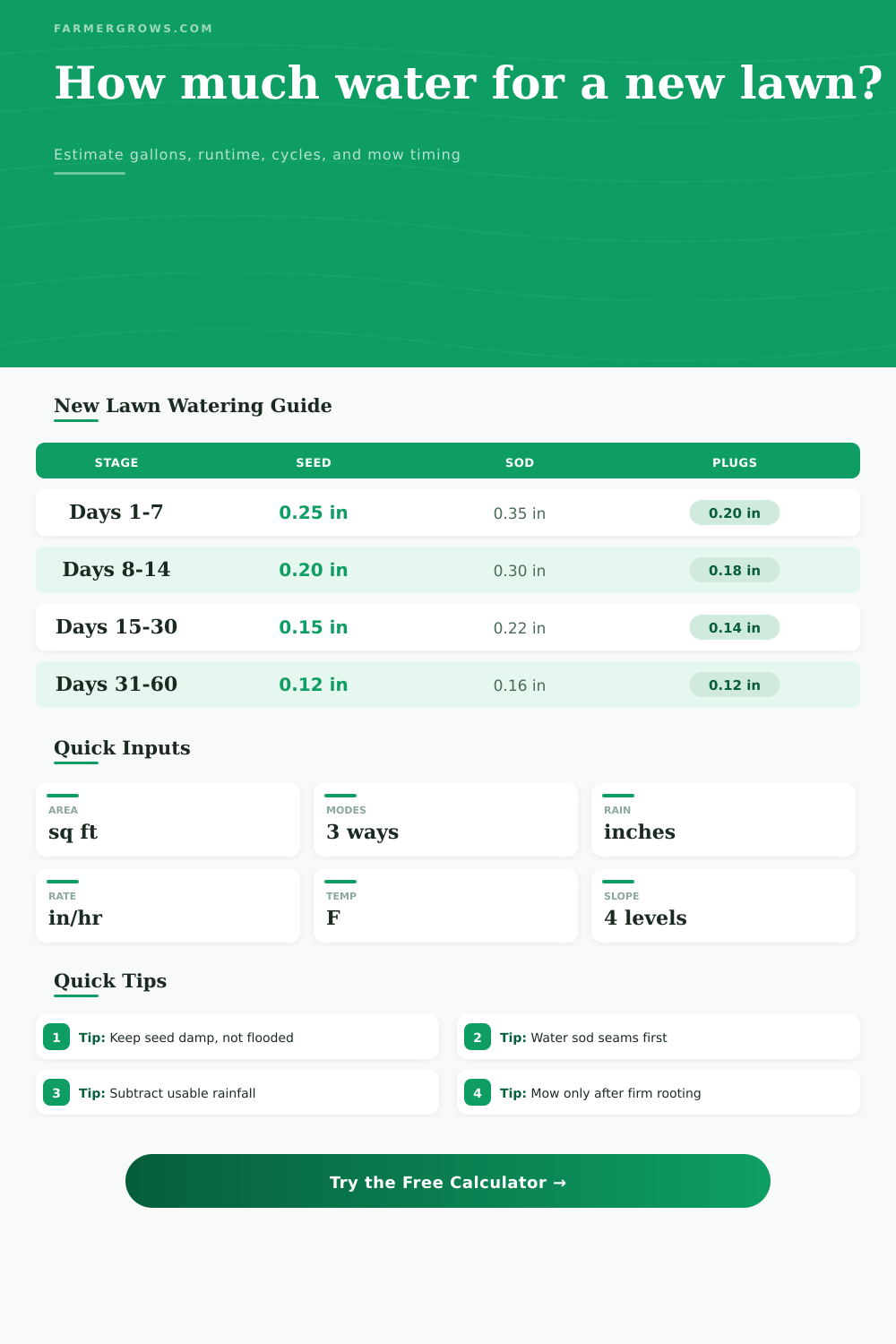
| Days 1 to 7 | 0.22 to 0.30 in/day | 0.30 to 0.45 in/day | 0.18 to 0.25 in/day | Several short cycles |
| Days 8 to 14 | 0.18 to 0.24 in/day | 0.25 to 0.35 in/day | 0.16 to 0.22 in/day | Two or three cycles |
| Days 15 to 30 | 0.12 to 0.18 in/day | 0.18 to 0.26 in/day | 0.12 to 0.18 in/day | Deeper, less frequent cycles |
| Days 31 to 60 | 0.08 to 0.14 in/day | 0.12 to 0.20 in/day | 0.08 to 0.15 in/day | Transition to normal lawn watering |
Targets are starting points. Local restrictions, irrigation audit results, seed label instructions, and installer guidance should override this estimate.
| Grass type | Typical first mow | Heat response | Early watering note |
|---|---|---|---|
| Tall fescue | 21 to 35 days | Moderate | Do not var the seedbed crust during warm spells. |
| Kentucky bluegrass | 28 to 45 days | Moderate | Germinates slowly, so keep the surface evenly damp. |
| Perennial ryegrass | 14 to 24 days | Moderate | Fast cover, but shallow roots still need gentle tapering. |
| Bermuda grass | 18 to 30 days | High warm-season demand | Establishes fastest when warm and consistently moist. |
| Zoysia grass | 25 to 45 days | Moderate | Plugs root slowly; avoid drying around plug holes. |
| St. Augustine grass | 14 to 28 days | High warm-season demand | Sod seams dry first and need close watching. |
| Buffalo grass | 25 to 45 days | Lower demand after rooting | Keep plugs moist early, then taper carefully. |
| Centipede grass | 25 to 45 days | Moderate | Slow early growth benefits from steady moisture. |
| Condition | Water holding | Max cycle guide | Adjustment used |
|---|---|---|---|
| Sand or loamy sand | Low | 8 to 12 minutes | More frequent, slight daily increase |
| Sandy loam | Medium-low | 10 to 15 minutes | Moderate frequency |
| Loam | Balanced | 12 to 18 minutes | Baseline schedule |
| Clay loam | Medium-high | 8 to 14 minutes | Shorter soak cycles |
| Clay or compacted | High but slow intake | 6 to 10 minutes | Run, pause, and soak to reduce runoff |
| Moderate or steep slope | Runoff risk | 5 to 10 minutes | More cycles with shorter runtime each |
| Sprinkler rate | Minutes for 0.10 in | Minutes for 0.25 in | Best use |
|---|---|---|---|
| 0.25 in/hr | 24 min | 60 min | Slow rotors and large zones |
| 0.40 in/hr | 15 min | 38 min | Mixed heads or low-pressure sprinklers |
| 0.50 in/hr | 12 min | 30 min | Common hose-end watering |
| 0.75 in/hr | 8 min | 20 min | Sprays with good overlap |
| 1.00 in/hr | 6 min | 15 min | Fast sprays, hand watering, small zones |
| Check | Ready sign | Wait sign | Why it matters |
|---|---|---|---|
| Height | About 3 to 4 inches | Below mowing height | Enough leaf area helps recovery after the first cut. |
| Root tug | Grass resists a light tug | Sod lifts or seedlings pull loose | Weak rooting can be torn by mower wheels. |
| Soil firmness | Footprints are shallow | Soft, muddy, or rutted surface | New lawns compact easily when too wet. |
| Blade sharpness | Freshly sharpened mower blade | Dull blade tears leaf tips | Clean cuts reduce stress on tender grass. |
Seed and plugs: keep the upper soil consistently moist, then taper slowly as roots deepen. If water begins to run off, split the runtime into more cycles.
Sod: check seams and corners first because they dry quickly. After rooting starts, shift from frequent surface watering toward deeper soak-and-dry intervals.
Standing on the edge of a new bed of green with a hose in one hand, you wonder: Water or don’t water? Some say soak it; others say let it go dry. It’s confusing, and the Internet is filled with contradictory information.
But here’s the secret: New plants are a moving target. They aren’t just one thing. Every day they grow, their root systems burrows deeper into the ground, altering what they require every single day.
How to Water Your New Lawn
When you plug in your own situation, the calculator above figures out the math for you. That means no more guessing if a quarter-inch of rain should count toward today’s watering requirement. No more wondering if your sprinkler is watering too quickly (or too slow) to do some good before running down the slope.
And then there’s how it was established. That’s what throws some people off at the beginning. A seed, a plug and sod are all very different beginnings.
The seed is small and exposed on the surface, making it vulnerable to drying out from the wind or sun in an hour flat. Treat it like a fine mist (not a flood).
Sod is technically a plant, though it hasn’t rooted itself in your ground yet. Heavy water deep down will help knit it into the earth.
And a plug? Somewhere between those two. Moisture enough to keep it alive through the trauma of moving in; too much, and you’ll have soup instead of dirt.
The tool takes this variation into account, changing its target depth to match whichever route you’ve selected.
The other part of the equation is timing. Anytime we’re seeding or laying sod, the critical window is the first week. For those first seven days, you want surface of the soil to remain moist, but not soaked. At all times.
Once the second week arrives, change tactics. Begin backing off on the frequency so the roots will reach down seeking moisture. If you water lightly and frequently during the next couple of weeks, they will never learn to grow deep. Shallow-rooted plant drown in springtime; in summertime, their roots cook.
The chart on the page spells it out: When? How much? Who knew.
Soil type is the great equalizer in all of this. Does yours drain like a sieve? If your soil is sand, you’ll need to water more frequent because the water runs out fast and you need to replace it faster. Or is it tight-clay that grabs at every drop? If it is clay, it sucks the water up slowly. This means if you pour a gallon onto your lawn, it’s simply going to roll right off.
That’s where those other two settings, the slope and cycle, come into play. If you run your sprinkler for short periods, the small amount of water soaks in before gravity pulls it downhill. They are frequent, but brief. They are little things, but they count. And the quickest way to kill your new lawn is to skip that cycle check, wasting all the water in the process.
Then there’s temperature. If it’s hot, the soil will lose moisture more quickly, regardless of whether or not the sky is clear, because hotter air evaporates more quicker. So if you don’t make any adjustment to your runtime, a few days of warming weather in the second week can negate several weeks’ worth of work. To make up for this, the calculator takes into account the heat and provides a net volume that reflects what the atmosphere is attempting to steal away from your soil. It’s not just how much you put on; it’s how much sticks around where it matters.
Remember: take out what you recieved if there was any real rainfall! It’s tempting to turn on the sprinkler because you feel like doing something with your hands, but not because the lawn needs it. If you had a half-inch rain, you don’t want another half inch of irrigation.
Both overwatering and underwatering are dangerous. The former suffocates roots and encourages fungus.
Read the mowing readiness output as well. No mowing till the root system holds the soil in place. The best test is to pull on the grass, and if it resists, just leave it alone and let the water do the work for now. Keep things damp but not sodden at the surface.
The first month is what establishes the pace for the remainder of the season. The temptation to soak the lawn can be strong because we look at the surface and see a dry-looking yard, but the numbers typically says something else. Believe me, believe in the depth targets and the cycle times. Let them guide you; don’t just guess how much to water.
Patience is a virtue here. Don’t want a swamp; want some strong root growth. Do the input first, monitor the runtime, then let the lawn tell you when is the time for the next stage.
That early moisture is the foundation…and getting it right is less effort for everyone later on.