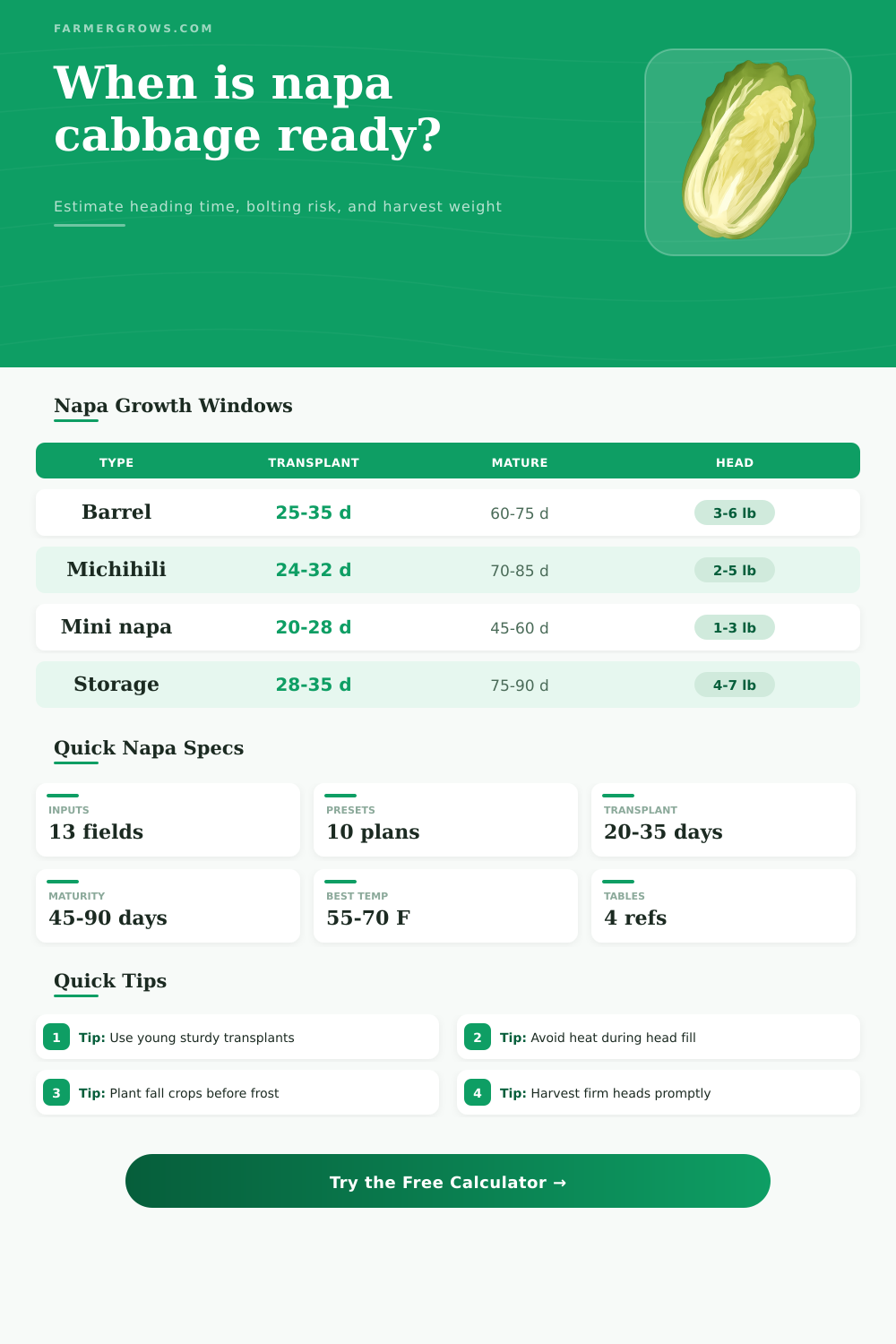
Napa Cabbage Growth Time Calculator
Estimate transplant-to-harvest timing for napa and Chinese heading cabbage, including barrel vs Michihili heads, transplant age, days to maturity, bolting risk, heat stress, head weight, and fall or spring windows.
This calculator is for napa cabbage, also called Chinese heading cabbage, after seedlings are started or transplanted. It is not a savoy cabbage chart, a loose broad Chinese cabbage estimate, or a seed-only germination tool.
Napa Cabbage Harvest Estimate
Choose a preset or enter your napa cabbage field conditions.
| Napa type | Typical transplant age | Days after transplant | Head shape | Best use |
|---|---|---|---|---|
| Barrel head napa | 25 to 35 days | 60 to 75 days | Short, broad, dense | Fresh market, stir-fry, slaw |
| Michihili type | 24 to 32 days | 70 to 85 days | Tall cylinder | Kimchi, long rib cuts |
| Mini napa | 20 to 28 days | 45 to 60 days | Small barrel | Baby heads, tight beds |
| Storage napa | 28 to 35 days | 75 to 90 days | Large dense barrel | Fall storage and processing |
| Red or purple napa | 24 to 32 days | 65 to 82 days | Open-to-dense color head | Specialty fresh market |
| Season | Best transplant timing | Main risk | Timing adjustment | Field note |
|---|---|---|---|---|
| Spring | After hard cold, before heat | Bolting after cold checks | Add 2 to 8 risk days | Use young plants and quick cover removal. |
| Fall | Late summer into cooling weather | Frost before full head fill | Often fastest quality window | Schedule enough days before repeated freezes. |
| Mild winter tunnel | Autumn transplant under cover | Slow growth in low light | Add 5 to 12 days | Vent tunnels to prevent soft heads. |
| Summer edge | High elevation or cool coast only | Loose heads and tipburn | Add 5 to 14 heat days | Shade and water are more important than extra fertilizer. |
| Temperature signal | Napa response | Bolting or heat concern | Practical correction |
|---|---|---|---|
| Below 45°F while young | Growth checks and vernalization pressure | Higher spring bolting risk | Transplant younger, avoid long cold exposure. |
| 55 to 70°F average | Firmest head fill | Low risk when moisture is steady | Maintain even water and nitrogen. |
| 75 to 80°F days | Faster growth but looser heads | Moderate heat watch | Harvest slightly early if heads firm. |
| Above 80°F during heading | Tipburn, loose wrap, pithy ribs | High heat stress | Use shade cloth, mulch, and quick harvest. |
| Head weight goal | Spacing guide | Days added | Harvest cue |
|---|---|---|---|
| 1 to 2 lb mini heads | 8 to 10 in | 0 to 2 days | Compact head, tender ribs |
| 3 to 4 lb medium heads | 12 to 14 in | 2 to 5 days | Firm squeeze at shoulder |
| 5 to 6 lb barrel heads | 15 to 18 in | 5 to 9 days | Dense head before outer leaf yellowing |
| 4 to 7 lb storage napa | 16 to 20 in | 8 to 12 days | Heavy head with tight wrapper leaves |
Transplant tip: Set napa before seedlings become root-bound. Older plants that sat cold are more likely to button, stretch, or bolt before a full barrel or Michihili head forms.
Season tip: Fall napa is usually easier than spring napa. Count backward from frost for the variety's maturity window, then protect the first week after transplanting.
Napa cabbage is fickle and need the right growing conditions. If you get the timing wrong, you’ll end up pulling what looks like a nice head, only to find it has bolted into bitterness at the other end. Plug your planting date (and local temps) into calculator, above. It does the math for you so you’re not left wondering if your fall heads will mature enough before first hard freeze or if your spring crop will even make it.
The tool measure more than just days. Unlike a weed (which grows linearly), napa cabbage reacts to temperature changes and day length as well. And if you plant seedlings that are too old, guess what? They’ve begun logging verification days. Come spring, the plant’s convinced it’s time to go and bloom, not make a head. Your local cold snap history combined with your transplant age can help alert you to that risk… More so different than soil pH or fertilizer most seasons.
How to Grow Napa Cabbage Successfully
Most growers think Napa cabbage is best sown in the fall, and they are correct most of the time. Sugars will concentrate during cooling nights, making heads dense and sweet for slaw or kimchi. But there’s nothing wrong with spring, provided you obey the clock and grow really young transplants (those who’ve been through no hard freezes). Seedlings destined for outdoors must be kept in a tray where they won’t shiver, otherwise they’re set to bolt at first lengthening day. Barrel types or Michihili varieties tends to respond this way; see the reference tables for how each reacts to such stressors.
And then there’s heat…which also affects heading (at least here). If day time temps gets over 80F, the outer leaves begin growing faster than the inner ribs can wrap around them. Voilà: a loose, pithy head with no strength to hold together, which doesn’t keep and tastes fibrous. Excess watering doesn’t help (often just promotes fast but weak growth).
So how do I know if you’ll need some shade cloth? The calculator uses average day and night temps. It tells you when to go under cover and when to pick just a bit earlier instead of waiting for an impossible-to-tighten head.
The other variable that people mess up on is spacing. Spacing the plants too closely to save bed space create bigger problems like smaller heads and greater opportunity for disease. Give a tall Michihili variety some vertical clearance, and a barrel type some horizontal space to expand. If you want high-quality heads for storage, big dense barrels requires a minimum of 16 inches of space between them. The tool factors in those spacing decisions, then tells you what kind of poundage of cabbage you can expect to be harvesting at the end. Then you don’t try to plan a fermentation project only to find you’ve got half as much volume as planned!
This isn’t just about putting seeds in the ground; it is about managing their energy to help them turn sunlight into physical growth rather than just making more seeds. Whether you’re growing something for eating now (like mini napa for fast-paced salads) or storing (for pickles to last through the winter), it’s all about getting the timing correct. You must maintain consistent watering while the heads fill out and prevent young transplants from becoming too old by the time they reach the earth. Finally, do not expose them to frost after that. Use data instead of your gut to plan your schedule, and you will be completly prepared.