
The next step in a process of hatching the eggs is a phase known as the incubation phase. During the incubation phase, the intention is for the eggs to be allowed to develop and create living embryo. The incubation phase will be successful only if certain condition are met and if certain rituals occur during that phase.
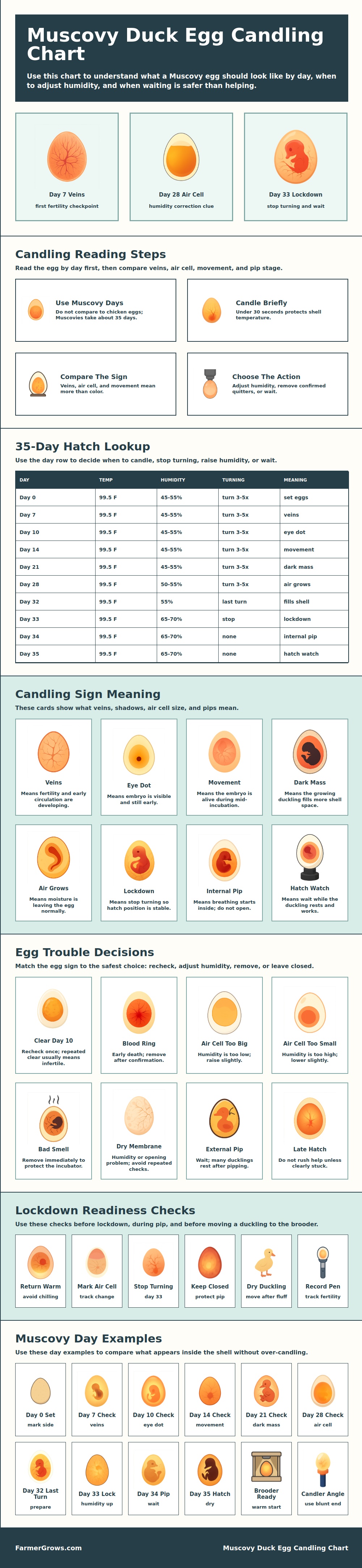
Such rituals include ensuring that the incubator keeps the eggs at 99.5 degrees F, that the eggs are kept at a certain humidity level (55-65 percent), and that the eggs is turned at least three time per day. Incubation of Muscovy duck eggs typically lasts for about 33-35 days. However, during the second week of incubation, many individuals begins to experience anxiety as to whether or not the eggs do actualy contain living embryos.
How to Hatch and Check Muscovy Duck Eggs
One way to verify that life does indeed exist inside of the Muscovy duck eggs is through a process called candling. Candling is a process in which a person use a source of high-intensity light in order to look through the eggshells. More specifically, the person placing the egg over the source of light is able to see what is developing inside of the egg.
This process is typically performed to confirm that an embryo is indeed developing inside of the egg. It is important that a person performs this process correct and carefully, however, as over-candling and improper candling can harm the developing embryos. For instance, over-candling refers to taking the eggs out of the incubator too frequently.
Each time that the lid to the incubator is opened, heat and humidity can escape from the incubator and diminish the temperature and humidity that is necessary for the development and survival of the embryos. Thus, when performing candling, it is important to do so relatively quick, by sliding the egg over the source of light, identifying what is developing inside of the egg, and then placing the egg back inside of the incubator before the egg has the chance to cool. In addition to identifying eggs containing developing embryos, candling can also reveal information about what stage of development the embryo inside of the egg has reach.
For instance, during the early stage of incubation, veins can be seen in eggs. These veins often may be mistaken for a spider web, as they radiate from a central embryo. However, the veins are actualy what provides nutrients to the embryo, thus being an important element of a functioning embryo.
Additionally, it is also possible at certain points of early incubation to see a small dark dot that represent the eye of the embryo. This means that the embryo is not only alive, but also developing into a creature. At later stages of incubation, it is also possible to see, upon candling, when a dark mass fills the entire inside of the eggshell.
At this point, an air cell will have grown at the blunt end of the eggshell. This air cell will provide the first breath of oxygen to the duckling before it break its eggshell. The size of this air cell can also be used to indicate whether or not the humidity levels in the incubator are correct.
If the humidity levels are either too high or too low, it can be harmful to the duckling, as improper humidity levels can result in the duckling becoming stuck in its membrane as it try to hatch from its eggshell. Thus, this final stage of incubation require entering a lockdown phase in which no more turning of the eggs should occur and in which humidity levels need to increase. When hatching occurs, it is possible to see what is called internal and external pips.
A pip refers to when the duckling has puncture its air cell or its eggshell. Additionally, there may be clear eggs (eggs that never began development) and blood rings (eggs in which development cease at an early stage). These are considered failed eggs.
In these cases, it is recommended that the person remove the eggs from the incubator immediately. If an egg explodes due to becoming rotten, this can also cause problem with an entire batch of Muscovy duck eggs. After hatching has succeeded, a dry and fluffy duckling will emerge from its shell.
It is also important to keep in mind that if external or internal pips are seen, the eggshell should not be disturbed (peeled away). The same is true for veins and eye dots during early stages of incubation. In other words, its best to just leave it be and allow nature to take its course!