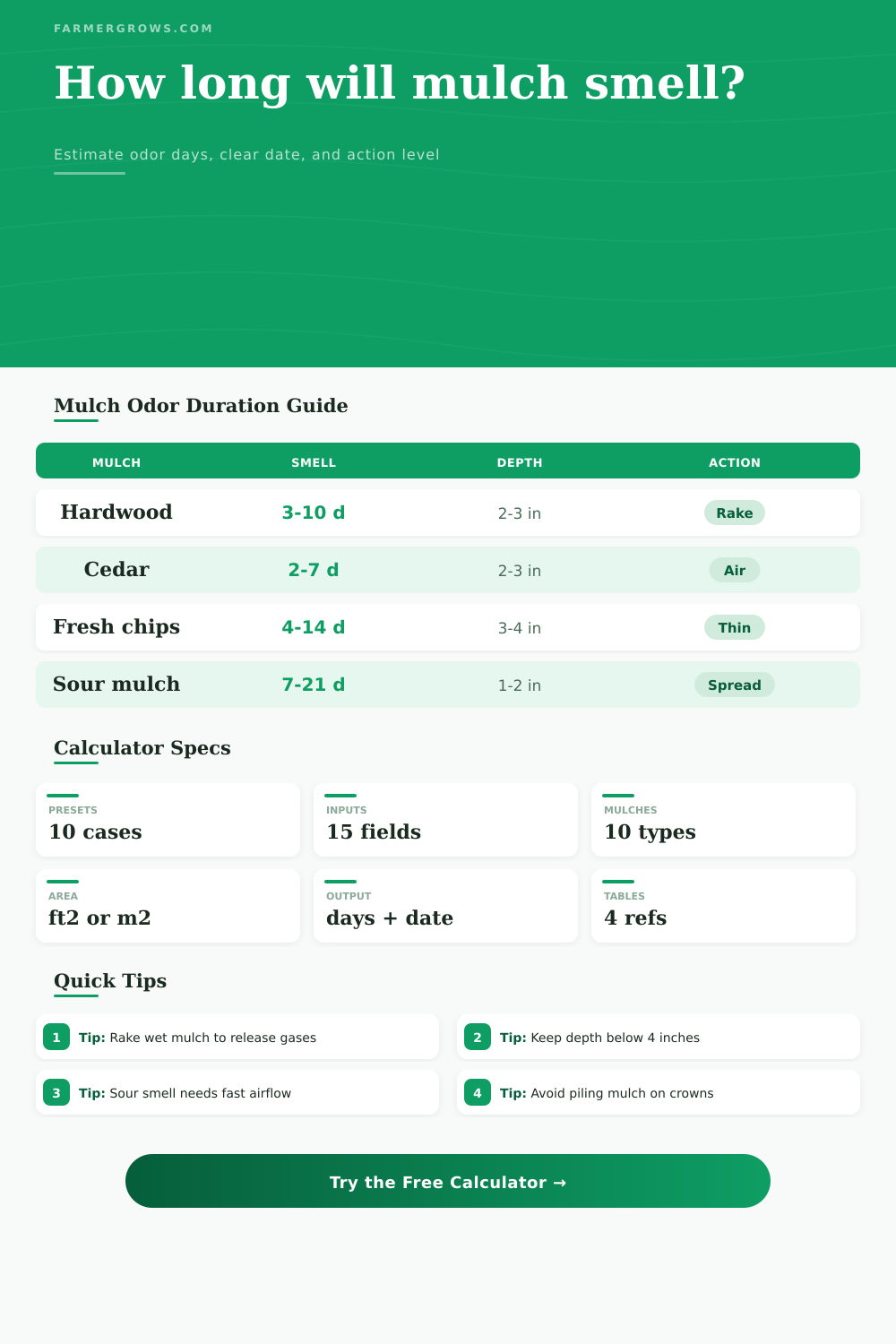
Mulch Smell Duration Calculator
Estimate how many days a new or sour mulch smell may remain noticeable, when it should clear, how strong it is likely to be now, and whether raking, thinning, drying, or removal is the better response.
Load a realistic mulch smell situation, then adjust material, depth, moisture, temperature, airflow, and odor type to match your bed or pile.
Mulch Smell Estimate
Your result will appear after calculation.
Woody, cedar, or earthy notes are usually strongest for the first few warm days, then fade as the surface dries.
Musty smell often means a wet, compacted layer. Raking and avoiding overwatering usually shortens the window.
Vinegar, silage, or rotten notes suggest low oxygen. Spread thin, dry, and avoid placing it against tender stems.
Sharp ammonia can injure sensitive roots. Air out composted material before using it near vegetables or seedlings.
| Mulch material | Typical odor window | Common smell | What lengthens it |
|---|---|---|---|
| Shredded hardwood bark | 3 to 10 days | Earthy wood, tannin | Wet piles, 4+ inch layers, still air |
| Cedar mulch | 2 to 7 days | Cedar resin, clean wood | Hot sun near patios, bag storage |
| Pine bark nuggets | 2 to 8 days | Pine resin, bark | Deep rings and sheltered beds |
| Fresh arborist chips | 4 to 14 days | Green wood, sap | Fresh leaves mixed in, damp shade |
| Compost mulch | 2 to 6 days | Earthy compost | Incomplete curing or excess moisture |
| Manure-based compost | 5 to 18 days | Manure or ammonia | High nitrogen, low curing time |
| Straw or hay mulch | 1 to 5 days | Dry grass or hay | Rain, mold, packed flakes |
| Rubber mulch | 7 to 30 days | Rubber or tire | Heat, full sun, low airflow |
| Condition | Shortens smell | Extends smell | Calculator factor |
|---|---|---|---|
| Layer depth | 1 to 2 inches for sour mulch | 4+ inches, matted | 0.85x to 1.85x |
| Moisture | Dry to slightly damp | Soggy or repeatedly soaked | 0.75x to 1.65x |
| Temperature | Cool, 45 to 60°F | Warm, humid, 80+°F | 0.85x to 1.35x |
| Airflow | Breezy raised bed | Tight foundation planting | 0.78x to 1.35x |
| Before spreading | Loose dry bulk pile | Warm bagged or soaked pile | 0.85x to 1.55x |
| Raking | Fluffed or spread thin | No raking after rain | 0.55x to 1.00x |
| Days since spreading | Normal bark smell | Sour or ammonia smell | Practical check |
|---|---|---|---|
| 0 to 2 days | Peak aroma is common | Open bags and spread thin | Check moisture and depth |
| 3 to 5 days | Should be fading | Rake or move from stems | Smell near soil surface |
| 6 to 10 days | Usually mild outdoors | Keep airing; avoid seedlings | Look for matted wet zones |
| 11 to 21 days | Persistent smell is unusual | Remove worst pockets if sharp | Inspect plant stress |
| 22+ days | Investigate new moisture source | Replace if odor remains strong | Check drainage and runoff |
| Symptom | Likely cause | Best response | Plant caution |
|---|---|---|---|
| Woody smell near patio | Fresh volatile oils | Wait, keep surface dry | Low |
| Vinegar or silage smell | Anaerobic fermentation | Spread thin and aerate | Moderate to high |
| Sharp ammonia smell | Excess nitrogen or immature compost | Cure away from roots | High |
| Moldy damp odor | Matted wet layer | Rake, thin, improve drainage | Moderate |
| Rubber odor in heat | Warm rubber mulch off-gassing | Air out before use areas | Low to moderate |
Depth tip: If mulch smells sour, thin it to about 1 to 2 inches temporarily, air it out, then re-level only after the sharp odor fades.
Moisture tip: Recheck after a dry, breezy day. If the smell drops sharply, moisture and low airflow were the main drivers.
If you’ve applied new mulch lately, you’ve probably also noticed it has a distinct aroma. Though the sight of freshly mulched landscape is one of richness and cleanliness, the scent can range from sharply acid (like an old sock meets vinegar) to woody. Is it time for it to go? Usually, no, not with a shovel. Unless there’s something wrong, most offensive odors are transitory ones caused by trapped gases or volatile organic compounds.
What is it? How bad will it last? Will it hurt the plants? The first step in solving the problem is to know what is causing it. Resins and tannins in fresh wood chips from pine trees or other hardwoods emit that aroma. It stinks to our noses, but poses no threat to the plants’ roots. As mulch settles down and dries out, the smell should subside. That’s normal chemistry in action.
Why Your Mulch Smells and How to Fix It
And then there’s the math: What’s right for you and your conditions? Use the calculator. No more guessing how long things are supposed to take… Two days? Is it three weeks? Instead, get answer from the math.
Things go south when mulch smells like something has gone wrong and shifts from earthy to sour-smelling. If it stinks like vinegar, that’s because the mulch is rotting, due to lack of air (oxygen). Many assume that with time it’ll improve; but a mulch bed without air can’t be fixed by time alone. You have to alter physical barrier so gases can escapes.
The key here is depth. When I pile on four inches of mulch, that’s an insulation blanket. It is a blanket that retains moisture and heat while shutting out air. Bacteria switches to anaerobic respiration and generates foul-smelling acids. How long the gases will linger depends on how thick your mulch layer is. That’s where this tool comes into play, estimating length of time based off the depth of your layer.
A stinky layer? The remedy: mechanical. Reduce it to just an inch or two for now by raking back down. Expose it to the sun and air, which halts fermentation and disperses the odor. It is a simple change that greatly helps healthy garden.
The material counts; so does its history of storage and moisture. Mulch kept in a warm garage for several months will be pre-fermented when it’s delivered. Microbes were already doing their work, at high speed, and there was no air flow in the bag to slow them down. When you spread such material, you’re starting with head start on the odor clock. The calculator shows those factors.
Worse: Rain intensifies the problem. It floods the voids between pieces of wood chips, forcing out oxygen that the bacteria require. A layer of mulch is fine if it is loosely laid and still somewhat dry. A mat of mulch that has become sodden? That’s smelly. The reference tables shows the impact of compaction and saturation on various kinds of materials.
The other factor is temperature. Volatile compounds are released more quickly at warmer temperatures, speeding the overall decomposition as well. Heat sustains that, too; in July, gas activity continues longer, making it smell and stink longer. In cool weather, that means same mulch smells weaker for longer because chemicals react more slowly. The tool takes your actual average daytime temperature and how much sun the mulched area gets into account. It adjusts its guess to tell you realisticly when the air might be clear again.
It even factors in airflow. Air will clear scent sooner on a raised bed with some breeze than on one planted against a wall where air can stagnate.
The last test is whether it is sensitive to plants. Some things (like vegetables) are not; others (tender seedlings) don’t like it at all. Maybe that faint whiff of ammonia or manure is fine along the driveway, for instance, but would burn roots of veggies or tender seedlings. The calculator notes such high risk areas. It alerts you to eliminate them or build a buffer area around them. You should of lost a little mulch than to lose a tomato plant to nitrogen toxicity from an ammonia or manure smell.
The tool provides an action level once you know which conditions exist where, and what’s causing the smell. Wait awhile in certain instances. Rake in other instances. Panic rarely. That’s what you want: to manage the environment surrounding the mulch. You control air flow, moisture, and depth. It will direct that material into an earthy neutral state.
A pungent smell at first is evidence that something is changing, not failing. Adjust accordingly; let the air clear. Let the landscape settle in. Hold off on holding your breath. And enjoy it all.