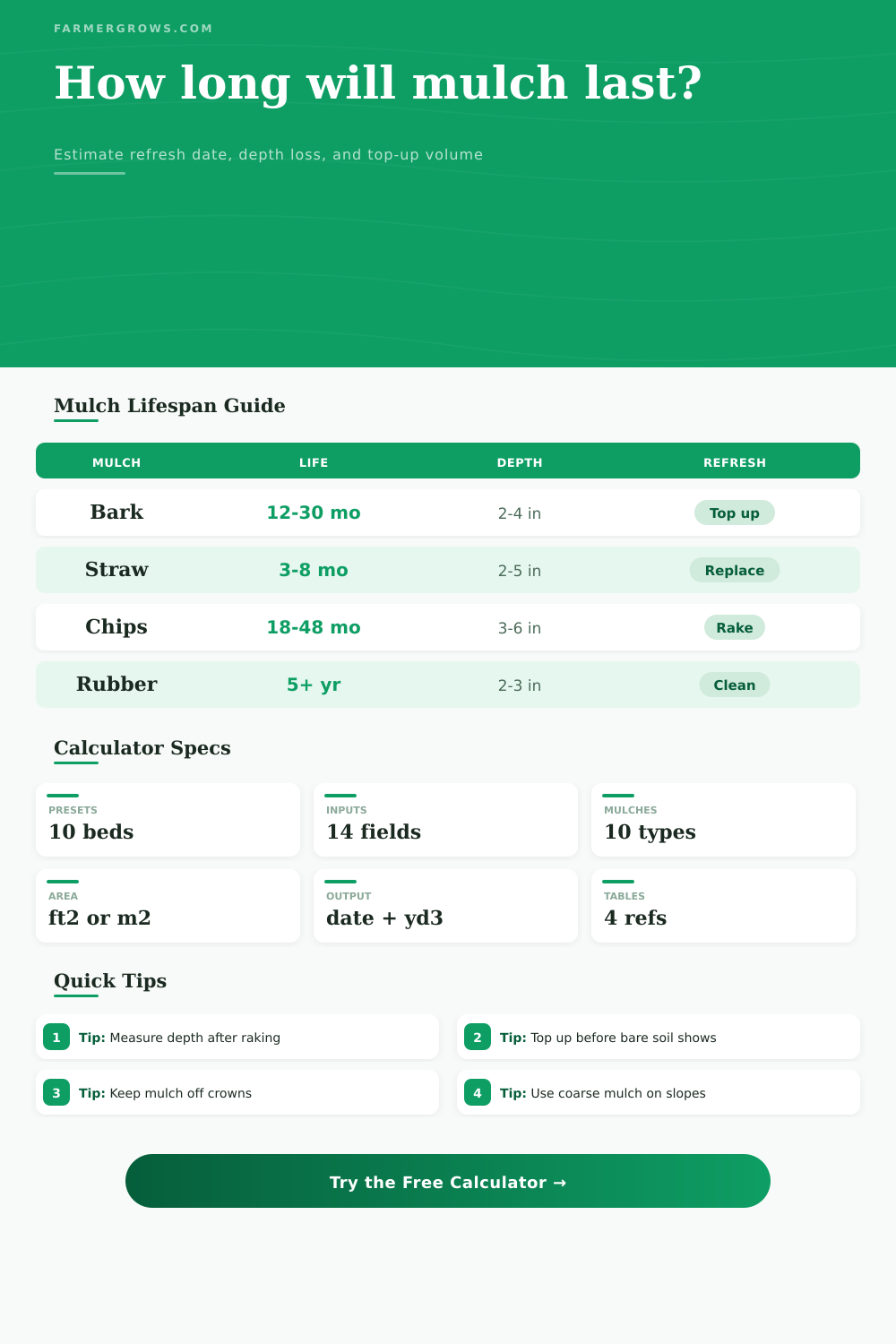
Mulch Lifespan Calculator
Estimate how long a mulch layer will keep working, when to refresh it, and how much top-up material is needed from mulch type, starting depth, current depth, bed exposure, climate, irrigation, slope, and installation date.
Load a realistic bed, orchard, path, or vegetable-row situation, then adjust the mulch, exposure, depth, and installation date to match your site.
Mulch Lifespan Results
Your mulch lifespan estimate will appear here.
Typical lifespan, depth behavior, and bulk density vary by chip size, local rainfall, soil biology, and how often the bed is disturbed.
Straw, leaves, and compost protect soil quickly but need seasonal renewal in active vegetable beds.
Hardwood, pine, cedar, and cypress hold a neat bed finish with annual or biennial top-ups.
Arborist chips last well around trees, paths, and orchard rows when kept 3 to 6 inches deep.
Stone and rubber do not feed soil; lifespan is limited more by migration, debris, and fabric failure.
| Mulch material | Typical useful life | Typical density | Best refresh signal |
|---|---|---|---|
| Shredded hardwood bark | 12 to 24 months | 500 to 800 lb/yd³ | Color faded, layer below 2 inches, weeds emerging |
| Pine bark nuggets | 18 to 36 months | 350 to 550 lb/yd³ | Nuggets scattered, thin edges, exposed soil around crowns |
| Cedar or cypress mulch | 24 to 42 months | 400 to 700 lb/yd³ | Layer thins after washing or surface turns gray and compacted |
| Arborist wood chips | 18 to 48 months | 500 to 850 lb/yd³ | Fines disappear, weeds root in openings, paths turn muddy |
| Straw or pine straw | 3 to 8 months | 100 to 250 lb/yd³ | Seasonal flattening, stems darken, soil splashes through |
| Shredded leaves | 4 to 10 months | 250 to 450 lb/yd³ | Matted cover collapses, bare patches appear near plants |
| Compost mulch | 6 to 12 months | 900 to 1,300 lb/yd³ | Layer blends into soil or crusts after rain |
| Stone or rubber mulch | 5 years or more | 900 to 2,800 lb/yd³ | Migration, debris buildup, fabric showing, uneven depth |
| Site pressure | Low effect | Moderate effect | High effect |
|---|---|---|---|
| Climate | Cool seasons slow breakdown | Temperate sites use baseline life | Warm humid sites speed decay and soil mixing |
| Sun and heat | Shade preserves color and moisture | Part sun gives normal fading | Reflected heat dries, fades, and shrinks bark faster |
| Water pattern | Dry beds decompose slowly but can blow away | Even moisture gives steady soil feeding | Wet runoff floats light mulch and decays fines faster |
| Slope or edge | Flat edged beds retain mulch | Gentle slopes lose some material | Runoff paths wash mulch out before it decomposes |
| Use area | Common depth | Minimum before refresh | Lifespan note |
|---|---|---|---|
| Annual vegetable rows | 2 to 4 in straw or leaves | 1 to 1.5 in | Usually seasonal, especially after harvest cleanup |
| Perennial flower beds | 2 to 3 in bark or leaf mulch | 1.5 to 2 in | Top up lightly without burying crowns |
| Shrub borders | 2 to 4 in bark mulch | 2 in | Refresh every 1 to 2 years in most climates |
| Trees and orchard strips | 3 to 6 in wood chips | 2.5 to 3 in | Keep mulch off trunks and widen ring as canopy grows |
| Paths and play zones | 3 to 6 in coarse chips or fiber | 2 to 4 in | Traffic loss can matter more than decomposition |
| Area at top-up depth | 0.5 in top-up | 1 in top-up | 2 in top-up |
|---|---|---|---|
| 100 sq ft | 0.15 yd³ / 2.1 bags | 0.31 yd³ / 4.2 bags | 0.62 yd³ / 8.3 bags |
| 250 sq ft | 0.39 yd³ / 5.2 bags | 0.77 yd³ / 10.4 bags | 1.54 yd³ / 20.8 bags |
| 500 sq ft | 0.77 yd³ / 10.4 bags | 1.54 yd³ / 20.8 bags | 3.09 yd³ / 41.7 bags |
| 1,000 sq ft | 1.54 yd³ / 20.8 bags | 3.09 yd³ / 41.7 bags | 6.17 yd³ / 83.3 bags |
Measure what is actually there. Mulch often looks thick at the edge but thin under plants, near downspouts, and along paths. Rake it level, measure several spots, and use the average current depth.
Refresh with restraint around plants. Top up to the target working depth, but keep mulch pulled back from trunks, stems, crowns, and vegetable rows where excess moisture can cause rot.
By late summer the mulch in a garden bed are often in bad shape. It didn’t dissapear overnight, but it has worn thin. What was a tidy layer in springtime might be more like a scuffed-up dusting by August. The mulch has compacted down in the middle and washed away on the sides leaving the underlying soil baked and dry, exposed to sunlight.
At this point many gardeners purchase a big load of new bark and top up everything in a thick layer. This is a waste of money; and bad for the plants.
How to Fix Your Garden Mulch
Use the calculator above to figure out exactly how much material you will need based off size of the bed and how much the mulch has sunk. No more guessing how many bags of mulch to order!
One misconception: Mulch simply dissapears into thin air. No, it doesn’t. What happens is that mulch gets washed away, compacts, and decomposes. The organic matter (whether it’s pine nuggets or hardwood bark) breaks down eventually, feeding the soil, but also losing volume along the way. For example, a three-inch layer of bark will compact from rain and gravity; in its first year it may be only two inches thick. Not a problem, just doing what it’s supposed to do.
If you’re seeing bare soil, replenish the mulch; if what you see is thin black flakes on top of dark, rich earth, no need for replenishment.
Mulch longevity also relates to materials used. Cedar mulch resist rotting due to its oils and lasts longest; it is also more expensive than other options and doesn’t improve soil structure quite so fast. Shredded hardwood bark smells nice, looks nice…but breaks down gradually. Replenish annually, or sooner. Wood chips work well in orchard strips and around trees. They are coarse, don’t pack down easily, and if applied deeply enough they’ll last several years. Straw works temporarily (maybe just a season), to shield vegetable rows, but will flatten out in a few months.
See the comparison chart on the page; which one you choose has to do with how much time you want to spend maintaining the bed. Thin, repeated topdressings are high-maintenance mulching, while thick, durable chips is low maintenance.
Few things break down at the pace you might think. Mulch breaks down slower in a cool climate with a shorter season. It also breaks down slower when the weather is cooler. This is actualy mostly because of microbes, which are dormant half the year. It breaks down quicker in warmer, moister climates. Humidity and heat convert organic matter to soil faster. Exposure to the sun also plays a role. A dry, brittle layer on top (plus full sun) bleaches the mulch color and dries it out. Moisture-retaining shade slows decomposition…but maintains appearance longer.
Gravity is not your friend if you’re working on a sloped area. Finer particles wash away as water move downhill. You’ll want to add more frequently on a hillside than along a flat border.
The first thing to do is measure what’s already there. How deep is it now? That’s the big part: Most folks guess. They eyeball where a plant was, spot a piece of bark in one corner, and figure all is well in the rest of the bed. Not so much. Because the mulch washes toward the plants, often center of the bed is the lowest (meaning: the most soil exposed). Before you get out the ruler, rake the bed smooth. Then pick a few places and average the depths; that will be your starting point. Compare that with how thick the mulch was originally. The more you lose, the faster the decline. That tells the calculator which value to use. Then it looks ahead and tells you when you’ll run out before you lose the day to brown, dead spots in high summer.
Don’t pile mulch on thick; if you have to top it up, don’t top it so high. Mulch piled too deep around the crowns of shrubs and trees holds moisture right next to their bark, inviting pests and causing rot. Pull it back a few inches from stems. Build up to about two or three inches (depending on what is “normal” in your garden), plus a bit more as a cushion for any that gets wasted along the way. You want to keep things topped up but not buried.
That’s why mulching well involves good management, which means things go slowly and quietly. No need to spread (or rake) all the time. Simply keep an eye on self-regulating system. As long as the soil remains moist and cool, the roots is happy. As long as weeds don’t get their foot in the door, the bed remains clean.
It is a little thing, but it is not unimportant. And you start to realize that the garden isn’t just a decoration, but a living layer, something that breathes, something that breaks down, something that requires attention. Mulch does most of this work for you. All you should of do is know when to step in.