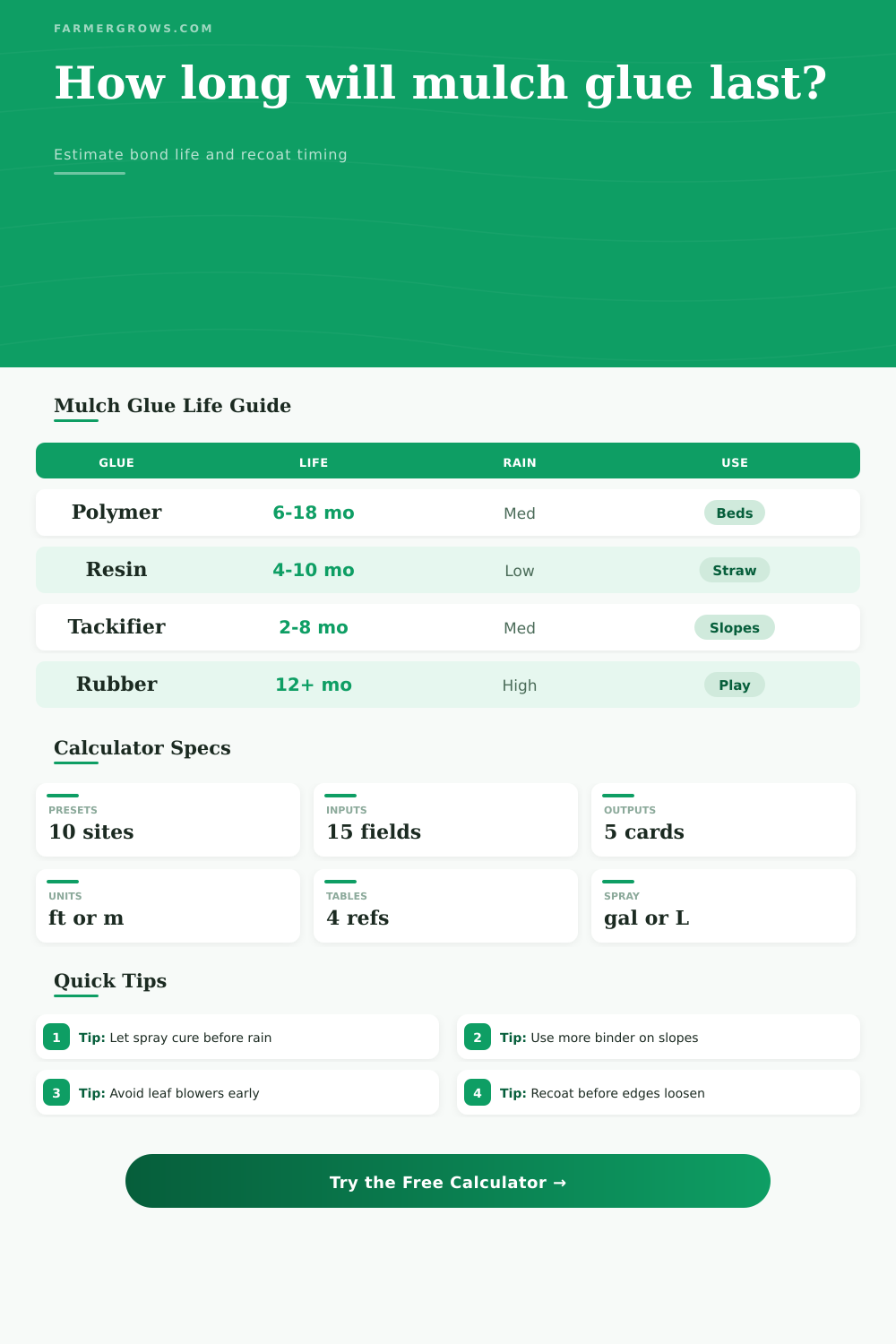
Mulch Glue Lifespan Calculator
Estimate how long mulch glue, landscape binder, or tackifier will hold a mulch surface together before the bed needs another light spray, edge repair, or full recoat.
Choose a close starting point, then tune the bed size, glue type, application strength, rainfall, slope, and traffic to match the site.
Mulch Glue Lifespan Estimate
Your estimated bond life and recoat timing will appear here.
Typical Ready Spray Coverage
| Surface | Light hold | Standard hold | Heavy edge hold |
|---|---|---|---|
| Shredded bark | 110-140 sq ft/gal | 80-110 sq ft/gal | 55-80 sq ft/gal |
| Bark nuggets | 90-120 sq ft/gal | 65-90 sq ft/gal | 45-65 sq ft/gal |
| Wood chips | 100-130 sq ft/gal | 70-100 sq ft/gal | 50-70 sq ft/gal |
| Straw or pine straw | 130-170 sq ft/gal | 95-130 sq ft/gal | 65-95 sq ft/gal |
| Rubber or stone | 70-100 sq ft/gal | 45-70 sq ft/gal | 30-45 sq ft/gal |
Site Stress Lifespan Factors
| Condition | Gentle site | Moderate site | High stress site |
|---|---|---|---|
| Rain and irrigation | Dry months, drip only | Regular rain, 1-3 wettings/wk | Heavy rain, sprinklers, runoff |
| Slope | 0-3% flat bed | 4-10% mild slope | Over 10% wash-prone slope |
| Traffic | Display bed only | Occasional edging or pets | Walkway, play, or wheel traffic |
| Maintenance | Hand weeding | Seasonal cleanup | Blower contact or raking |
Recoat Timing Examples
| Project | Area | Spray target | Inspection cue |
|---|---|---|---|
| Front foundation bed | 120 sq ft | 1.2-1.7 gal | Edges lift after rain |
| Tree ring pair | 100 sq ft | 1.0-1.4 gal | Loose mower-side mulch |
| Sloped chip strip | 240 sq ft | 3.0-4.8 gal | Rills or chip trails |
| Rubber play pad edge | 300 sq ft | 5.0-7.5 gal | Thin scatter at entries |
Rainfast Planning
| Dry window | Expected result | Calculator penalty | Practical response |
|---|---|---|---|
| Less than half rainfast time | Weak skin, wash risk | Heavy lifespan reduction | Patch or recoat soon |
| Half to full rainfast time | Partial cure | Moderate reduction | Inspect after first storm |
| Full rainfast time met | Normal set | No early rain penalty | Use normal schedule |
| Double rainfast time | Best early bond | Small bonus | Useful on exposed beds |
Application rate: Mulch glue life depends heavily on coverage. A pretty mist can improve appearance but may not lock deep or rounded particles.
Cure window: Rain, sprinkler water, or dew before the binder turns rainfast can shorten the first season more than normal monthly rainfall.
One week you put down new mulch; on Saturday it’s nice and colorful, the edges are tidy. But fast-forward through some days of showers and sprinkling, and voila: not anymore. By Tuesday the driveway’s all beat up, and your dog has trampled the bark in that same area. It is so annoying, which is why there are things called landscape binders.
This one (above) predicts future decline before it occurs, and makes guesswork into do-something-about-it work. Most homeowners treat mulch glue like paint. Most homeowners think of it this way: I’ll put some on, then forget about it till spring. Don’t count on that. It’s not static; it’s livig.
What Makes Mulch Glue Last
A single label does not account for all those variables. A good glue lasts for more or less time depending on the type and also on the size and shape of the bed. What holds 100 percent on a level shady garden for a year may be gone in three months on a steep slope where feet walks. That isn’t about glue quality as much as it is physics at work on a fragile surface.
Rain is obvious. Less so: Irrigation. A sprinkle from above wets the glue slowly and works it loose. But so what? Just wait, then see the mulch slide down. The model factors in both rain and you, and tests the glue’s cure rate. Water right after application, and you wash off active ingredients before they hardens. Short windows of no-water time cost dearly, since non-cured glue won’t bind.
Another dimension is slope. Loose material wants to flow downhill, so your binder must contend with gravity. The higher the grade (i.e., the greater the incline), the less likely standard application rates will do the job. More coverage per square foot are required to hold it down. For this reason, the calculator shortens its estimated life on steeper grades. Check them more often, as slopes fails from the edge outward. Look there for signs of trouble.
How you take care of the maintenance makes all the difference. Repeated air blasting with a leaf blower shreds the material that holds the mulch together inside its surface. It sounds like an insignificant thing. However, those repeated air blasts breaks the film that holds the chips in place. This is why the disturbance factor are part of the tool. Raking too hard (or even blowing around debris weekly) won’t make your glue hold as well as if you were gently hand-weeding. Sometimes the solution isn’t to buy a pricier glue, but to change how you maintain the bed so the glue lasts longer.
Coverage rates is displayed on the page in reference tables. How much do I need to apply for heavy hold, standard hold or light hold? Those rate ranges will give you an idea of your effort ahead (and cost). Pine straw in a quiet row needs a lighter hold than bark nuggets on a busy commercial strip. Knowing that ahead of time spares disappointment from under-application. And it could of save you money by keeping you from applying too heavily where stress is less.
You do not need to make the mulch last for all time. You just want to keep it looking this way until you’re ready to update it. Using the calculator, I get my recoat date from the percentage of bond strength I’m OK with losing. Maintaining a utility zone in the back means I’ll recoat later than if I’m caring about perfect edges along the front yard. It’s a tradeoff, looks versus effort. Knowing the tradeoff makes managing the process possible.
When it rains, the mulch stays put, the bed stays sharp and your driveway stays clean.