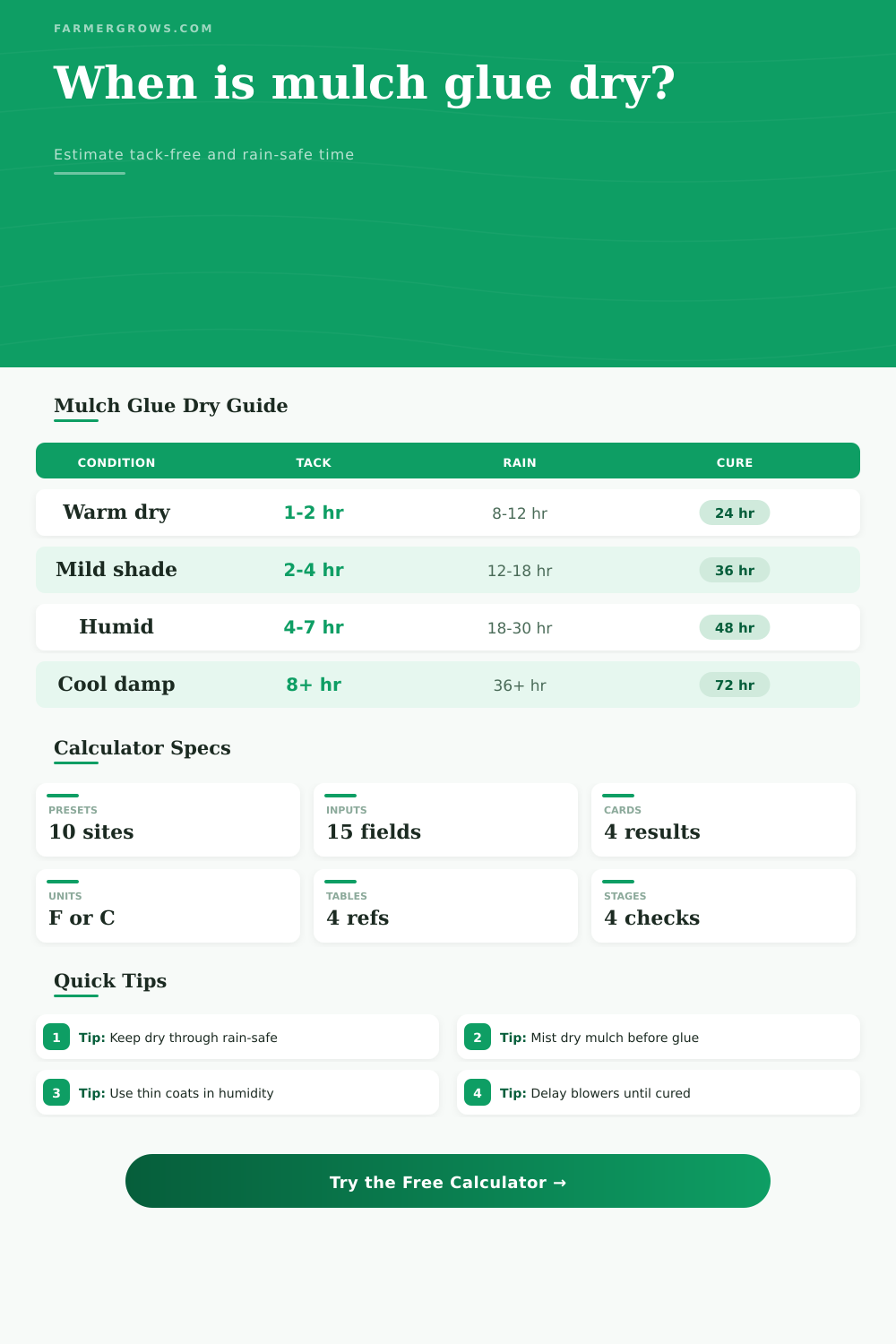
Mulch Glue Dry Time Calculator
Estimate tack-free time, rain-safe cure, walk-on timing, and full bond development for mulch glue on bark, chips, straw, rubber mulch, or decorative stone.
Pick a close site condition, then tune weather, surface moisture, spray rate, and coat count to estimate how long the glued mulch should stay protected.
Mulch Glue Dry Time Estimate
Dry time updates as you change the site conditions.
Dry Stage Planning Table
| Dry stage | What it means | Typical timing | Safe activity |
|---|---|---|---|
| Tack-free | Top surface no longer feels wet or milky. | 1 to 8 hours | Keep pets, leaves, and hoses off the bed. |
| Rain-safe | Binder has skinned enough to resist a light shower. | 8 to 36 hours | Normal irrigation can usually resume after this point. |
| Walk-on | Bond resists light foot traffic or careful maintenance. | 18 to 54 hours | Use paths gently and avoid dragging tools. |
| Full cure | Water has largely evaporated and the glue film is stronger. | 24 to 96 hours | Leaf blowers, rakes, and play use are less risky. |
Weather Modifier Table
| Condition | Drying effect | Calculator factor | Planning note |
|---|---|---|---|
| Warm air, 70 to 85 F | Fastest normal drying | 0.85 to 1.00 | Thin coats can be rain-safe the same day. |
| Cool air, 45 to 55 F | Slower evaporation | 1.35 to 1.70 | Plan for overnight protection before rain. |
| Humidity above 75% | Water leaves the film slowly | 1.30 to 1.75 | Use lighter coats and more air movement. |
| Wind above 8 mph | Faster surface drying | 0.82 to 0.92 | May also cause uneven overspray on edges. |
Application Rate Guide
| Surface | Ready spray per 100 sq ft | Drying behavior | Good target |
|---|---|---|---|
| Shredded bark | 0.8 to 1.2 gal | Average dry speed | Standard coat with edge pass |
| Bark nuggets | 1.0 to 1.5 gal | Slower between large pieces | Two light coats, not one flood coat |
| Pine straw | 0.6 to 1.0 gal | Fast surface skin | Mist evenly and avoid puddling |
| Rubber mulch | 1.4 to 2.2 gal | Slowest full cure | Long dry window before play use |
Common Dry Time Benchmarks
| Scenario | Area | Weather | Expected rain-safe time |
|---|---|---|---|
| Front bark bed | 120 sq ft | 72 F, 55% humidity | About 14 to 18 hours |
| Shady foundation | 160 sq ft | 62 F, 72% humidity | About 22 to 30 hours |
| Hot open border | 90 sq ft | 88 F, 35% humidity | About 8 to 12 hours |
| Cool fall bed | 140 sq ft | 48 F, 80% humidity | About 36 to 48 hours |
Check the rain-safe number before watering. A glued surface can look dry while the film below the top particles is still soft, especially under bark nuggets or rubber mulch.
Favor two thin coats in damp weather. Heavy one-pass spraying can lengthen cure time because trapped water has to leave the mulch surface before the binder toughens.
There you are, standing with your sprayer in hand. There’s that new mulch bed, and now there’s this dark stain spreading across it. Looks like water damage. But no, it’s an anti-erosion barrier.
The problem isn’t how I apply it; the problem is waiting for it to dry. Mulch glue doesn’t dry, it cures. These are two different thing, each on its own timeline. You need to know difference, or else you will waste money and end up with washed out beds.
How to Let Mulch Glue Dry Properly
Homeowners typicaly think it’s done when their hands no longer stick to the surface. Not so! They might be cool and the top layer of bark chips will no longer stick, but underlayer of binder is frequentely still soft. Actual rain protection doesn’t equal tack-free time; that’s what the calculator breaks out.
Time equals glue. But only if there is time to buy. And how much? That’s up to the surrounding air in your garden.
Humidity is a less obvious variable, but it’s more important then temperature. On a hot humid day, the air can’t take any more water; the glue film will have trouble releasing it because the air is full of it. When the relative humidity rise over seventy percent, tool will adjust the cure time to match. It’s physics, not magic. Water goes from a wet surface to a dry one. And if the air is wet? Well, the water hangs out in the glue. The glue keeps its softness.
Maybe you’re looking at the humidity gauge and ignoring it because it’s sunny outside, but guess what: The sun also warms that mulch which doesn’t dry out the binder if there’s moisture in the air.
The nature of the wind alters the drying routine. A consistent breeze will pull the moisture off the surface faster and form skin sooner. According to the reference table, an eight mile per hour wind can reduce the drying time. But here’s where the wind becomes a two edged sword. On one hand it dries quicker but on the other it blows your spray off target. You have to adjust for both factor. Air speed versus accuracy.
Is it too windy? Don’t spray.
Most people don’t give enough thought to what kind of mulch they use. Mulches like shredded bark has a lot of surface area. They hold more glue and dry faster. Rubber mulch or bark nuggets is coarse and have little surface area. The glue needs to span the gaps between nugget to work, which takes more time. The texture changes amount needed. The calculator accounts for that.
If you apply a thin coat to nuggets, they’ll stay loose. If you apply a thin coat to shredded bark, it will lock in tight. More product equals longer cure time. It’s a necessary tradeoff.
Most DIYers mess up on their coat strategy. It feels like you’re being efficient if you put one thick coat on. But you’re not. When you apply a thick coat, that layer trap moisture in the film. You see the outside dry but then the inside is still wet for days.
Two thin coats are usually better than one thick coat. One coat penetrates and tacks. The second coat seals and protects. Give each layer time to breathe. With each layer you add another barrier for moisture to escape. The tool lengthens the timeline of multiple coat.
The final test is rain. Spraying something with knowledge of impending rain within 6 hours doesn’t work. The rain safe number is when the glue has firmed up enough to withstand a light shower or irrigation sprays on the bed. Until then, do not put a hose on the bed. Ever.
Gotta be patient and let the glue work, track the weather and follow the numbers. It’ll take time. Rushing it isn’t an option; rushing the curing means failure. You should of trusted the math, and wait. Once you clear the timeline, the bed will not budge.