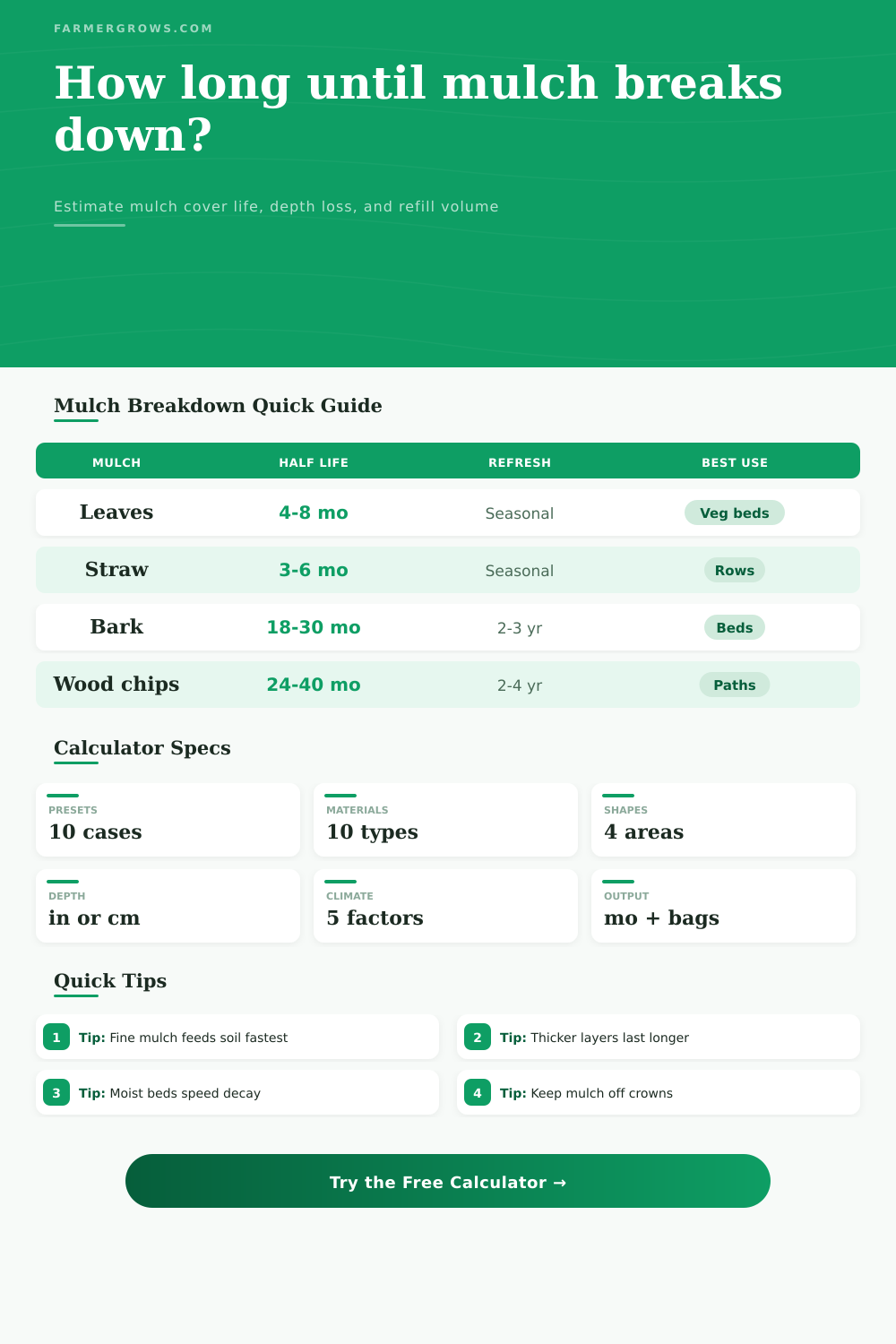
Mulch Breakdown Time Calculator
Estimate how long mulch will keep visible cover, when to refresh it, how much depth is already gone, and how much material will restore the layer.
Load a real garden, orchard, path, or landscape situation, then tune the material, thickness, moisture, particle size, and refresh target for your site.
Mulch Breakdown Estimate
Set your mulch material and site conditions to estimate breakdown timing.
Grass, leaves, straw, and hay disappear quickly but add organic matter during the same season.
Seasonal mulch suppresses weeds, buffers soil moisture, then gets composted or turned under.
Arborist chips and hardwood chips hold structure and build fungal soil over several seasons.
Bark nuggets and cedar products keep visible cover longest, especially when kept coarse and dry.
| Mulch material | Typical half-life range | Carbon profile | Common refresh habit |
|---|---|---|---|
| Grass clippings | 2 to 4 months | Low C:N, decomposes hot if thick | Reapply thin layers every few weeks |
| Clean straw | 3 to 6 months | Hollow stems, moderate carbon | Top up once or twice per crop season |
| Shredded leaves | 4 to 8 months | Leaf mold starter, medium carbon | Replenish annually or each fall |
| Pine needles | 12 to 24 months | Waxy needles, slower wetting | Refresh yearly around berries or paths |
| Shredded bark | 18 to 30 months | Lignin-rich bark fibers | Refresh every 2 to 3 years |
| Wood chips | 24 to 40 months | High carbon and fungal friendly | Top up paths or orchards every 2 to 4 years |
| Condition | Faster breakdown signal | Slower breakdown signal | Calculator factor |
|---|---|---|---|
| Particle size | Fine shredded mulch has more surface area | Chunky nuggets expose less surface | 0.68x to 1.35x speed |
| Moisture | Damp, irrigated beds keep fungi active | Dry crusted mulch stalls decay | 0.62x to 1.48x speed |
| Temperature | Warm soils and long seasons speed biology | Cool dormant periods slow microbes | 0.58x to 1.36x speed |
| Soil contact | Earthworms and mixing increase breakdown | Fabric barriers reduce contact | 0.68x to 1.42x speed |
| Nitrogen contact | Compost, clippings, or manure feed microbes | Woody low-N surfaces decay slowly | 0.82x to 1.42x speed |
| Starting depth | Common use | One cubic yard covers | Breakdown effect |
|---|---|---|---|
| 1 inch | Seedling beds, grass clippings, light leaves | 324 sq ft | Fast visible thinning |
| 2 inches | Vegetable beds and flower borders | 162 sq ft | Moderate seasonal cover |
| 3 inches | General mulch depth for weed suppression | 108 sq ft | Baseline calculator depth |
| 4 inches | Ornamental beds and coarse bark | 81 sq ft | Longer cover, watch crowns |
| 6 inches | Paths, orchards, coarse arborist chips | 54 sq ft | Slowest visible depth loss |
| Breakdown target | Visual condition | Best decision point | Calculator meaning |
|---|---|---|---|
| 25% depth loss | Layer still looks full | Appearance-focused top-up | Early refresh trigger |
| 40% depth loss | Soil peeks through thin places | Balanced garden refresh | Default refresh trigger |
| 65% breakdown | Mulch is patchy and mixed with soil | Weed control is fading | Cover life warning |
| 80% breakdown | Mostly humus and fragments | Soil-building cycle is ending | Late decomposition stage |
Use depth and texture together. A 3-inch layer of fine straw can disappear before a 2-inch layer of coarse bark because surface area, moisture, and nitrogen contact drive decay.
Refresh before weed control fails. For vegetable beds, top up when thin patches appear. For trees and shrubs, keep the mulch ring open around trunks and crowns.
So you add some new bark, which has such rich color. Perfect, the bed seem finished. But then summer arrive. Sun and rain activate soil microbes, and suddenly that fat layer of mulch are paper-thin. Out comes the weed barrier, and you’re back to purchasing mulch all over again.
But why does it happen? Why doesn’t mulch lasts longer? It’s not an act of nature, it’s a predictable chain reaction between the elements. There is only a few factors involved. Here’s how to learn them.
How to Make Mulch Last Longer
It spits out a schedule based off estimates that the calculator do the math for you. And it teaches you why those numbers change, so you can shop smart.
Consider the concept of half-life: How long until half the stuff you see dissapears? Roughly, grass clippings has a half-life of maybe two months, while straw is fast-decomposing. Cedar nuggets may take up to four years. This is quite a contrast.
Put some quick-to-disappear straw in a bed intended to last three years, and you’ll have a naked-looking bed by July. Toss in some slow cedar in a vegetable patch where you want nitrogen today…well, you’re erecting a fence around your tomatoes.
Half the solution are material selection. The other half is physics. Decay is driven by surface area. Chunky wood chips lasts longer then fine shredded leaves. Small pieces gets attacked on all sides by fungi and bacteria.
Moisture also plays a part, because a dry surface of mulch remains dormant. If the bed is damp, it’s a buffet for the decomposers; the warmer the soil, the quicker the biology. That’s why the tool account for these variables, allowing you to adjust it for particle size, moisture, and climate.
When do you top up? When will the mulch be gone? Everyone waits for the soil to show before doing anything. Wrong move. As soon as the soil’s bare, moisture escapes right off the surface, and weeds take root. Better to top up sooner then later.
Use the calculator to determine your trigger point, then decide whether you want to reapply at 25-percent loss of depth or let things get down to 40 percent. Waiting until the last minute saves you trips to the store now. But you create patchy bed later on. You should of choose between looks and convenience.
Then there is also the issue of volume: “So many people think that if their bed has lost mulch, all they have to do is add some more. They don’t realize that as mulch ages it compacts, and the voids are filled in.” A thin layer of mulch spread here and there might look like a pretty dusting, but it won’t look finished. To really make things right, you’ve got to replace what was lost… Both in color and amount.
That’s why the tool calculates not only bags (or cubic yards) required, but how many bags will be needed to return the bed to proper height. It allows for waste, so you won’t end up with two bag short of three.
No contact with soil, PLEASE: Mulch placed atop plastic landscape fabric takes a long time to rot because it’s isolated from any life in the underlying soil. Mulch that touches a living soil… Particularly if there are earthworms around, rots far more rapidly. Those worms take the organic matter into themselves and drag it downward. This results in improved soil structure, but you lose visual cover faster.
Decide: Do you want a quick fix of improved soil or do you prefer the mulch to slowly fade away for visual reasons? You will need different plan.
And last: Look at those crowns. Piling thick mulch right up against plant stems can smother them over time. Leave a bare circle of soil around the stem and trunk. The mulch can do its thing (suppressing weeds, holding in moisture) but not touch the plant parts.
That’s where the calculator comes in. It doesn’t know where your rose is; all it knows is that some time is a good time. And then you must exercise judgment. Make a maintenance calendar, like topdressing landscape borders every couple of years, or refreshing veggie beds twice a season. Building on the estimates makes this a schedule (easier to plan for than a surprise).
Now it looks like a finished bed again. Stand back and look. It is uniform. Now you know just when you’ll be back out here with the wheelbarrow.