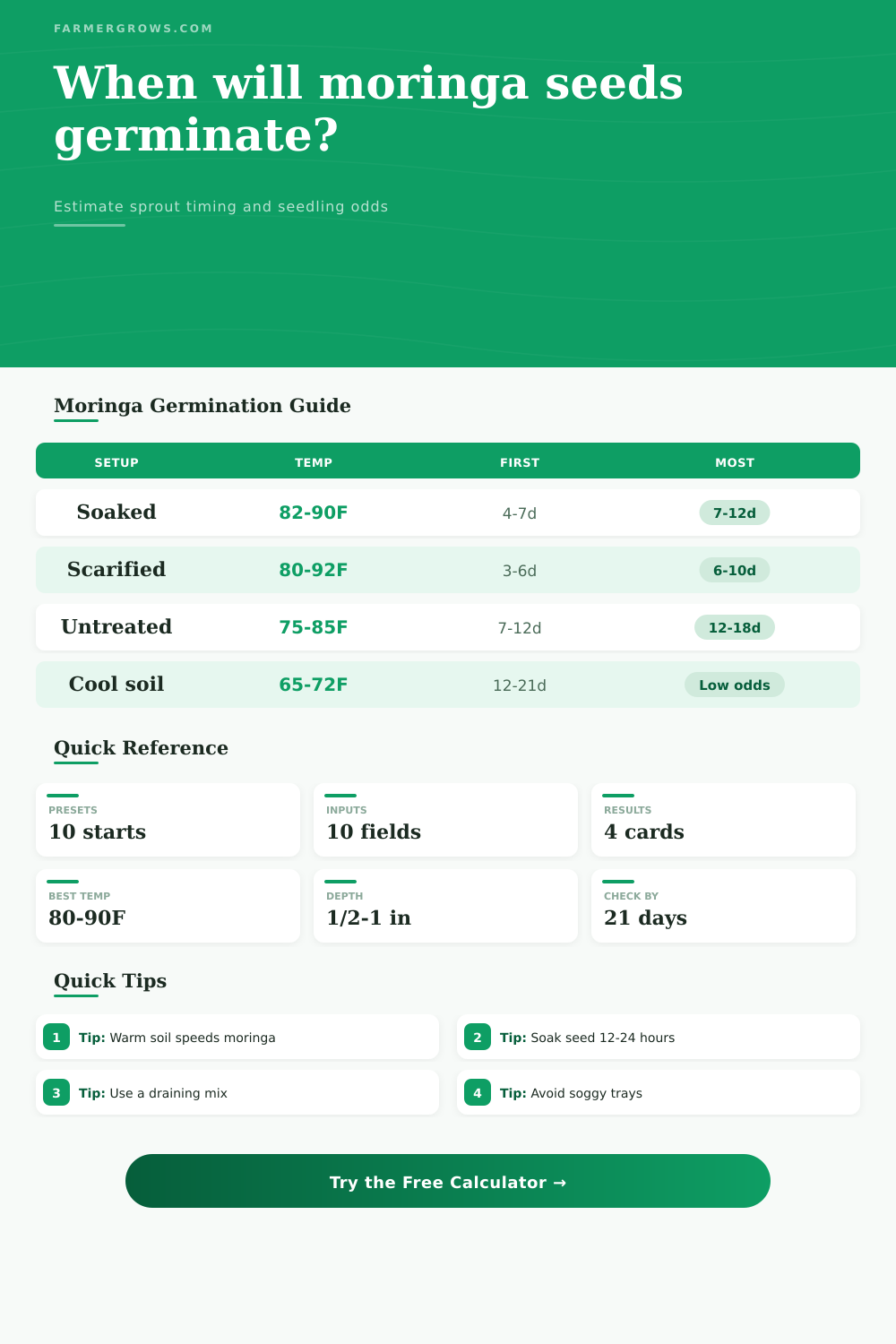
Moringa Seed Germination Time Calculator
Estimate moringa sprout timing, emergence odds, check dates, and setup risk from seed age, soaking or scarification, soil temperature, depth, humidity, moisture, drainage, heat, light, and days since sowing.
Moringa seeds usually emerge fastest in warm, airy media after a short soak or light scarification. This calculator estimates a practical window for trays, nursery bags, pots, and direct sowing.
Moringa Germination Estimate
Adjust the inputs to estimate your seed's likely sprout window.
| Soil temperature | Expected timing | Effect on moringa | Grower note |
|---|---|---|---|
| 90-95°F / 32-35°C | 4-8 days | Very fast if moisture is even | Watch for drying in small cells |
| 80-89°F / 27-32°C | 5-12 days | Best practical range | Ideal for heat mat or warm nursery |
| 72-79°F / 22-26°C | 8-16 days | Moderate speed | Keep media warm overnight |
| 65-71°F / 18-22°C | 12-24 days | Slow and uneven | Use bottom heat if possible |
| Below 65°F / 18°C | 21+ days | Low odds, higher rot risk | Wait for warmer soil |
| Seed preparation | Typical first sprout | Timing effect | Risk note |
|---|---|---|---|
| Scarified plus soaked | 3-6 days | Fastest for hard seed coats | Nick lightly; avoid embryo damage |
| Soaked 12-24 hours | 4-8 days | Reliable speed boost | Plant promptly after soaking |
| Scarified only | 4-9 days | Helpful when soak is skipped | Needs steady moisture after sowing |
| Untreated dry seed | 7-14 days | Wider window | Works best with fresh seed and warmth |
| Over-soaked seed | Variable | Can slow or fail | Oxygen shortage and sour water are concerns |
| Planting depth | Moisture behavior | Emergence effect | Best use |
|---|---|---|---|
| 1/4 inch / 0.6 cm | Dries quickly | Fast but needs close watering | Humid trays or paper pre-sprouts |
| 1/2 inch / 1.3 cm | Balanced | Excellent for most seed lots | Plug trays and small pots |
| 3/4-1 inch / 1.9-2.5 cm | Steadier moisture | Good for direct sowing | Nursery bags and warm beds |
| 1.5 inches / 3.8 cm | Cooler and wetter | Slower emergence | Use only in dry sandy beds |
| 2+ inches / 5+ cm | Often too wet or deep | Delayed or weak emergence | Usually avoid for moringa |
| Setup | Drainage target | Humidity target | Common adjustment |
|---|---|---|---|
| Plug tray | Good to excellent | 55-75% | Use dome briefly, then vent |
| Nursery bag | Excellent | 50-70% | Water deeply, then var surface breathe |
| Direct bed | Loose sandy loam | Local air | Mulch lightly if surface crusts |
| Paper towel | Air gap after sprout | High inside bag | Move before taproot tangles |
| Heavy compost mix | Often poor | High near seed | Add perlite or sand before sowing |
Moringa seed often looks dormant when the medium is cool. Raise soil temperature into the 80-90°F range before adding more water to a slow tray.
If the calculator says the seed is late, check one sample seed at the edge first. Soft, sour, or hollow seeds point to rot, while firm seeds may only need more warmth.
Moringa is known to be hard to grow from seed. Hard maybe, but certainly particular: if you’ve ever spent three weeks staring at a tray of nothing but blank-faced seedling pots (no sprouts in sight), then you understand what I’m talking about.
Generally, when something like this happen with a seed, it’s not because there’s anything wrong with the seed itself. No, the issue is typicaly with what you created around it. Moringa wants its own way… Like all tropical plants, it requires warm temperatures and air. And it doesn’t give a hoot how long you wait. It want oxygen and heat in the soil.
How to Grow Moringa Seeds Successfully
It happens so much that you don’t know whether to panic over a slow start or not worry at all. That’s where this cool little calculator comes into play (above). It does all that complicated math for you, you plug in your own scenario, such as whether you scarified your seed. Soak it?) and it gives you a ballpark estimate of when to expect those babies to pop up.
And why should you care about the sprout window? Because depending off your preparation methods, each variety of moringa seed behaves very different. A freshly harvested seed that’s been soaking for a dozen hours will behave much more differently than an older, dried-out seed with no treatment whatsoever. And seed age is something most growers forget about till it’s too late. After eighteen months, viability plummets, particularly if stored somewhere warm.
The biggest factor of all is heat. Yes, I know it sounds obvious, but here’s why: Moringa is not a cool weather plant. Below 70 degrees F, the biological activity within the seed slows to a crawl. Even then, the reference tables on the page makes clear how much slower things go: Germination doubles when temperatures fall. It is not a suggestion; it is a hard limit.
Want to start seed outdoors in early spring when the ground won’t be warmed up? You’ll want a heat mat. Root tips feel the temperature first; so bottom heat works best; top heat less so. As for the air over the tray? Cool’s fine; don’t worry about the seed.
Most people kill their seeds with moisture. When you’re waiting for them to sprout, the tendency is: water more. Wrong. Moringa seeds are very susceptible to rotting if you sit them in a dense medium that stays soggy. It has to take up water so the seed can swell…but it must also be able to breathe. Too much water, not enough air. A really good compost mix will hold excess water; it will block out oxygen.
Use the calculator, which takes into account drainage. If your drainage isn’t great, no matter how warm the soil gets, your chances goes way down. With an airy, lightweight mix such as one that includes perlite or vermiculite, the water flows through and leaves air pockets surrounding embryo. It should be damp, like a sponge that’s been wrung out, not soaked like a towel.
Another mistake? Depth. The moringa seeds is big and tough, but even so, they still need to push through soil. If planted too deeply, the seed will run out of steam before it ever sees daylight. An inch or a half-inch is good. Enough to stabilize the seed and keep it from drying out, without burying the emerging shoot too far. Deeper than that, and you’ll be waiting longer… Which gives more time for rotting.
It will tell you what day to check it, too, your check date. That way, you won’t disturb the seeds before they’re ready or give up on them too soon. If the calendar indicates that the seed’s late, gently check one sample. Is it smelling sour and soft? It is rot. Firm but not? Then maybe it’s simply still cold. The status cards are quick to show you your risk level, whether your set-up skews more to success, or to rot.
With germination, it’s like racing the rot: Either the seed has to sprout first or the conditions will be the killer. Faster sprouting = warmer. Avoiding kill = good drainage. Get those two things in harmony and then you don’t hover anxiously over the tray anymore; you get action. What I love most about using the thing is that it takes the guessing out of it, so all your attention can go toward making sure the medium stays warm and moist; and look, your seeds will tell you what they want.