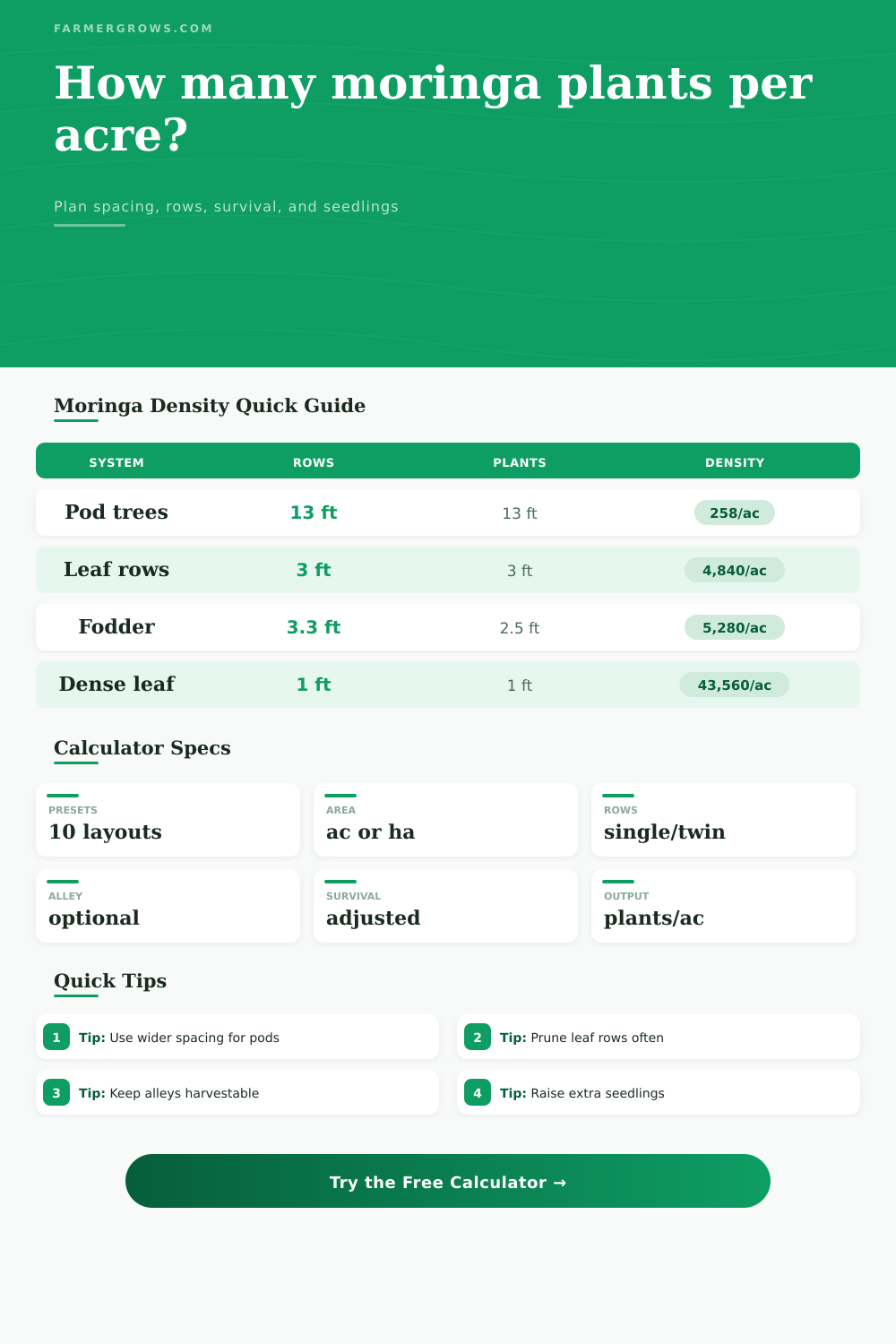
Moringa Plants Per Acre Calculator
Estimate moringa orchard, leaf hedge, fodder row, or nursery block density from row spacing, in-row spacing, alley access, usable acre percentage, survival, and seedling overage.
Choose a real moringa planting pattern, then tune the spacing, usable acreage, alley interval, survival rate, and seedling buffer for your farm layout.
Your Moringa Planting Density
Results update when you calculate.
Use wider spacing, permanent tree structure, open middles, and pruning room for pod harvest ladders or picking paths.
Balances leaf cutting and pods, often with vegetable alleys or livestock access between moringa rows.
Designed for repeated coppicing, fast regrowth, frequent harvest, irrigation, and close nutrient management.
Very dense stands suit short-cycle leaf harvests, not long-term tree form; alleys and thinning matter.
| Spacing pattern | Approx plants per acre | Approx plants per hectare | Best fit |
|---|---|---|---|
| 20 x 20 ft | 109 | 269 | Large pod, seed, shade, or long-lived tree orchard |
| 13 x 13 ft | 258 | 637 | Pod orchard with equipment and picking access |
| 10 x 10 ft | 436 | 1,077 | Small-farm pod and leaf combination layout |
| 6.5 x 3.3 ft, about 2 x 1 m | 2,031 | 5,019 | Semi-intensive leaf rows with hand harvesting |
| 3 x 3 ft | 4,840 | 11,959 | Leaf block or short tree coppice planting |
| 1 m x 0.75 m | 5,396 | 13,332 | Fodder and cut-and-carry foliage rows |
| 40 x 40 cm | 25,293 | 62,500 | Dense irrigated leaf production |
| 20 x 20 cm | 101,172 | 250,000 | Very dense nursery-style leaf production |
| Row or strip spacing | Single-row feet per acre | Plants at 1 ft in-row | Plants at 3 ft in-row |
|---|---|---|---|
| 2 ft between rows | 21,780 ft | 21,780 | 7,260 |
| 3 ft between rows | 14,520 ft | 14,520 | 4,840 |
| 4 ft between rows | 10,890 ft | 10,890 | 3,630 |
| 6 ft between rows | 7,260 ft | 7,260 | 2,420 |
| 10 ft between rows | 4,356 ft | 4,356 | 1,452 |
| 13 ft between rows | 3,351 ft | 3,351 | 1,117 |
| Survival expected | Seedlings for 1,000 target plants | Add 10% nursery buffer | When to use |
|---|---|---|---|
| 95% | 1,053 | 1,158 | Strong nursery transplants and drip irrigation |
| 90% | 1,112 | 1,223 | Good transplanting season and reliable watering |
| 80% | 1,250 | 1,375 | Direct seeding, heat, wind, or uneven rainfall |
| 70% | 1,429 | 1,572 | Rough seedbed, pest pressure, or marginal water |
| Planting purpose | Typical density band | Management style | Spacing caution |
|---|---|---|---|
| Pods or seed | 100 to 450 plants/ac | Train as trees and prune for access | Too tight reduces canopy airflow and picking room |
| Leaf plus pods | 450 to 2,000 plants/ac | Prune lower, harvest leaves, keep some canopy | Plan headlands before counting the full acre |
| Leaf blocks | 2,000 to 25,000 plants/ac | Cut back repeatedly for tender shoots | Needs fertility, irrigation, and weed control |
| Fodder rows | 3,000 to 10,000 plants/ac | Cut-and-carry with clear harvest lanes | Alleys reduce density but save labor |
| Nursery-style leaves | 25,000+ plants/ac | Short harvest cycle and possible thinning | Not suitable for mature pod trees |
Separate tree spacing from leaf-crop spacing. A pod orchard needs light and picking access, while a leaf block is usually cut low and can carry far more plants per acre.
Count alleys before ordering seed. Dense moringa looks good on paper, but access lanes, drains, and headlands can remove 10% to 25% of a working acre.
When planning your moringa farm, understand this: The amount of seedlings you plant is not necessarily equal to number who will live long enough to produce. Moringa is farmed in three dimensions, not two. An acre looks like a rectangle, but it is not. Consider root competition, canopy light, space to harvest by walking through rows and so on.
So how many plants per acre? That’s not just arithmetic; it’s also a matter of your personal management style. How much do you want to trade off accessibility for potential yield? It takes your planned spacing, multiplies it to account for survival rate and field edges, then tells you how many plant you’ll get. Most novices forget to include space for walking or using machine. When harvesting leaves, can’t have them too close together so you don’t has access to the interior of tree (if you’re picking by hand). It takes that unusable space away, and gives you an accurate picture of field with pathways cut in.
How to Space Your Moringa Plants
That said: What will be your harvest objective? Trees in full sun on all sides will bear if goal is pods. Spacing should then be about 13 feet between plants and 13 feet between rows. This allow for the development of a good-sized canopy and sturdy trunk. Sounds skimpy, right? But pod trees does not tolerate crowding because it causes weak wood and disease pressure. Don’t think you can fix problem later with heavy pruning.
If the objective is leaves, you are farming foliage rather than fruit or timber, so leaf production is a completely different game. Competition makes a leaf block happy. Planting moringa too far apart allows it to stretch out and not make many branches below its height; if they are three feet apart by three feet, they have no choice but to bush up and go vertical, which can be cut easily and maintained as a hedge. The downside: You need to water every day, or feed more often; so the innermost plants don’t wilt and die. That’s when folks usually goof, putting in a lot of plant but not providing for hungry appetite of this crop.
Of course, there’s no spreadsheet in nature, meaning that some seeds don’t make it, some transplants shock, and someone (or something) digs them up. You can account for this with the expected-loss function of the calculator, which is important when you do math for planning. For instance: If things don’t survive in your area at the rate of nine out of 10, or 90 percent, you will know to grow additional plants, which prevents last-minute panic that you’re short when time for planting gets here. Having a little wiggle room is such a huge thing for your peace of mind.
Keep in mind that there’s also a lifecycle to the plot. In terms of how it holds together, this means a dense block of leaves is high-intensity, but short-term. Roots tangle; the soil tires; and eventually it’ll be harder to harvest. To keep things running smoothy (and maintain soil health), many farmers will rotate through these blocks, clearing the space every few years and resting the land, or shifting to a lower-density pod orchard. It transforms a fixed plan into a changing system.
To conclude, plant what you can sustainably maintain. Sounds good in theory, but heavy-duty maintenance (i.e., weeding and watering) gets difficult at high densities. Begin where you can manage physically. With a crew and drip irrigation, you can go all-out. By yourself, holding a watering can? Back off. The numbers come from the calculator; but they’re limited by your ability to do the work. Design for what you can do, not for what you hope to get. That’s how a farm runs smooth.