Mob Grazing Calculator
Calculate paddock size, number of paddocks, and rest periods for ultra-high density grazing
Quick Presets
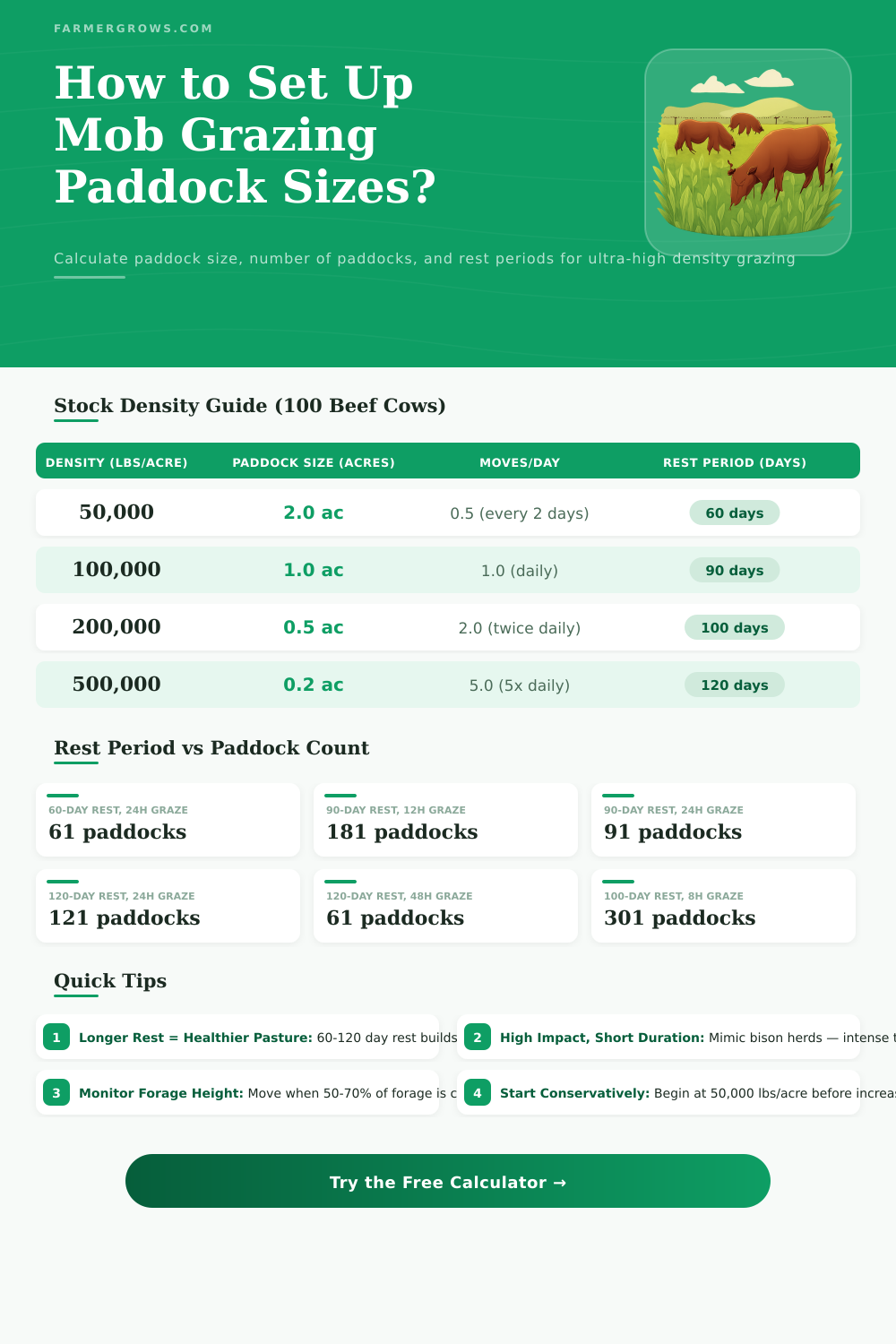
Stock Density Guide (100 Beef Cows @ 1200 lbs each)
| Density (lbs/acre) | Paddock Size (100 cows) | Moves per Day | Rest Period Needed |
|---|---|---|---|
| 25,000 lbs/acre | 4.8 acres | Every 2 days | 45–60 days |
| 50,000 lbs/acre | 2.4 acres | Every day or 2 | 60–75 days |
| 100,000 lbs/acre | 1.2 acres | Once daily | 75–90 days |
| 200,000 lbs/acre | 0.6 acres | Twice daily | 90–100 days |
| 300,000 lbs/acre | 0.4 acres | 3x daily | 100–120 days |
| 500,000 lbs/acre | 0.24 acres | 5x daily | 120+ days |
Rest Period vs Paddocks Required
| Rest Period (days) | Grazing Hours | Paddocks Needed | Total Area / 100 Cows |
|---|---|---|---|
| 60 days | 24 hours | 61 | 73 acres |
| 75 days | 24 hours | 76 | 91 acres |
| 90 days | 24 hours | 91 | 109 acres |
| 90 days | 12 hours | 181 | 109 acres |
| 100 days | 24 hours | 101 | 121 acres |
| 120 days | 24 hours | 121 | 145 acres |
Mob vs Rotational vs Traditional Grazing Comparison
| Parameter | Mob Grazing | Rotational | Traditional |
|---|---|---|---|
| Stock density (lbs/acre) | 50,000–500,000+ | 5,000–50,000 | 500–2,000 |
| Grazing duration per paddock | Hours to 2 days | 3–7 days | Continuous |
| Rest period | 60–120+ days | 21–45 days | None |
| Paddock count | 60–300+ | 4–20 | 1 |
| Infrastructure cost | High (many paddocks) | Moderate | Low |
| Pasture recovery | Excellent | Good | Poor |
Mob grazing involve moving a groups of animals from paddock to paddock to mimic the movement of wild herds. These movements result in benefits to the pasture and the pasture land. Additionally, mob grazing allow farmers to increase the forage available on there land and to reduce an amount of hay that they must purchase for their animal.
Stock density are a calculation of the total weight of the herd divided by the number of acre in the paddock. With high stock density, there are many animal in a small paddock. These animals stomp on the paddock land, pushing the plant residue into the soil.
How mob grazing helps land and animals
The plant residue add to the organic matter in the soil, increasing the soil’s ability to hold water. Low stock densities result in the animals not stomp on the paddocks as much, and thus introducing less plant matter into the soil. Grazing time is the length of time that the animal remain in a paddock before moving to the next paddock.
The grazing time will impact the length of the rest period for the paddock. With short grazing time, the animals eat the grass quick in the paddock. The grass has a long rest period before the animals return to the paddock.
A rest period is the length of time that a paddock is without animal, allowing the grass to regrow. For healthy pasture, the rest periods should of been long enough for the grass to develop its root and seeds. Short rest periods result in the grass having shallow roots.
Forage availability is the total amount of food that the pasture can produce for the animal. This number can be calculated for each paddock. You can adjust the calculation according to the amount of grass that you allow to grow in each paddock.
For example, if sixty percent of the grass is allowed to grow in the paddock, the grass roots will be fed with plant matter and the grass will grow back easy. If the soil in the paddocks is poor in its fertility, there will be less forage availability. In contrast, if the soil in the paddocks is rich in nutrients, there will be more forage availability.
Mathematical formula are used to calculate aspect of mob grazing. For instance, one can calculate the total weight of a herd. If a farmer has a herd of one hundred beef cattle, each weighing twelve hundred pounds, the total weight of the herd is twelve hundred thousand pounds.
With such a weight, if the farmer desire high stock densities, the farmer will use many paddocks with the animals moving frequent between paddocks. A low stock density will require fewer paddocks and less movement of the animals between paddocks. Mob grazing has a number of benefit for the land and the animals.
When land is grazed continuously, bare spot develop in the pastures. Additionally, those bare spots allow weed to grow in the land. Mob grazing prevents these problems by ensuring that the animals eat the grass uniform and that the animals trod on the grass paddocks.
This result in benefits to the soil biology, as worms and bacteria live in soils with a high amount of organic matter. Additionally, mob grazing increase the amount of forage on the land by twenty to fifty percent, and mob grazing reduce the amount of weeds on the land. However, there are some infrastructure cost associated with mob grazing.
Fencing is required to create paddocks in which the animals will graze. Additionally, water must be provided for the animals moving between paddocks. The height of the grass in each paddock must also be monitored.
When the grass is grazed to a certain height, the animals must be moved to another paddock. Finally, change in the weather may impact mob grazing practices. For example, during periods of drought, there will be a decrease in forage availability, thus increasing the rest period for the paddocks.
Additional resource can be provided to enhance mob grazing practices. Minerals and salt lick can be provided for the animals. Shade trees can also be placed in the paddocks.
Using other species of animal, such as sheep or goats, could also be used to graze the paddocks. Because mob grazing increases the amount of forage available to the animals, the animals may gain more weight than continuous grazing practices. Thus, despite the initial cost to set up mob grazing practices, the increased weight gain of the animals may help to compensate for the infrastructure cost.